
Vernon Dent bio details the career of a second banana
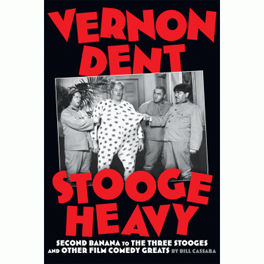
It’s a safe bet that you might recognize the face of Vernon Dent, but it’s far less certain one recollects the name. Yet Vernon Dent is one of the most ubiquitous of film comedy pioneers, an entertainer who began his career in the era of Mack Sennett and concluded just as the Three Stooges’ tenure with Columbia was nearing its end.
In “Vernon Dent: Stooge Heavy, Second Banana to the Three Stooges and Other Film Comedy Greats,” (Bear Manor Media http://www.bearmanormedia.com/), author Bill Cassara focuses on his roughly 45-year career in comedy shorts, silent and sound. Dent is best known for his tenure with the Columbia Three Stooges comedies, and it’s a fair bet that Dent, who made 400-plus films (many with the Stooges) is seen with Curly, Shemp, Larry and Moe on TV every week. He’s a fat man with a mustache, usually in a suit, with a forbidding air; if he lived today he might be Uncle Vernon in the Harry Potter films.
As Cassara writes, Dent was a superb, talented comedian with timing honed from his earliest career days; he first worked with Hank Mann of the Keystone Cops, and later was a Fatty Arbuckle imitator in a series of shorts. In the early 1920s, he even appeared in drama features. However, by the mid 1920s Dent was appearing regularly in comedy shorts, often with comedy star Harry Langdon, with whom he had a lifetime friendship. As Cassara notes, there were a couple of efforts to make Dent a comedy shorts star. He was once paired with Monty Collins, another silent veteran.
But Dent did not click as the feature actor in shorts. It may be that he was a little too forbidding in his comedy turns; he was very funny, but he mostly played the bad guy, or the selfish colleague, or boorish society man. He lacked the likability factor that an actor such as Oliver Hardy, of Laurel and Hardy, possessed via screen presence. And by the mid 1930s he was established as a go-to guy in comedy shorts, someone who could play any role, from co-star, to feature to even bit part.
He may not have achieved stardom but he was well paid for his comedy character actor career, earning the equivalent of $100,000-plus through the mid 1950s, when diabetes crippled his health, eventually blinding him. He died in 1963, survived by his wife, Eunice.
Cassera’s book is focused on Dent’s career, not his personal life; He covers Dent’s early life in northern California but until he meets third wife Eunice in the late 1930s the personal life is at a minimum; marriages and family deaths are covered in paragraphs by Cassera. This may annoy persons who want to know more of the personal but Cassera has compensated by providing strong research into his career, including scores of newspaper articles, press releases, and a compendium of his scores of performances in Stooges shorts. Dent was in many other Columbia shorts, including Langdon’s, but those are not seen on TV today, although some can be seen via YouTube. Many of his silent shorts can be accessed via Turner Classic Movies, YouTube, or are for sale via amazon, etc.
I recently saw Dent on an episode of Fox News’ “The O’Reilly Factor,” which was using old Stooges clips in one of its segments. Not unsurprisingly, he received a pie in the face. Dent is a fascinating figure of early comedy, and this career biography is worth a read by fans of the genre.
The Man Who was Old Mother Riley
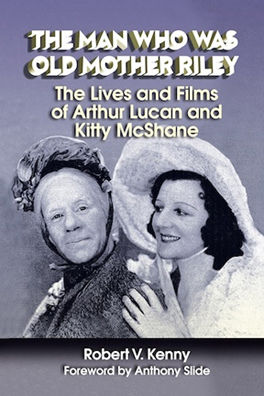
Another Bear Manor Media offering is a biography of an entertainer who in the United States is at best a game show trivia question. Who, indeed, is Arthur Lucan or Old Mother Riley? As Robert V. Kenny explains in the biography, “The Man Who was Old Mother Riley: The Lives and Films of Arthur Lucan and Kitty McShane,” Lucan was a pantomime dame, a man who performed in costume as an old woman. It was popular in music halls 100 years ago. It was not a performance geared toward gays, and Lucan was not a drag performer. It was a comic genre of generations ago, and once very popular.
And Lucan was extremely successful as “Old Mother Riley.” He became so successful that his act, performed with his wife, Kitty McShane, once was performed for the British Royal Family. He and McShane made a series of films, mostly in the 1940s, that featured “Old Mother Riley” and her spunky daughter, “Kitty.” They were very popular in Britain and with the films and acts, the pair were earning the equivalent of a million dollars a year.
Kenny’s biography is heavy on the personal, and much of it details the dysfunctional relationship between Arthur and Kitty. Their troubles, most caused by Kitty McShane, according to Kenny, bankrupted and split the team, and kept Lucan working until the day he died, a broke 50-year veteran of the stage. It’s an interesting read, both about a genre long gone and a comedy pair’s troubled relationship.
Lucan is best known in the U.S. for making a film in London, “Mother Riley Meets the Vampire,” with an aging Bela Lugosi in 1952. It barely got a release in the U.S., where it played as “My Son the Vampire.” It occasionally pops up on TV and can be seen via YouTube and purchased online. Most of Lucan’s “Old Mother Riley” films, the ones he made with McShane, can be purchased Region 2 in Europe. He’s still well known in England, where fans visit his home town and his grave. Kitty McShane died in obscurity a few years after Lucan. Allthough she was buried with a few mourners, the location of her grave is unknown.
dgibson@standard.net