
ROADSIDE ATTRACTIONS: Majestic elk, one big bull, a waterless water tower and a rockin’ mailbox

BECKY WRIGHT/Standard-ExaminerMadison Kuester of Perry looks at a domestic elk herd in Willard.

BECKY CAIRNS/Standard-ExaminerCalvin Grant stands next to a fiberglass bull that sits on the grounds of his family business west of I-15 in Brigham City.

Standard-Examiner file photoThe water tower in the Business Depot Ogden is a landmark in the Ogden area.
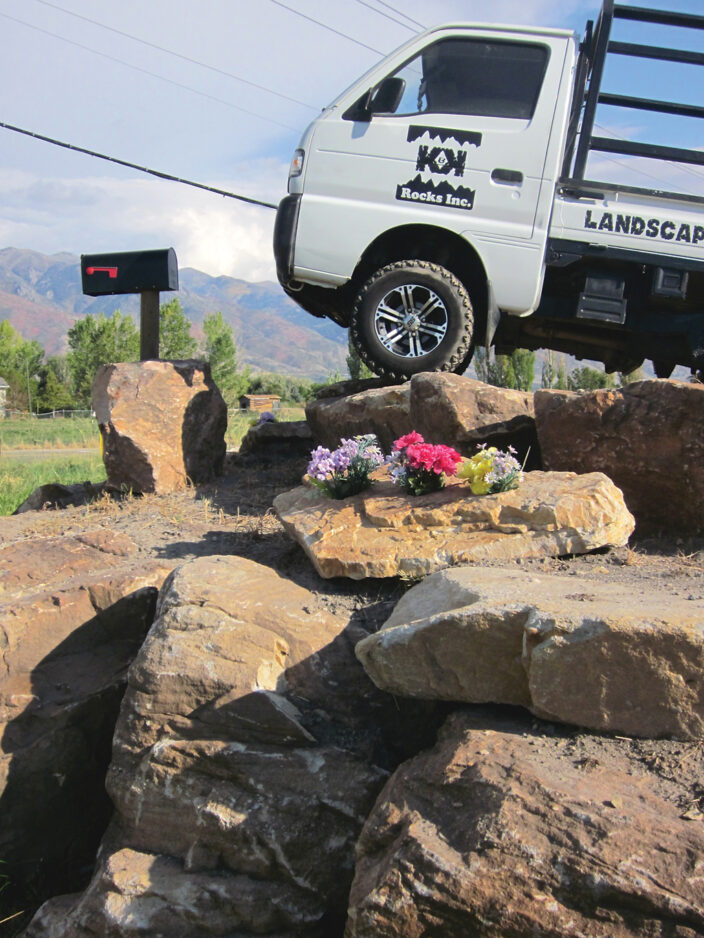
BECKY WRIGHT/Standard-ExaminerThis rock landscaping in a layton pasture, was designed to advertise K & K Rocks Inc. The business has been asked not to advertise, and without the truck there many passersby have speculated that the construction is a memorial for a mail carrier.
Not-so-wild wapiti
It’s elk hunting season, and they’ve been spotted in big numbers in Willard. In fact, people are shooting dozens of elk at a time — with a camera.
Denny Schwartz, of Brigham City, noticed the large herd about three weeks ago.
“I think it’s just neat to see them,” he said. “I haven’t stopped until today, but I wanted to send my friend a picture.”
It’s easy to see the elk, because they’re a domestic herd in a fenced pasture along U.S. 89, north of Pettingill’s Fruit Stand and across the street from an LDS church building.
Signs on the fence say the elk belong to White Peaks Ranch which, according to the Utah Department of Agriculture and Food website, is registered to Weber County resident Randy Marriott. Marriott didn’t return phone calls from the Standard-Examiner about the herd, but Cody James is familiar with the operation.
“Mr. Marriott recently asked if he could put up that new fence, and make his elk facility a little bigger,” said James, who serves as the livestock inspection bureau chief for the Utah Department of Agriculture and Food. “I got my first chance to look at that about two weeks ago, and the facility is amazing. He has large bulls, and good-looking cows.”
The Domestic Elk Act was put into statute in 1997.
“You have to be a registered facility to own these elk, and you have to get all of your initial elk from another licensed facility,” James said, explaining that none of the elk were captured in the wild, and that livestock inspections and high fences are required to keep it that way. “Elk that are owned can’t get out, and no wildlife can get into the facility.”
Since the Domestic Elk Act was passed, quite a few Utahns have been raising them.
“This is income for them, just as many ranchers have cattle,” said James.
Marriott’s facility is registered as both an elk farm and an elk hunting park.
“For the most part, what is done is people pay to come and have a private hunt on their property,” James said. Hunting is not done in the fenced area next to the road, where there would be no challenge, but in mountain areas that are part of the property.
Some folks say elk meat is a healthier alternative to beef. James doesn’t know if that’s true or not. “But I’ve tasted it, and it’s good to eat,” he said. “To me, it’s one of the better game meats out there.”
Lance Bryce, a Brigham City resident, brought a spotting scope to look for elk with big antlers on the hillside. Those are the animals for hunters. Antlers have been removed from the animals near the road.
“He may be saving them for breeding purposes,” said James. “The reason bulls are antlerless is so there’s not fighting with other bulls.”
Even though the elk don’t have antlers, and have never lived in the wild, they’re not domesticated in the same way as horses and other farm animals.
“They’re not something you could walk up to and have your kids pet,” said James. “They would run away … or worse.”
— Becky Wright
Standard-Examiner staff
Just think of the steaks …
As advertising “signs” go, here’s one that rustles up quite a bit of attention — and that’s no bull.
Well, actually, it is a bull. A huge black fiberglass bovine, standing 12 1/2 feet tall and measuring 20 feet long, tail and all.
Maybe you’ve seen him, towering along the west side of Interstate 15 just north of Brigham City. It’s been a year ago this October that the enormous creature rambled into a hayfield and became the official “mascot” of Grant Range Bull Company Inc.
“We see a lot of people stopped on the freeway taking its picture,” says Doug Grant, one of the owners of the Brigham City company that sells registered breeding bulls.
Some folks will even hop the fence to pose with the jumbo-sized Angus.
The bull — he doesn’t have a name — came to Utah from Colorado, after company founder Cal Grant spotted him in a Western antiques shop in Cortez.
He took a picture of the statue and brought it home to show his son Doug, and grandsons Tim and Clint, who run the business with him.
“I’d never seen anything that big and I thought, ‘Oh, it’d just be fun to have,’ ” says the Pleasant View resident.
So the cock-and-bull story ended with the Grants purchasing the critter and having him delivered, by trailer, to Brigham City.
The bull sat in the yard at Grant Range Bull for about six months, tethered to a semi-truck so he wouldn’t blow away. Then the Grants hauled him out to a site on their 300-acre property north of Exit 365, the turnoff for Corinne and the Golden Spike National Historic Site.
Cal says he likes to tell folks, “We tried to keep him in the corral here, but he wouldn’t stay. When we caught him out there, we just tied him up and left him.”
The big guy is bolted to a metal stand, and tethered with four guy wires, to hold him steady in the wind.
Before going on display, the bovine got a touchup coat of black paint, in part to cover some “wounds” in his 1/2-inch-thick fiberglass hide.
“There’s lots of bullet holes in him if you look close,” says Doug, a resident of Slaterville.
The business owners believe the bull was originally a Hereford before someone painted him black, because there are red and white markings visible under his coat. As a black, he “matches” the Angus bulls that are part of the company’s 500 head of stock.
“A black is a very popular color in cattle right now,” Cal says, “but maybe if the Charolais cattle get real popular, we’ll paint him white.”
No, he doesn’t have any horns, but black Angus cattle are naturally lacking in horns, Cal says.
The bull is believed to have been an advertising logo for a steakhouse before he wound up at the Colorado antiques shop. And now he’s becoming a sort of Top of Utah landmark, something to brighten a daily commute or tourist route along this patch of interstate.
Last Fourth of July, the bull was decorated with a wreath of American flags around his neck by an anonymous do-gooder.
One of these Christmases, Doug says, the owner of Fantasy at the Bay at Willard Bay State Park has an idea for giving the critter some holiday spirit.
“He’s going to build me a Santa Claus on top of that bull and we’re going to light him up,” Doug says.
But the company drew the line at a caller who offered to decorate the bovine for every holiday, from St. Patrick’s Day to Easter.
Shaking his head, Doug says, “That would be kind of overbearing … (to) turn him into an Easter bunny.”
— Becky Cairns
Standard-Examiner staff
DDO, BDO icon
Standing on its six lengthy legs some 18 stories high in a traffic circle on Second Street, the Business Depot Ogden water tower watches over the city’s northwest side. Though now out of service as a reservoir in the sky, the tower today is a symbol of reinvention.
Ogden and the Boyer Company took the military center, targeted by the 1995 Base Realignment and Closure Act, and made it into an important hub of commerce for Northern Utah.
Along with its water tower, the former Defense Depot Ogden Utah, one of seven sites created around the country to move and store supplies and offer administrative support for the war effort, was built in 1941. The tower stands approximately 185 feet high, and had the capacity to hold 250,000 gallons of water.
The tower was taken out of service in 1997 when the facility ceased its formal military operations. The city of Ogdenand the Boyer Company worked together to reinvent the facility as a multiusebusiness and manufacturing center, getting up to full steam in about 2003.
Though no longer operational, the tower remains as the depot’s primary symbol. Kinara Graphics of Ogden included a stylized version of the tower in its 2000 logo design for BDO. The image now appears on all BDO buildings, both refurbished and new.
Sources: Blake Wahlen, general manager, and Linda Babcock, office manager, of the Boyer Company; original blueprints of the water tower
— Linda East Brady
Standard-Examiner staff
Mailbox in a rock
There’s a grassy pasture in Layton, and rising up from the pasture is a mound of rocks topped with flowers and a mailbox.
“It’s become an enigma,” said Harris Adams, who lives nearby. “People wonder what it is.”
Adams’ family used to own the pasture, at the corner of Antelope Drive and Fort Lane. “You can’t believe how many people have asked me what it is, because they still think I own it,” he said.
The land belongs to the Love family now, and they also field a lot of questions about the mailbox-topped rocks.
“People ask, ‘Is that a memorial for a mailman, or what?’ ” said Kory Love.
Others teasingly ask how a mailman’s supposed to get up there to leave letters. The truth is, it’s not a memorial, and no one delivers mail there.
“It’s mainly just for advertisement,” said Love. “We started a landscape company, and what we do is build rock walls.”
Twin brothers Kory and Karl Love, of K & K Rock, spent a day hauling large stones from their quarry, and arranging them to form a rounded wall with a ramp in the back. Then they decided to show off what can be done when you drill holes in landscape rocks.
“We make mailbox rocks,” said Kory. “It’s just a rock with a hole drilled in it for the post.”
They also added rocks with holes drilled for plantings, and filled them with silk flowers. For the pièce de résistance, they drove the company truck up the dirt ramp in the back and parked it on top.
Then they were told they couldn’t do that. “Layton City is really picky on how people do advertising, and it’s not zoned for business,” Kory Love said of the property. “They told us to avoid having any signs on there.”
The brothers say were also asked to move the truck, and park it behind the barn where the no one could see the company’s name emblazoned on the side.
The Loves say their efforts did result in some business. “Eventually, we might zone it for business and put some more stuff there,” said Kory.
But for the foreseeable future, people will drive by and wonder who loved a postal worker enough to build a memorial.
— Becky Wright
Standard-Examiner staff