
Just the facts about tundra swans

BENJAMIN ZACK/Standard-ExaminerWildlife biologist Howard Browers points out the physical differences between the trumpeter swan and the tundra swan (which used to be called a whistling swan).
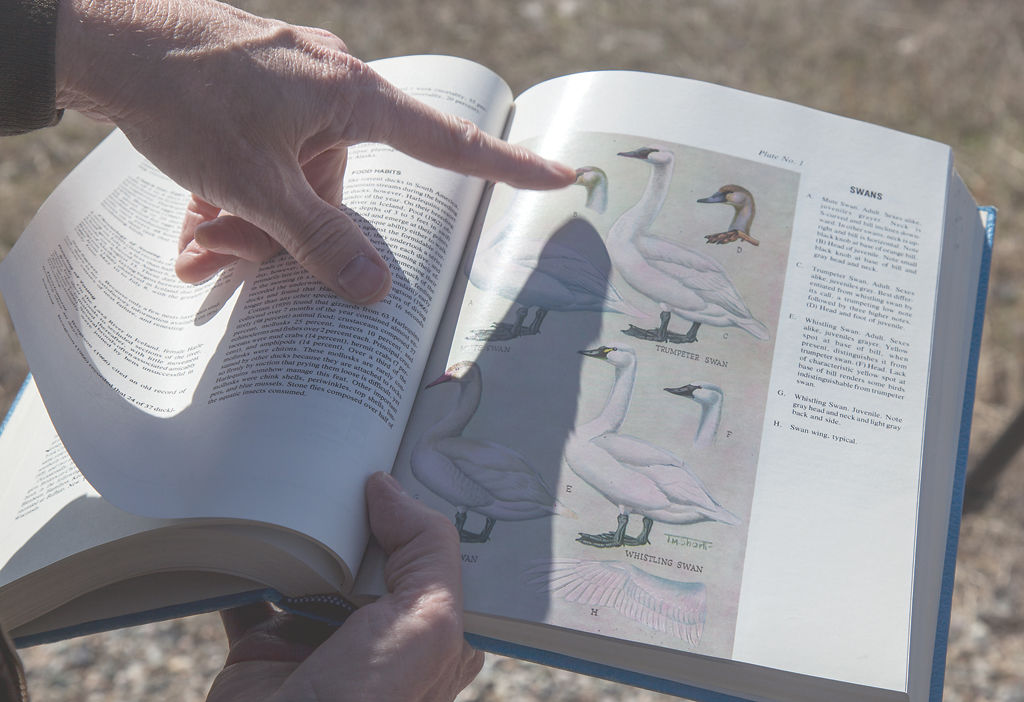
Wildlife biologist Howard Browers points out the physical differences between the trumpeter swan and the tundra swan (which used to be called a whistling swan) at the Bear River Wild Bird Refuge on Wednesday, March 5, 2014. Every spring, tens of thousand of tunda swans stop at the refuge as they migrate north to the Arctic. (BENJAMIN ZACK/Standard-Examiner)
You might call tundra swans one of the rock stars of the bird world.
The swans are considered a “charismatic” species, or a bird that captures the minds and imaginations of birdwatchers, says ornithologist John Cavitt of Ogden’s Weber State University.
“They have that elegance and gracefulness to them,” the zoology professor says.
No wonder we want to know more about these large and long-necked birds now migrating through the Top of Utah.
• Scientific name: Cygnus columbianus
• Common name: The birds are named for the region where they breed and nest — the tundra of Alaska and northern Canada. Before 1983, they were more commonly known as whistling swans, for the sound their wings make while beating in flight, according to the Utah Division of Wildlife Resources Wildlife Notebook Series.
• Vital stats: Tundra swans weigh 12-20 pounds and may be 47-58 inches long. They have a wingspan of 5-7 feet and may live as long as 20 years.
• Appearance: The birds are all white, with a black bill and black feet. One of the adult’s distinguishing characteristics is a small yellow patch, or “lore,” beneath its eye, says Howard Browers, biologist for the Bear River Migratory Bird Refuge in Brigham City. However, Browers says, the marking isn’t found on every adult tundra swan.
• Redheads?: Some swans may boast red feathers on their heads or necks. This is caused by staining from the iron content in the water where they feed, Cavitt says.
• Sounds: The call of the tundra swan is described by the National Audubon Society as a “mellow bugling call — hoo-ho-hoo.” In a group, the birds can be very noisy, Cavitt says, adding, “You can certainly hear them well before you see them.”
As with other swans and cranes, the trachea of the tundra swan passes through its sternum and into its lungs, Cavitt says, which enables the bird to a make a deep, resonating call when in flight.
• Muscle power: Tundra swans have strong pectoral muscles for flying great distances and, as a result, very powerful wing thrusts. “They can hit a person hard enough to actually break an arm,” says Jennifer Evans, curator of exhibit collections at Tracy Aviary in Salt Lake City.
• Family ties: Tundra swans form long-term pair bonds and may mate for life, Cavitt says.
Lucky Utah birdwatchers might get the thrill of seeing the swans do their “victory display,” adds Phil Douglass, conservation outreach manager for the Utah Division of Wildlife Resources’ Northern Region. In this ritual, which reinforces the pair bond, a male and female face each other and sort of bow to one another, Douglass says.
“It’s the kind of graceful behavior you would expect to see from a swan,” he says.
The birds travel in family groups when migrating, Cavitt says. The young birds are easy to spot because their feathers are still gray, as they were when they hatched. The fledglings stay with their parents through the first winter, he says, and go off on their own when the families return to the tundra in spring.
• Diet: The tundra swan’s favorite food is sago pondweed, an aquatic plant rich in nutrients, says Rich Hansen, manager of Farmington Bay Wildlife Management Area. “They get their carbs and their proteins from it,” he says, adding that the food source gives the birds the necessary energy to migrate and to be ready to nest and bear young when they reach the tundra.
Hansen says it’s interesting to watch the swans pull the plants out of the water; coots and ducks often hang out nearby to eat up the parts of the pondweed that the swans don’t eat.
• Flying high: During their travels, tundra swans typically fly at rather high altitudes, around 9,000 feet, Cavitt says. “They can really move; they’ve been clocked at 50 miles per hour during migration,” he says.
• Relatives: Tundra swans, and their swan “cousins,” are the largest members of the duck and geese family. Tundras are one of two swan species native to North America — the other is the larger and similar-looking trumpeter swan, which also migrates in small numbers through Utah.
So how do you tell these two big white birds apart?
When looking at a tundra swan’s face, the eye and top of the bill appear separated, Browers says, whereas the trumpeter swan’s eye and bill seem connected. Also, a trumpeter swan can weigh more than 30 pounds and be up to 70 inches long. These birds also have a loud, trumpet-like call.
“If you see a trumpeter and a tundra side by side, there’s a big difference,” Browers says. At a distance, however, it may be difficult to tell them apart.
• Mistaken identity: Those pretty swans floating on the ponds at parks or botanical gardens aren’t tundra swans but mute swans, an ornamental bird from Europe that has an orange and black knobby bill.
“They’re domesticated; they’re not what we consider a wild bird,” says Les Talbot, field trip chairman for Wasatch Audubon and a Roy resident.
— Becky Cairns