
Ladies are stylin’ in their best Renaissance fashions

Laura Bedore, of Salt Lake City, dresses as Queen Elizabeth in a 25 pound dress during the Utah Renaissance Festival and Fantasy Faire in Marriott-Slaterville on Saturday, May 10, 2014. "Jewels and decorations were a mark of nobility," Bedore explained. "The jewels were worn really long with pearls, gold and other jewels." (BRIANA SCROGGINS/Standard-Examiner)

Robyn Rawlins, of Ogden, dresses as Queen Mary I in a 80 pound hand made dress during the Utah Renaissance Festival and Fantasy Faire in Marriott-Slaterville on Saturday, May 10, 2014. As the daughter of Catherine of Aragon, her dresses had a Spanish influence accented with gold lace, pearls, hanging sleeves and aglets. A farthingale, or hoop skirt was worn under the dress to give the illusion of floating. (BRIANA SCROGGINS/Standard-Examiner)
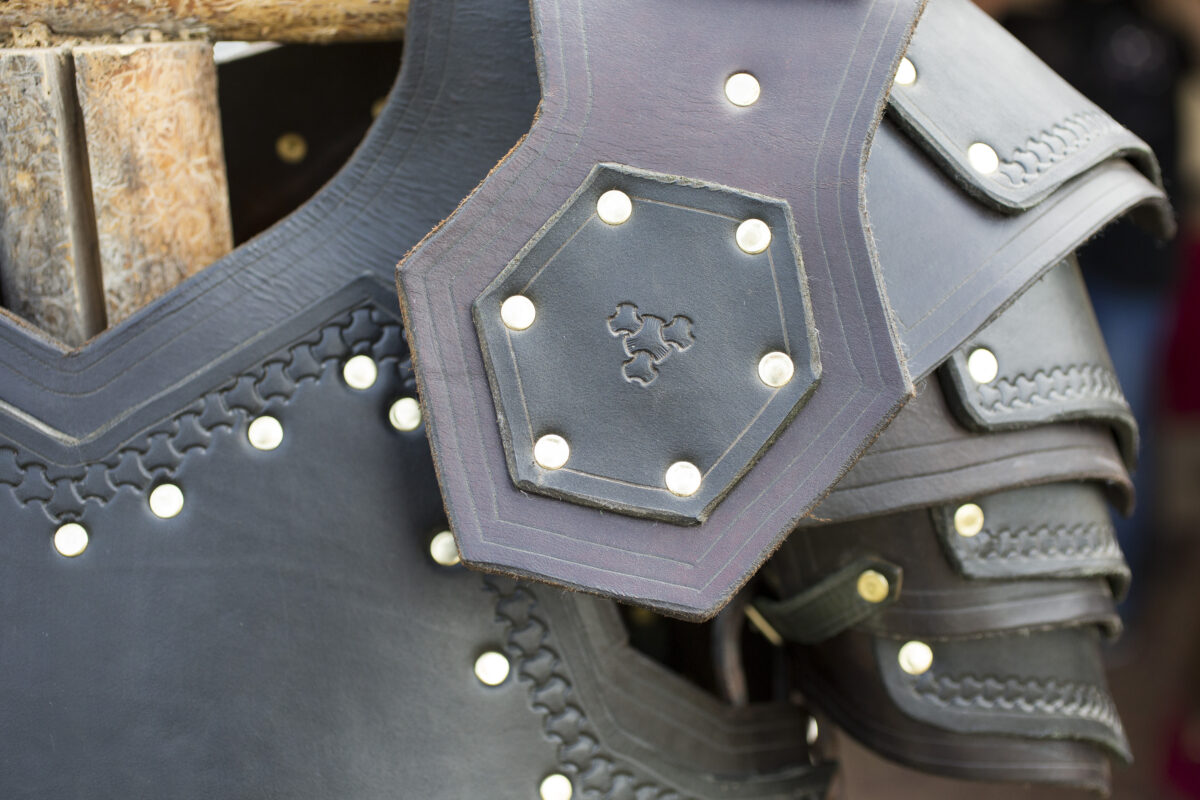
A 32 pound leather pauldron was for sale during the Utah Renaissance Festival and Fantasy Faire in Marriott-Slaterville on Saturday, May 10, 2014. (BRIANA SCROGGINS/Standard-Examiner)
Well, that depends, my lady, on whether you be peasant or royalty.
Women of both the upper and lower crusts are flaunting their best fashions at the annual Utah Renaissance Festival and Fantasy Faire now underway in Marriott-Slaterville.
And when it comes to the dictates of dress in the 15th and 16th centuries, who knows the trends better than the queen of the fair herself, “Queen Elizabeth” (also known as costume shop owner Laura Bedore of Salt Lake City), and her court attendant Lady Elysabeth Ashby (none other than Sheri Mathes, of Grand Junction, Col.).
The women took a break from their courtly duties Saturday to highlight some of the garb visitors may see at the festival Friday, May 16, through Sunday, May 18, and May 23-25, ranging from glamorous jewels to practical work garments.
The first thing to know about clothing during the Renaissance is you could tell a lot about someone by how they were dressed.
“The finer the fabric and the more bejeweled, the higher the station of the person,” said Mathes, a member of the historical re-creationist society The Order of the Azure Rose.
• Gowns galore. All women of the Renaissance, poor or rich, would be wearing dresses, said Bedore, who has portrayed Queen Elizabeth for seven years at the Top of Utah fair.
“A woman would never be seen in pants — never, ever, ever,” she said.
Other than the queen, of course, a woman’s wardrobe was limited. “Fabric took so long to make that it was very precious,” Bedore said, and most women, except for the very wealthy, only had a couple of outfits to their name. “There was not a lot of variety,” she added.
• Trendy colors and fabrics. On this day, Her Majesty was wearing an elegant gold brocade gown, embellished with a multitude of pearls and glass beads.
“The more elaborate the better — she’s the queen,” Bedore said.
The wealthy women of the era would have owned gowns made of silk, velvet or finely woven wool, while the peasants would have been outfitted in linen or coarser wools. Rich and vibrant colors like red, blue or purple were worn only by the rich, Bedore said, because such dyes were expensive. Peasants typically wore dark browns and greens, earth tones and yellows.
Also, “if you didn’t have a certain standing, it was illegal to wear fur,” Bedore said, adding, “If you were dressed above your station, you could get in trouble.”
• Bodice rippers. Dresses featured bodices with laces; the laces were how a woman put the garment on since there were no zippers, Bedore said. Even sleeves were sometimes laced on to the bodice so they could be removed and interchanged with various tops.
A peasant woman’s dress would lace up the front because she had to dress herself, Mathes said. A wealthy woman had servants to dress her, so her dress might lace up in the back, and the laces might be hidden beneath other layers of clothing.
• Swishy skirts. The skirt of a dress would be full, with various underskirts or petticoats beneath it. A bolster or “bum roll” was a roll of padding tied around the hip and worn under the skirt to help support its weight.
Dresses were always long because “a lady’s legs were not seen,” Mathes said.
Men, however, did show off their legs by wearing short, puffy “pumpkin pants” with hosiery.
“A well-turned man, he’d have sexy legs,” Bedore quipped.
• Undergarments. All women, no matter their class, wore a linen chemise or smock underneath their dress. For poor women, the chemise would often double as a nightgown, Bedore said.
Mathes added, “It was worn close to the skin and therefore laundered more often (than outer garments).”
Corsets were worn by the aristocrats but Mathes said, “A person of common status seldom if ever wore a corset.” Instead, her dress bodice might be stiffened with extra fabric or with leather.
• Hats. With the exception of young girls, women didn’t wear their hair loose and most ladies kept their heads covered, Mathes said. Muffin caps — like the one atop her own head — or flat caps were two fashionable options.
Also popular was the snood, a net-like head covering. A peasant woman’s snood would be made of sturdy wool to keep her hair out of the way while she was working and to keep her head warm without adding extra weight, Mathes said.
Snoods for noble women would be fancier, perhaps crocheted out of gold thread or lace.
• More headgear. Bedore, as Queen Elizabeth, was sporting jewels in her hair that dangled down onto her forehead.
“It was a fashion statement to have a very high forehead,” Bedore said, and the real queen actually plucked her brow back to create what was considered a look of intelligence.
Wigs were also popular with some women, the costume expert said. Due to problems like lice or bed bugs, it was more comfortable to shave off the hair and wear wigs, which could be more easily washed, or, if necessary, thrown away.
• Jewelry. “Pearls were extremely popular for Elizabeth; she loved pearls,” Bedore said.
Gold could only be worn by the queen, Mathes said; various polished gems were also in vogue, as were miniatures, or tiny painted portraits worn as jewelry.
Ordinary women wouldn’t wear much jewelry, and never anything fine, Mathes said. One had to remember one’s station, she explained, adding there’s a tale of the real Queen Elizabeth “boxing the ears” of a common woman “who deigned to wear jewels like that of the queen.”
• Accessories. Although Bedore’s outfit included an ornate gold-embellished purse, Mathes’ bag was more utilitarian, a leather pouch worn on a belt around her waist, for safety’s sake. Inside such a pouch, Lady Elysabeth Ashby might keep coins, keys or a sewing kit.
A real lady didn’t require a purse because her attendants would carry her things for her, Mathes said. But, she added, “If I have need of anything, I would have to carry it on my person because I do not have any servants.”
• Foot work. For a peasant woman, “a sturdy, flat shoe would have been worn, something one could slog in the mud with if necessary,” Mathes said.
Shoes were made of leather or even wool, and most of them were not very comfortable, said the secretary-treasurer of the Order of the Azure Rose.
The real Queen Elizabeth was known to own some fancy and bejeweled dancing shoes, and some wealthy women of the era did wear some “crazy cool heels,” Bedore said, adding, “I think we (women) have always been a little strange that way.”
Contact reporter Becky Cairns at 801-625-4276 or bcairns@standard.net. Follow her on Twitter at @bccairns or like her on Facebook at www.facebook.com/SEbeckycairns.
?