
A look back: Completion of transcontinental railroad a monumental moment for country, Utah and Ogden

Ogden's rail depot in the late 1800s.
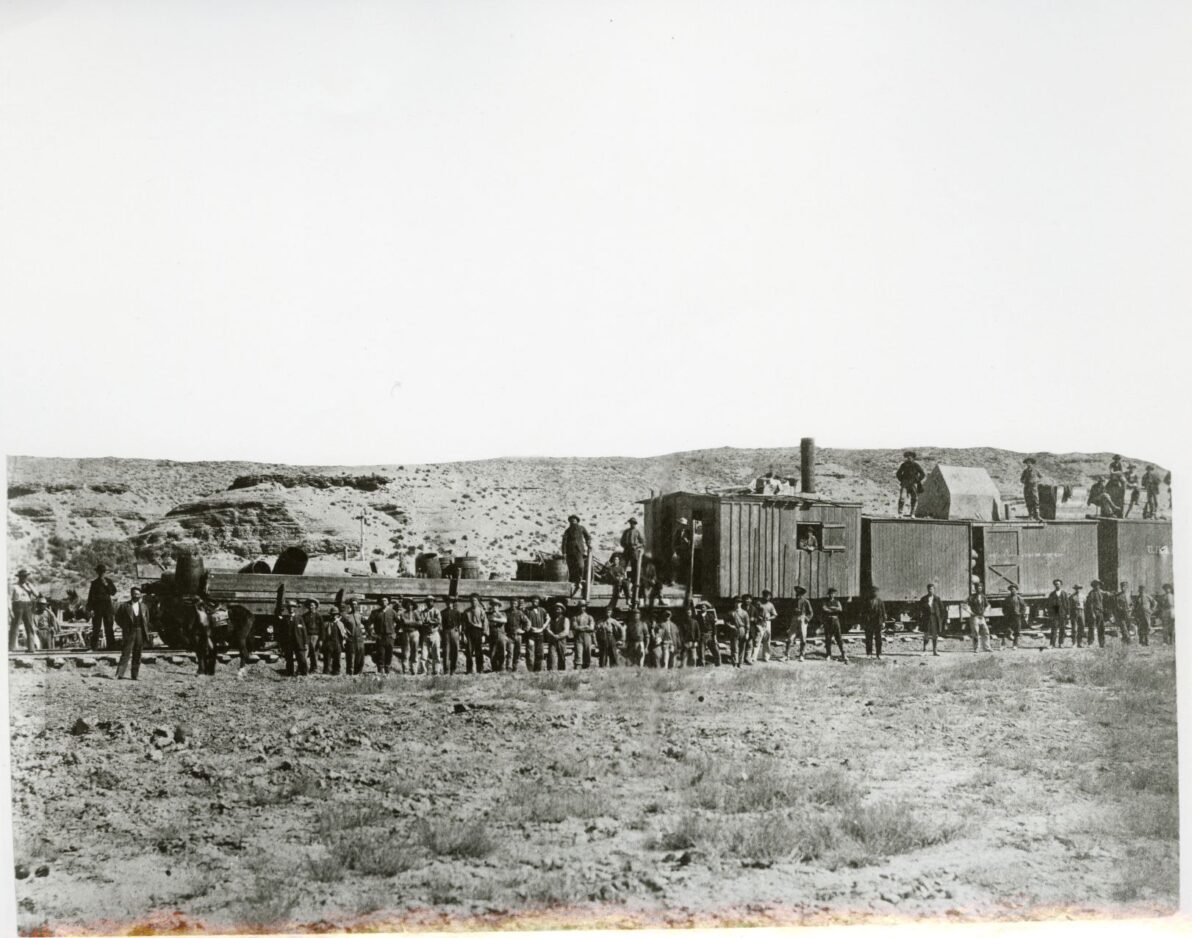
The Transcontinental Railroad in Box Elder County in the 1860s.
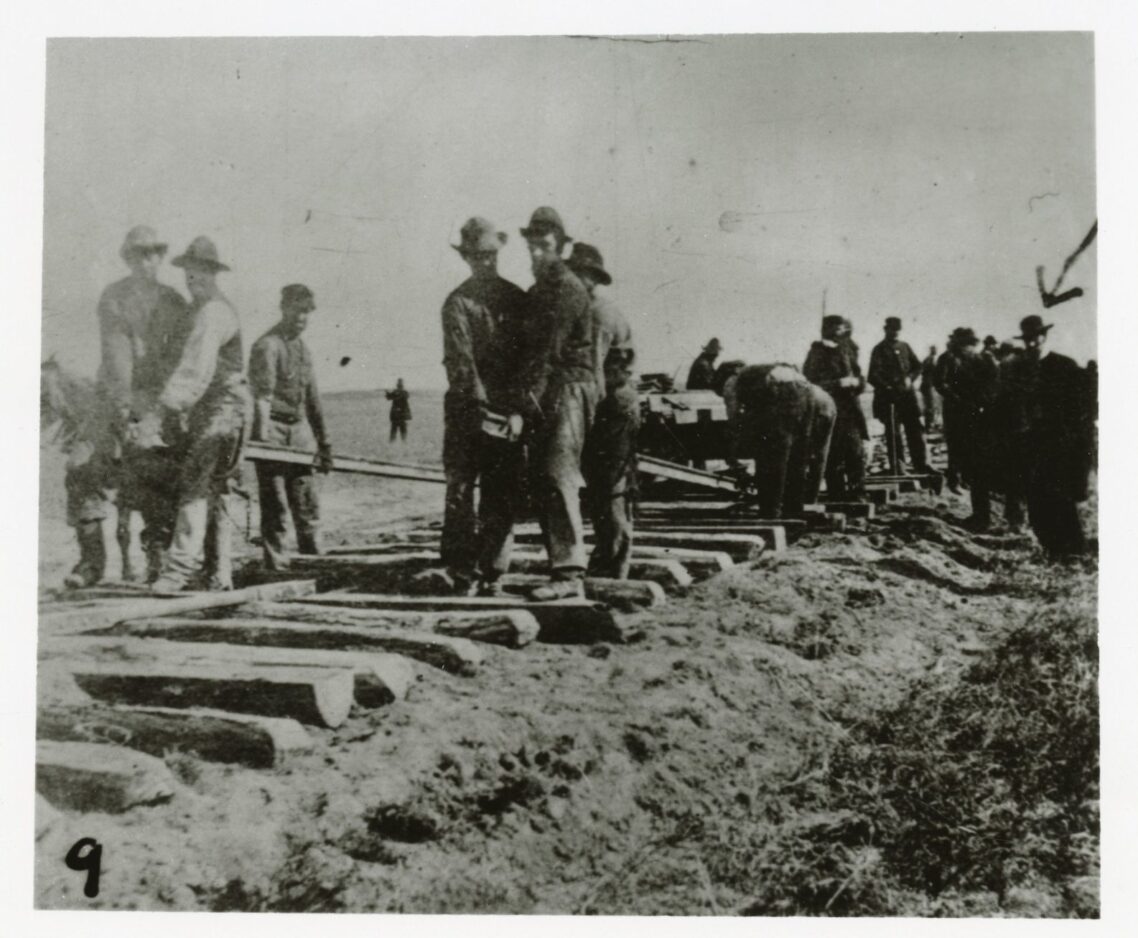
A historic image of men constructing the railroad in Utah.
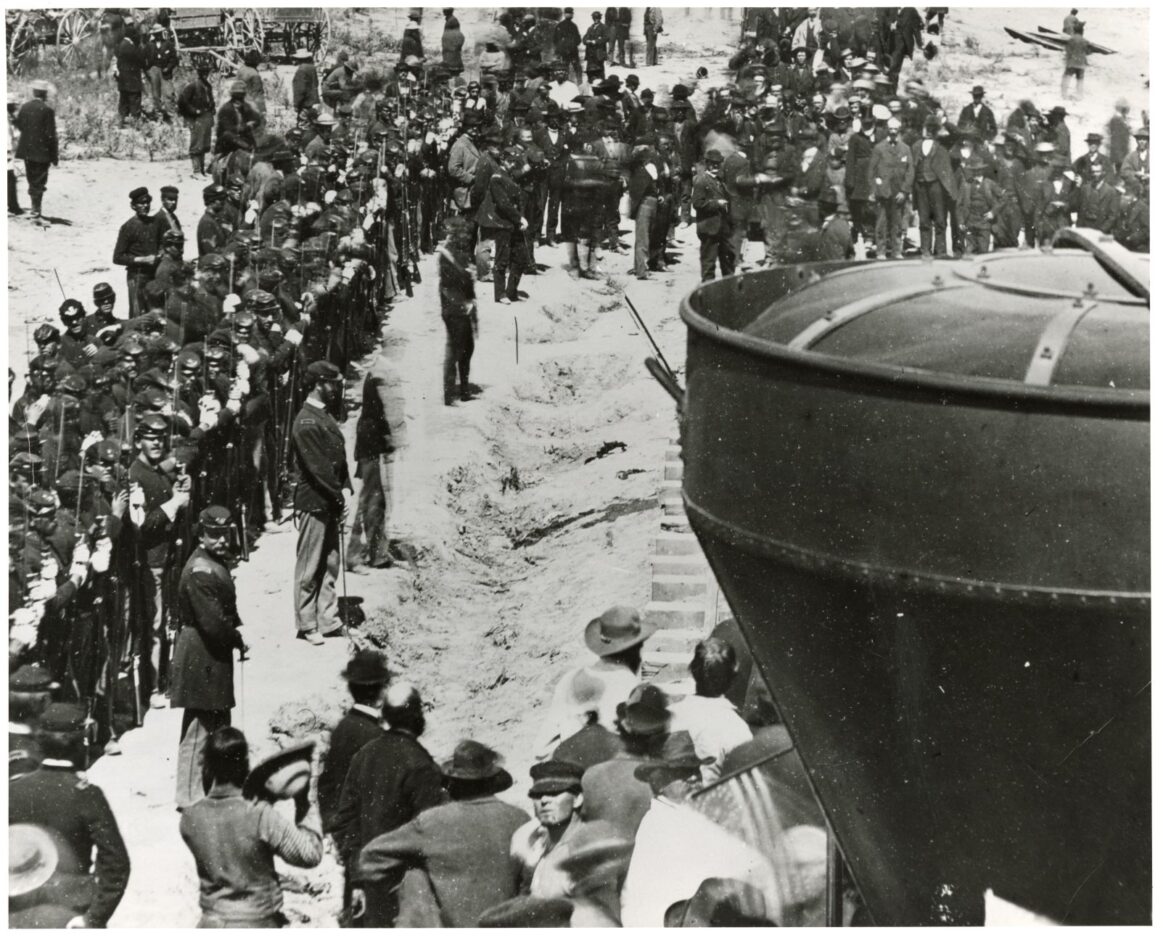

Officers of the Union Pacific Railroad lay the last rail at a ceremony at Promontory Summit in 1869. The photo is part of the exhibit "The Spike at 150: Myths and Realities" at the Brigham City Museum of Art & History.
PROMONTORY — Nearly 150 years ago, what many would argue was the nation’s most arduous, ambitious and historically significant infrastructure project was finished after six years of back-breaking labor.
And it happened here, in Northern Utah.
The first transcontinental railroad across the United States was completed on May 10, 1869, with the ceremonial Golden Spike driven at Promontory Summit in Box Elder County. That final spike connected the rail lines of the Central Pacific and Union Pacific and forever changed the world.
President Abraham Lincoln signed the Pacific Railway Act, which authorized the connection of the two railroads, in 1862 during the American Civil War.
Built between 1863 and 1869, the transcontinental line connected the Pacific Coast at San Francisco Bay with the existing eastern U.S. railway. The railroad revolutionized the American West with a dependable transportation system that brought western states economic prosperity through the relatively inexpensive and speedy movement of both goods and people.
“In 1868, if you wanted to go from New York to San Francisco you could either go by ship, around Cape Horn (at the southern end of South America), for a couple months, or you could take six months and travel by horse or wagon,” Union Pacific Railroad Senior Public Affairs Director Nathan Anderson recently told the Ogden City Council. “On May 11, 1869, that trip took a week. You didn’t have to say, ‘If I’m going to the west — I’m going for good. You could say, ‘I’m going to visit and I’m coming back.’ We saw the nation literally united by iron rail and wooden ties.”
The railroad’s impact on the United States and the world as a whole is mirrored — albeit on a more micro level — by the historical influence it had on Northern Utah, specifically Ogden. Several special events and celebrations will occur here this May as part of the sesquicentennial anniversary.
In 2017, Weber State University history professor Richard Sadler told the Standard-Examiner the railroad played a major role in shaping Ogden and is largely responsible for the city’s decades-long rough-and-tumble identity.
The city’s Union Station eventually served as the biggest rail center between the Midwest and the West Coast. Travelers from all over the world passed through the city. So did soldiers during World War II. Union Station’s position — centered at the west end of 25th Street — spawned the activity for which the corridor became infamous and the railroad ushered in economic prosperity and ethnic diversity still seen in Ogden today.
“In 1869, this was just startling and it changed our perception of time,” said Weber State University history professor and Director of Public History Kathryn MacKay. “The building of the transcontinental railroad completely transformed Utah economically, culturally, and socially.”
According to the Utah Division of State History, Salt Lake City experienced a 56 percent jump in population in the year after the railroad was finished and the city’s population more than doubled again by 1880. The swelling population could be attributed, the UDSH says, to the January 1870 construction of a railroad that connected the transcontinental line in Ogden to Salt Lake City, providing low-cost transportation that would help bring in large numbers of immigrants.
Ogden’s population growth was just as rapid. The city had about 1,400 people in 1860, a number that nearly tripled by 1870. By 1880, the population reached more than 6,000.
“The railroad just brought people to Ogden in general,” said Sarah Singh, WSU Special Collections curator. “In large numbers and of all different types. It brought jobs, ethnic diversity, tourists and changed the landscape of Ogden in a variety of ways. The history of Ogden has long been tied to the railroad. Even 150 years later, the railroad still impacts Ogden and the surrounding areas.”
Up until World War II and the emergence of Hill Air Force Base, the railroad was Northern Utah’s largest employer. Both Singh and MacKay said aside from that direct impact on the local economy, the railroad also spawned thriving centers of commerce in Ogden, like the American Can Company and the Ogden Union Livestock yards.
The livestock center is said to have once been the biggest such market between the Pacific Coast and Denver. In 1949, more than 2.4 million sheep, hogs, cattle and horses came through the stockyards, accounting for a haul of more than $87 million, or about $1.2 billion in today’s dollars. The canning company employed hundreds of people and produced millions of fruit and vegetable cans for farmers in Weber County and around the west.
MacKay said the sprawling former military installation, Defense Depot Ogden, also likely wouldn’t have been built without the railroad. Rail spurs were built into the depot for shipping supplies and goods and the site was another a major Ogden employer before military activity there was slowly phased out and the depot closed for good in 1997. Today the site is home to the Boyer Business Depot Ogden, which features more than 125 businesses and employs more than 6,000 people.
To help commemorate the sesquicentennial, Singh organized WSU’s “All Aboard Whistle Stop Tour,” which for the past several weeks has been examining the history of the transcontinental line through lectures held around Weber County.
MacKay has spent the last several months teaching a special WSU honors coarse called “Transcontinentals: Railroads and the American West.” The class is focused on the railroad’s impact on the American West and students have taken field trips to historic railroad locations, including riding the California Zephyr from Sacramento to Salt Lake City.
Both historians say the sesquicentennial anniversary should be a time of reflection and introspection for Northern Utah residents.
“These occasions allows us to reassess,” MacKay said. “So many of us lack a historical perspective. History asks us to look long-term and look at consequences and speculate about what might have been. Without the railroad, a lot of us (in Ogden) probably wouldn’t be here today.”