Conference Counsel: The power of the two great commandments
-
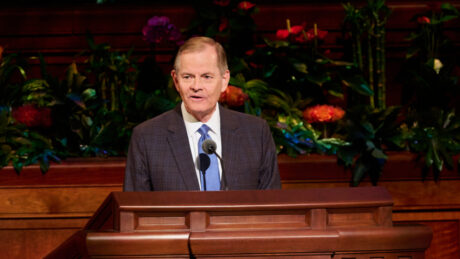
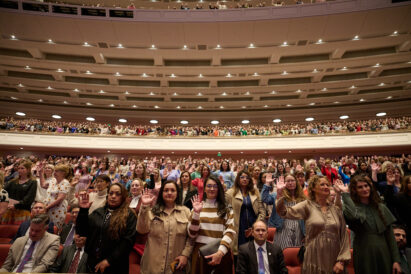
- Elder Gary E. Stevenson of the Quorum of the Twelve Apostles provides counsel to members during the Sunday afternoon session of general conference at the Conference Center in Salt Lake City, Utah, on April 7, 2024.
-

- Ryan Comer
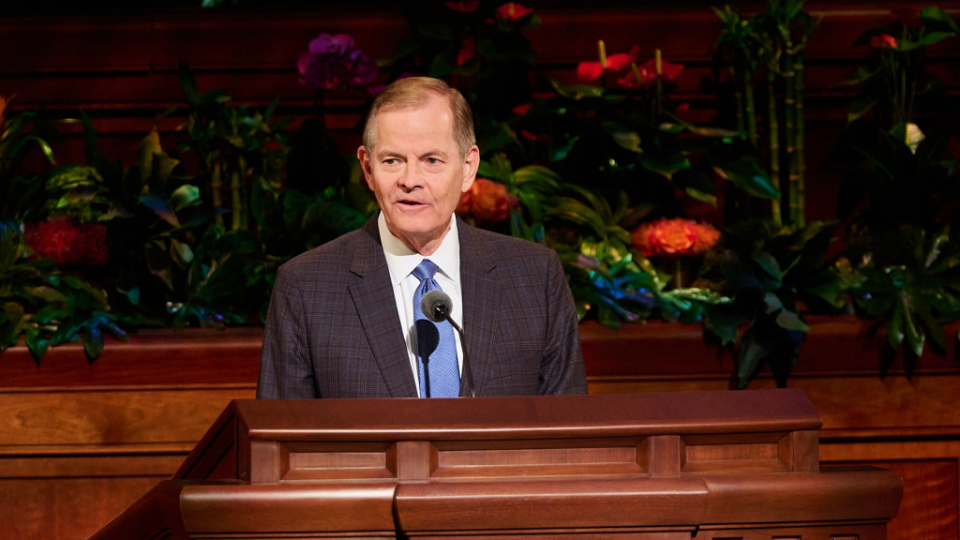
Photo supplied, Intellectual Reserve
Elder Gary E. Stevenson of the Quorum of the Twelve Apostles provides counsel to members during the Sunday afternoon session of general conference at the Conference Center in Salt Lake City, Utah, on April 7, 2024.
When I was 12 years old, my family took a trip from our home in western Washington to southern California. This was easily the most fun and memorable vacation I remember as a kid, even despite the many hours of driving the trip required. We went to Universal Studios in Los Angeles, where I remember enjoying the E.T. Adventure and Jurassic Park: The Ride. We had to wait in line for three hours for the latter, I think, because it had just opened. I’m sure my parents still have the photo taken at the moment of our final splashdown on the ride, which involved an 85-foot drop. The photo shows my tiny twig-like frame pushed up against my dad for protection with my hands clinging to the bars in front of me for dear life.
One aspect of this trip to California that I remember, but unfortunately don’t have as fond a memory of, was when we reached the Golden Gate Bridge in San Francisco on our way to Los Angeles. That might seem odd. Why would reaching such an iconic structure not produce a fond memory? Well, it was extremely cold and windy outside, and it was at night. All I can remember is how miserable I felt standing outside for pictures and how eager I was to get back into our vehicle.
I wish I had a better memory of the bridge. Perhaps someday I’ll be able to create one.
The Golden Gate Bridge was used as the lead-in to the talk delivered by Elder Gary E. Stevenson of the Quorum of the Twelve Apostles of The Church of Jesus Christ of Latter-day Saints during the church’s general conference in April. He said, “It is a classic suspension bridge with bookend towers, supported by massive piers. The colossal, majestic weight-bearing twin towers soaring above the ocean were the first elements to be constructed. Together they shoulder the load of the sweeping main suspension cables and the vertical suspender cables, which cradle the roadway below. The extraordinary stabilizing capacity — the power of the tower — is the magic behind the engineering of the bridge.
“Early construction images of the bridge bear testimony of this engineering principle. Each bridge element finds weight-bearing support from the symmetrical towers, both interdependently connected one to another.

Ryan Comer, Standard-Examiner
Ryan Comer
“When the bridge is complete, with its two powerful towers firmly in place and piers anchored in a foundation of bedrock, it is an image of strength and beauty.”
Elder Stevenson invited those watching and listening to his address to use a “gospel lens” as they thought about the bridge and its towers. He continued: “In the twilight of Jesus Christ’s ministry, during what we now call Holy Week, a Pharisee who was a lawyer (Matthew 22:35; Mark 12:28; Luke 10:25) asked the savior a question he knew was nearly impossible to answer: ‘Master, which is the great commandment in the law?’ The lawyer, ‘tempting him’ and seeking a legalistic answer, with seemingly deceitful intent, received a genuine, sacred, divine response.
“‘Jesus said unto him, Thou shalt love the Lord thy God with all thy heart, and with all thy soul, and with all thy mind.
“‘This is the first and great commandment.’ Hearkening to our bridge analogy, the first tower!
“‘And the second is like unto it, Thou shalt love thy neighbour as thyself.’ This is the second tower!
“‘On these two commandments hang all the law and the prophets.’ (Matthew 22:36-40) The remaining elements of the bridge!”
Is it really that simple? Of all that we could be asked to do, the two great commandments are to love the Lord with all our heart, soul and mind, and to love our neighbors as ourselves? Yes, it really is that simple.
Of course, just because something is simple doesn’t mean it’s easy, and in practice, those two simple commandments can be extremely hard for people to follow. First, Elder Stevenson discussed the first great commandment – the first tower. He said:
“In this answer, Jesus Christ condenses the essence of the law embodied in the sacred teachings of the Old Testament. To love the Lord centers first on your hear t– your very nature. The Lord asks that you love with all your soul (Doctrine and Covenants 88:15) — your entire consecrated being — and finally, to love with all your mind — your intelligence and intellect. Love for God is not limited or finite. It is infinite and eternal.
“For me, the application of the first great commandment can sometimes feel abstract, even daunting. Gratefully, as I consider further words of Jesus, this commandment becomes much more graspable: ‘If ye love me, keep my commandments.’ (John 14:15) This I can do. I can love Heavenly Father and Jesus Christ, which then leads to prayer, scripture study and temple worship. We love the Father and the Son through the payment of tithes, keeping the Sabbath day holy, living a virtuous and chaste life and being obedient.
“Loving the Lord is often measured in small daily deeds, footsteps on the covenant path: for young people, using social media to build up rather than tear down; leaving the party, movie or activity where standards might be challenged; showing reverence for things sacred.”
When I was in the Missionary Training Center, there was an elder in my group who said something one day that frankly shocked me. We were discussing movies we had seen prior to entering the MTC (probably not an appropriate discussion topic for missionaries, admittedly) and he said there was a specific movie he had gone to the theater to see but decided to walk out of it. I had seen that movie as well and I personally didn’t think it was as bad as he seemingly thought it was. In the moment, I thought he was overreacting and just trying to maybe show off his righteousness. Looking back, I realize that I should have appreciated his love for the Lord as evidenced by the types of movies he was not willing to see. I admire this former missionary a lot more now than I did then.
Elder Stevenson continued: “Consider this tender example. It was fast Sunday as Vance and I knocked on the door of a small, humble home. We and other deacons in the quorum had come to expect the words ‘Please come in,’ yelled warmly in a thick German accent loud enough to hear through the door. Sister Muellar was one of several immigrant widows in the ward. She couldn’t answer the door very easily, as she was legally blind.
“As we stepped inside the dimly lit home, she greeted us with kind questions: What are your names? How are you doing? Do you love the Lord? We answered and shared that we came to receive her fast offering. Even at our young age, her meager circumstances were readily apparent, and her faith-filled response was profoundly touching: ‘I placed a dime on the counter earlier this morning. I am so grateful to offer my fast offering. Would you be kind enough to place it in the envelope and fill out my fast-offering receipt?’ Her love of the Lord lifted our faith each time we left her home.
“King Benjamin promised remarkable power for those who follow the first great commandment. ‘I would desire that ye should consider on the blessed and happy state of those that keep the commandments…. They are blessed in all things, … and if they hold out faithful to the end they are received into heaven … in a state of never-ending happiness.’ (Mosiah 2:41)
“Loving the Lord leads to eternal happiness!”
Latter-day Saints are often ridiculed for the focus put on obedience. We are told we’re trying to earn something, specifically a spot in heaven. But obedience isn’t about trying to earn something. It’s about trying to prove something. Every day we have the opportunity to make choices that prove whether or not we love the Lord. Imagine if every day we thought about our decisions from the mindset of, “Would this decision prove I love the Lord or not?” Many people lament commandments. “Why do I have to follow that commandment?” “Why does that commandment have to be so hard?” This is a flawed mindset. Instead of complaining about the difficulty and purpose of commandments, we should see them as opportunities to prove our love for the Lord. The woman in Elder Stevenson’s story loved the Lord, and she proved it.
Elder Stevenson then spoke of the second commandment – the second tower – saying, “Jesus then said, ‘And the second is like unto it, Thou shalt love thy neighbour as thyself.’ (Matthew 22:39) This is the second tower of the bridge.
“Here Jesus bridges our heavenly upward gaze, to love the Lord, with our earthly outward gaze, to love our fellow men and women. One is interdependent on the other. Love of the Lord is not complete if we neglect our neighbors. This outward love includes all of God’s children without regard to gender, social class, race, sexuality, income, age or ethnicity. We seek out those who are hurt and broken, the marginalized, for ‘all are alike unto God.’ (2 Nephi 26:33) We ‘succor the weak, lift up the hands which hang down, and strengthen the feeble knees.’ (Doctrine and Covenants 81:5)
“Consider this example: Brother Evans was surprised when he was prompted to stop his car and knock on an unknown door of an unknown family. When a widowed mother of over 10 answered the door, their difficult circumstances and great needs became readily apparent to him. The first was simple: paint for their home, which was followed by many years of temporal and spiritual ministering to this family.
“This thankful mother later wrote of her heaven-sent friend: ‘You have spent your life reaching out to the least of us. How I would love to hear the things the Lord has to say to you as he expresses his appreciation for the good you have done financially and spiritually for the people that only you and he will ever know about. Thank you for blessing us in so many ways, … for the missionaries you provided for…. I often wonder if the Lord picked on you exclusively or if you were just the one who listened.’
“To love your neighbor includes Christlike deeds of kindness and service. Can you let go of grudges, forgive enemies, welcome and minister to your neighbors and assist the elderly? You will each be inspired as you build your tower of love for neighbor.
“President Russell M. Nelson taught: ‘Giving help to others — making a conscientious effort to care about others as much as or more than we care about ourselves — is our joy. Especially … when it is not convenient and when it takes us out of our comfort zone. Living that second great commandment is the key to becoming a true disciple of Jesus Christ.'”
Several years ago, my wife and I went to Tepanyaki for an anniversary dinner. At the end of our meal, I noticed that other people at the table had received their check but not us. Thinking it must have been some sort of error, I asked the waitress where our check was. She said that we had no need to pay for the meal because someone else in the restaurant had already done so for us. I was astonished. I never found out who paid for our dinner that evening, but I can’t say enough about how grateful I was. This was not some cheap (relatively speaking) meal at some fast-food restaurant. That person, whoever it was, did something that they didn’t have to do, at great cost, almost certainly knowing there would be no recognition from us.
This has stuck with me over the years as an amazing example of loving your neighbor. I think many others can think of examples of someone who has done something similar.
Elder Stevenson then explained why it is important that the two commandments are connected and followed equally.
“Jesus further taught, ‘On these two commandments hang all the law and the prophets.’ (Matthew 22:40) This is very instructive. There is an important interdependency between loving the Lord and loving one another. For the Golden Gate Bridge to perform its designed function, both towers are equally strong and with equal power to bear the weight of the suspension cables, the roadway and the traffic crossing the bridge. Without this engineering symmetry, the bridge could be compromised, even leading to collapse. For any suspension bridge to do what it was built to do, its towers must function together in complete harmony. Likewise, our ability to follow Jesus Christ depends upon our strength and power to live the first and second commandments with balance and equal devotion to both.
“The increasing contention in the world suggests, however, that we at times fail to see or remember this. Some are so focused on keeping the commandments that they show little tolerance of those they see as less righteous. Some find it difficult to love those who are choosing to live their lives outside of the covenant or even away from any religious participation.
“Alternatively, there are those who emphasize the importance of loving others without acknowledgment that we are all accountable to God. Some refuse entirely the notion that there is such a thing as absolute truth or right and wrong and believe that the only thing required of us is complete tolerance and acceptance of the choices of others. Either of these imbalances could cause your spiritual bridge to tip or even fall.
“President Dallin H. Oaks described this when he said: ‘We are commanded to love everyone, since Jesus’s parable of the good Samaritan teaches that everyone is our neighbor. But our zeal to keep this second commandment must not cause us to forget the first, to love God with all our heart, soul and mind.'”
It’s interesting to me that our zeal can be at the root of the problem for following each of the two commandments. Zeal to keep the first commandment can lead some to show no tolerance for those they deem to be unrighteous, while zeal to keep the second commandment can lead some to show total tolerance for any behavior as if there is no such thing as right and wrong except for what a person decides for themselves in their own lives. Really, it’s zeal in one direction that’s the problem.
The Book of Mormon teaches us about a group called the people of Ammon. These people “were … distinguished for their zeal towards God, and also towards men; for they were perfectly honest and upright in all things; and they were firm in the faith of Christ, even unto the end.” (Alma 27:27). That is a people who had, as Elder Stevenson put it, “strength and power to live the first and second commandments with balance and equal devotion to both.” The result was that they were “firm in the faith of Christ, even unto the end.” Their bridge was strong.
Elder Stevenson concluded his talk with a question and then some counsel, saying, “So the question for each of us is, How do we build our own bridge of faith and devotion — erecting tall bridge towers of both loving God and loving our neighbors? Well, we just start. Our initial efforts might look like a plan on the back of a napkin or an early-stage blueprint of the bridge we hope to construct. It might consist of a few realistic goals to understand the Lord’s gospel more or to vow to judge others less. No one is too young or too old to begin.
“Over time, with prayerful and thoughtful planning, rough ideas are refined. New actions become habits. Early drafts become polished blueprints. We build our personal spiritual bridge with hearts and minds devoted to Heavenly Father and His Only Begotten Son as well as to our brothers and sisters with whom we work, play and live.”
I know that because the Lord gave us these commandments, and highlighted them as the most important, that he will help us figure out a way to follow them. If we want to, there is nothing that has to stop us.
Contact Ryan Comer at rcomer@standard.net. Follow him on Facebook at https://www.facebook.com/rbcomer8388.
Faith
Sunday General Conference sessions focus on the resurrection of Jesus, the value of peacemakers
Three takeaways from Saturday’s sessions of General Conference