Conference Counsel: Following the cycle of the doctrine of Christ
-
- Elder Dale G. Renlund of the Quorum of the Twelve Apostles offers instruction during the morning session of general conference at the Conference Center in Salt Lake City on Sunday, April 7, 2024.
-

- Ryan Comer
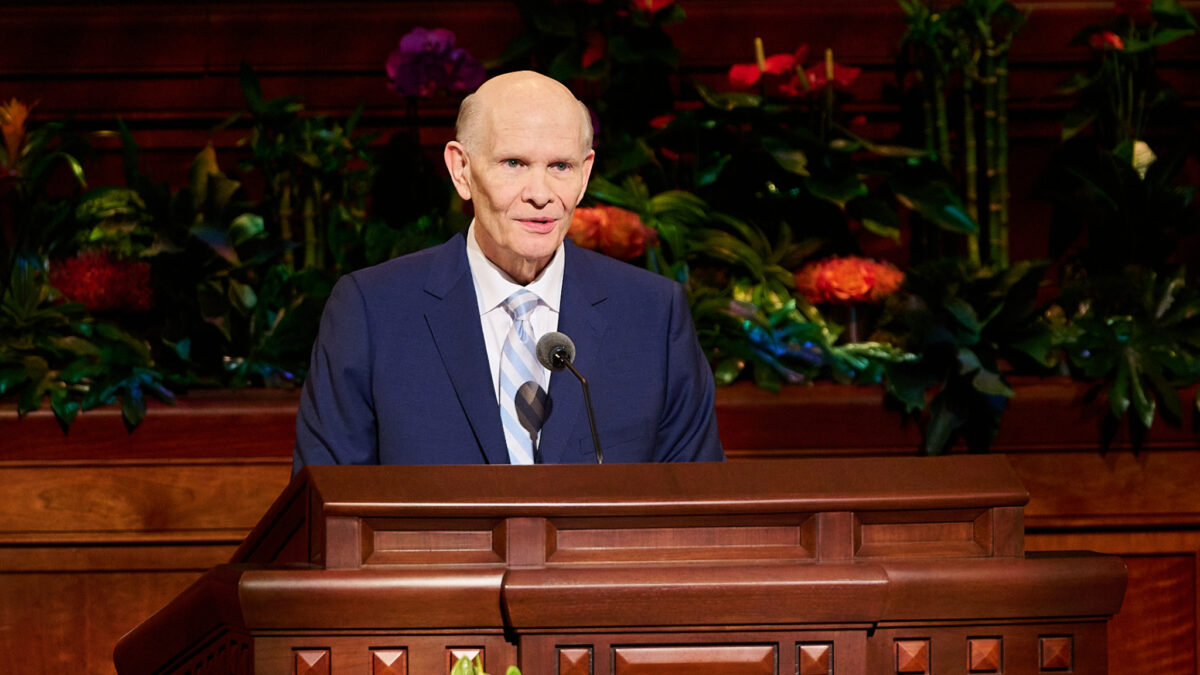
Photo supplied, Intellectual Reserve
Elder Dale G. Renlund of the Quorum of the Twelve Apostles offers instruction during the morning session of general conference at the Conference Center in Salt Lake City on Sunday, April 7, 2024.
I love hearing stories of Latter-day Saint leaders having been humbled. Phrasing it that way kind of sounds horrible, but the reason is it helps me realize that it’s OK if I’m not perfect and occasionally need to be humbled myself.
I once heard a story told by a church leader who I greatly admire in which he discussed an experience he had many years ago that involved him having to choose between spending his time in two different ways. If he made one choice, he would have fun, but it would have been satisfying for only himself. If he made the other choice, he wouldn’t have as much fun, but he would have done something that helped someone else. He acknowledged the struggle he faced in deciding but ultimately chose the second option. He later learned just how important it was that he made that decision and felt grateful.
As I heard this story, I felt personally strengthened. Here was this man of incredible faith acknowledging that in a certain moment, he struggled to make a correct decision. I was inspired by it not just because it showed that everyone struggles to make correct choices from time to time, but also because I was able to learn something about how we can be blessed by making correct choices.
Later on, I was speaking to some friends who also heard the story. I mentioned how this church leader inspired me because he acknowledged a moment of difficulty for himself. One of them quipped, “Yeah, but it only happened to him that one time.”
At the April general conference of The Church of Jesus Christ of Latter-day Saints, Elder Dale G. Renlund of the Quorum of the Twelve Apostles in the church shared a story that similarly highlighted a moment of weakness he experienced but that he learned a valuable lesson from.

Ryan Comer, Standard-Examiner
Ryan Comer
“Years ago, my wife, Ruth; our daughter, Ashley; and I joined other tourists on a kayaking excursion in the state of Hawaii in the United States. A kayak is a low-to-the-water, canoe-like boat in which the rower sits facing forward and uses a double-bladed paddle to pull front to back on one side and then on the other. The plan was to row to two small islands off the coast of Oahu and back again. I was confident because, as a young man, I had paddled kayaks across mountain lakes. Hubris never bodes well, does it?
“Our guide gave us instructions and showed us the ocean kayaks we would use. They differed from the ones I had previously paddled. I was supposed to sit on top of the kayak, instead of down inside it. When I got onto the kayak, my center of gravity was higher than I was accustomed to, and I was less stable in the water.
“As we started out, I rowed faster than Ruth and Ashley. After a while, I was far ahead of them. Though proud of my heroic pace, I stopped paddling and waited for them to catch up. A large wave — about 13 centimeters — hit the side of my kayak and flipped me over into the water. By the time I had turned the kayak upright and struggled to get back on top, Ruth and Ashley had passed me by, but I was too winded to resume paddling. Before I could catch my breath, another wave, this one truly enormous — at least 20 centimeters — hit my kayak and flipped me over again. By the time I managed to right the kayak, I was so out of breath I feared I would not be able to climb on top.”
It’s fun to watch this talk as opposed to reading it to see Elder Renlund’s voice inflection and hand gestures as he describes the height of these “large” and “truly enormous” waves. He continued:
“Seeing my situation, the guide rowed over and steadied my kayak, making it easier for me to climb on top. When he saw that I was still too breathless to row on my own, he hitched a towrope to my kayak and began paddling, pulling me along with him. Soon I caught my breath and began paddling adequately on my own. He let go of the rope, and I reached the first island without further assistance. Upon arrival, I flopped down on the sand, exhausted.
“After the group had rested, the guide quietly said to me, ‘Mr. Renlund, if you just keep paddling, maintaining your momentum, I think you’re going to be fine.’ I followed his advice as we paddled to the second island and then back to our starting point. Twice the guide rowed by and told me I was doing great. Even larger waves hit my kayak from the side, but I was not flipped over.
“By consistently paddling the kayak, I maintained momentum and forward progress, mitigating the effect of waves hitting me from the side. The same principle applies in our spiritual lives. We become vulnerable when we slow down and especially when we stop. If we maintain spiritual momentum by continually ‘rowing’ toward the savior, we are safer and more secure because our eternal life depends on our faith in him.” (2 Nephi 2:6-7; 2 Nephi 9:23-24)
It’s helpful to know that even apostles have had moments of pride. Thankfully, Elder Renlund learned a valuable lesson from the experience, which is the importance of momentum, and was willing to share it with us. I was strengthened as I heard it.
Another reason Elder Renlund’s story resonated with me is because I have a personal testimony of the power of spiritual momentum. I have seen my faith strengthen and weaken at different moments of my life, and I can tie it all to how much I was embracing the doctrine of Christ. When I embrace the doctrine of Christ, my faith and spiritual momentum grow. I see the benefits and I want to continue embracing it. When I don’t embrace the doctrine of Christ as well, my faith and spiritual momentum are diminished. I don’t see as many benefits, and I have less of a desire to embrace it. If I haven’t done well at embracing it for a while, it can be hard to start embracing it again. I’ve learned that it’s simply better to continue building my spiritual momentum, though I’m definitely more successful at some times than I am at others. I’m a work in progress.
The doctrine of Christ and how it relates to spiritual momentum was the central theme of Elder Renlund’s address. He said:
“Spiritual momentum is created ‘over a lifetime as we repeatedly embrace the doctrine of Christ.’ Doing so, President Russell M. Nelson taught, produces a ‘powerful virtuous cycle.’ Indeed, the elements of the doctrine of Christ — such as faith in the Lord Jesus Christ, repentance, entering a covenant relationship with the Lord through baptism, receiving the gift of the Holy Ghost and enduring to the end (2 Nephi 31:2-21; 3 Nephi 9:14-22; 3 Nephi 11:7-41; 3 Nephi 27:1-21) — are not intended to be experienced as one-time, check-the-box events. In particular, ‘enduring to the end’ is not really a separate step in the doctrine of Christ — as though we complete the first four elements and then hunker down, grit our teeth and wait to die. No, enduring to the end is repeatedly and iteratively applying the other elements of the doctrine of Christ, creating the ‘powerful virtuous cycle’ that President Nelson described. (2 Nephi 28:30; Alma 12:10-11; Doctrine and Covenants 20:31-34; Doctrine and Covenants 50:24)
“Repeatedly means that we experience the elements of the doctrine of Christ over and over throughout our lives. Iteratively means that we build on and improve with each repetition. Even though we repeat the elements, we are not just spinning in circles without a forward trajectory. Instead, we draw closer to Jesus Christ each time through the cycle.
“Momentum involves both speed and direction. If I had paddled the kayak vigorously in the wrong direction, I could have created significant momentum, but I would not have reached the intended destination. Similarly, in life, we need to ‘row’ toward the savior to come unto him.” (2 Nephi 2:6-7; 2 Nephi 9:23-24)
When I was a kid, I thought of enduring to the end as a separate step in the doctrine of Christ. I thought it basically meant hanging on for dear life, hoping that I could somehow avoid Satan’s arrows just enough to eventually return to Heavenly Father and Jesus Christ. Like Elder Renlund said, however, it involves “repeatedly and iteratively applying the other elements of the doctrine of Christ.” I appreciate this perspective because eternal life is the goal I’ve always had, but it seems so far away, and if enduring to the end means hanging on for dear life, then I almost feel like eternal life is unattainable. Am I really going to be able to hang on for that long? But when I think of it as Elder Renlund taught, I suddenly have achievable goals in front of me that I know I can be successful at. Instead of trying to take one big leap across the giant chasm of mortality, I see smaller steps that I can take, and the more steps I take, the more my confidence grows because of the success I’m having. I develop momentum, and suddenly, eternal life doesn’t seem like such an unachievable goal.
Elaborating on each part of the doctrine of Christ, Elder Renlund said:
“Our faith in Jesus Christ needs to be nourished daily. It is nourished as we pray daily, study the scriptures daily, reflect on the goodness of God daily, repent daily and follow the promptings of the Holy Ghost daily. Just as it is not healthy to defer eating all our food until Sunday and then binge our weekly allotment of nutrition, it is not spiritually healthy to restrict our testimony-nourishing behavior to one day in the week.” (Colossians 2:6-7)
It is so easy to fall into the trap of doing spiritual things just once a week. But we take a risk with that approach because we give Satan a greater chance of having success over us. Satan will never take a day off from trying to negatively influence us, so we need to be embracing the doctrine of Christ on a daily basis by doing the things Elder Renlund listed. These aren’t just good ideas that maybe if one has time for they can do. They are necessary steps in establishing the positive momentum required to successfully endure to the end.
Elder Renlund continued:
“When we assume responsibility for our own testimonies, we gain spiritual momentum and gradually develop bedrock faith in Jesus Christ, and the doctrine of Christ becomes central to the purpose of life. Momentum likewise builds as we strive to obey the laws of God and repent. Repentance is joyful and allows us to learn from our mistakes, which is how we progress eternally. We will undoubtedly have times when we flip over in our kayaks and find ourselves in deep water. Through repentance, we can get back on top and continue, no matter how many times we have fallen off. (Mosiah 26:30; Alma 34:31; Moroni 6:8; Doctrine and Covenants 58:42) The important part is that we do not give up.
“The next element of the doctrine of Christ is baptism, which includes the baptism of water and, through confirmation, the baptism of the Holy Ghost. (2 Nephi 31:13) While baptism is a singular event, we renew our baptismal covenant repeatedly when we partake of the sacrament. The sacrament does not replace baptism, but it links the initial elements in the doctrine of Christ — faith and repentance — with reception of the Holy Ghost. As we conscientiously partake of the sacrament (Doctrine and Covenants 59:9), we invite the Holy Ghost into our lives, just like when we were baptized and confirmed. As we keep the covenant described in the sacrament prayers, the Holy Ghost becomes our companion.
“As the Holy Ghost exerts a greater influence in our lives, we progressively and iteratively develop Christlike attributes. Our hearts change. Our disposition to do evil diminishes. Our inclination to do good increases until we only want ‘to do good continually.’ (Mosiah 5:2) And we thereby access the heavenly power needed to endure to the end. (2 Nephi 31:2-21; 3 Nephi 11:23-31; 3 Nephi 27:13-21; Moroni 4:3; Moroni 5:2; Moroni 6:6; Doctrine and Covenants 20:77, 79; Doctrine and Covenants 59:8-9) Our faith has increased, and we are ready to repeat the powerful, virtuous cycle again.”
Again, I have seen this proven true in my own life. As I’ve allowed the Holy Ghost to exert a greater influence on my life, I have noticed that I progressively and iteratively develop Christlike attributes. I’m more patient. I’m more understanding. I have greater faith. My heart changes and I notice a difference. My desire to only do good continually increases. I have a greater desire to be in the house of the Lord as much as possible, which is what Elder Renlund spoke about next. He said:
“Forward spiritual momentum also propels us to make additional covenants with God in the house of the Lord. Multiple covenants draw us closer to Christ and connect us more strongly to him. Through these covenants, we have greater access to his power. To be clear, baptismal and temple covenants are not, in and of themselves, the source of power. The source of power is the Lord Jesus Christ and our Heavenly Father. Making and keeping covenants create a conduit for their power in our lives. As we live according to these covenants, we eventually become inheritors to all that Heavenly Father has.” (Doctrine and Covenants 14:7; Doctrine and Covenants 84:33-38)
An important component of living the doctrine of Christ is ministering to others in helpful ways. Said Elder Renlund:
“Consider how the expedition guide helped me after I flipped over in the kayak. He did not shout from afar an unhelpful question such as, ‘Mr. Renlund, what are you doing in the water?’ He did not paddle up and chide me, saying, ‘Mr. Renlund, you would not be in this situation if you were more physically fit.’ He did not start towing my kayak while I was just trying to get on top of it. And he did not correct me in front of the group. Instead, he gave me the help I needed at the time I needed it. He gave me advice when I was receptive. And he went out of his way to encourage me.
“As we minister to others, we do not need to ask unhelpful questions or state the obvious. Most people who are struggling know that they are struggling. We should not be judgmental; our judgment is neither helpful nor welcome, and it is most often ill-informed.
“Comparing ourselves to others can lead us to make pernicious errors, especially if we conclude that we are more righteous than those who are struggling. Such a comparison is like drowning hopelessly in 3 meters of water, seeing someone else drowning in 4 meters of water, judging him a greater sinner, and feeling good about yourself. After all, we are all struggling in our own way. None of us earns salvation. (Ephesians 2:8-9) We never can. Jacob, in the Book of Mormon, taught, ‘Remember, after (we) are reconciled unto God, that it is only in and through the grace of God that (we) are saved.’ (2 Nephi 10:24) We all need the savior’s infinite atonement, not just part of it.
“We do need all our compassion, empathy and love as we interact with those around us. Those who are struggling ‘need to experience the pure love of Jesus Christ reflected in (our) words and actions.’ As we minister, we encourage others frequently and offer help. Even if someone is not receptive, we continue to minister as they allow. The savior taught that ‘unto such shall ye continue to minister; for ye know not but what they will return and repent, and come unto me with full purpose of heart, and I shall heal them; and ye shall be the means of bringing salvation unto them.’ (3 Nephi 18:32) The savior’s job is to heal. Our job is to love — to love and minister in such a way that others are drawn to Jesus Christ. This is one of the fruits of the powerful, virtuous cycle of the doctrine of Christ.”
I love the following quote Elder Renlund used from Jeffrey R. Holland, acting president of the Quorum of the Twelve Apostles, in the footnotes of his talk. In a 1984 address at a Brigham Young University devotional, President Holland said:
“When a battered, weary swimmer tries valiantly to get back to shore, after having fought strong winds and rough waves which he should never have challenged in the first place, those of us who might have had better judgment, or perhaps just better luck, ought not to row out to his side, beat him with our oars and shove his head back underwater. That’s not what boats were made for. But some of us do that to each other”
I don’t think a single person who has struggled has ever said, “You know, that person was extremely judgmental and rude to me, and that made me feel better. I’m better off because of that interaction.” A couple of questions to ask when talking to people who are struggling would be, “What is my objective? What am I actually trying to accomplish?”
Concluding his remarks, Elder Renlund said:
“I invite you to live the doctrine of Christ repeatedly, iteratively and intentionally and help others on their way. I testify that the doctrine of Christ is central to Heavenly Father’s plan; it is, after all, his doctrine. As we exercise faith in Jesus Christ and his atonement, we are propelled along the covenant path and motivated to help others become faithful disciples of Jesus Christ. We can become heirs in Heavenly Father’s kingdom, which is the culmination of faithfully living the doctrine of Christ.”
Contact Ryan Comer at rcomer@standard.net. Follow him on Facebook at https://www.facebook.com/