Conference Counsel: Obtaining blessings through making, keeping covenants
-

- Sister J. Anette Dennis, first counselor in the Relief Society General Presidency, speaks at the morning session of general conference at the Conference Center in Salt Lake City on Saturday, April 6, 2024.
-

- Ryan Comer
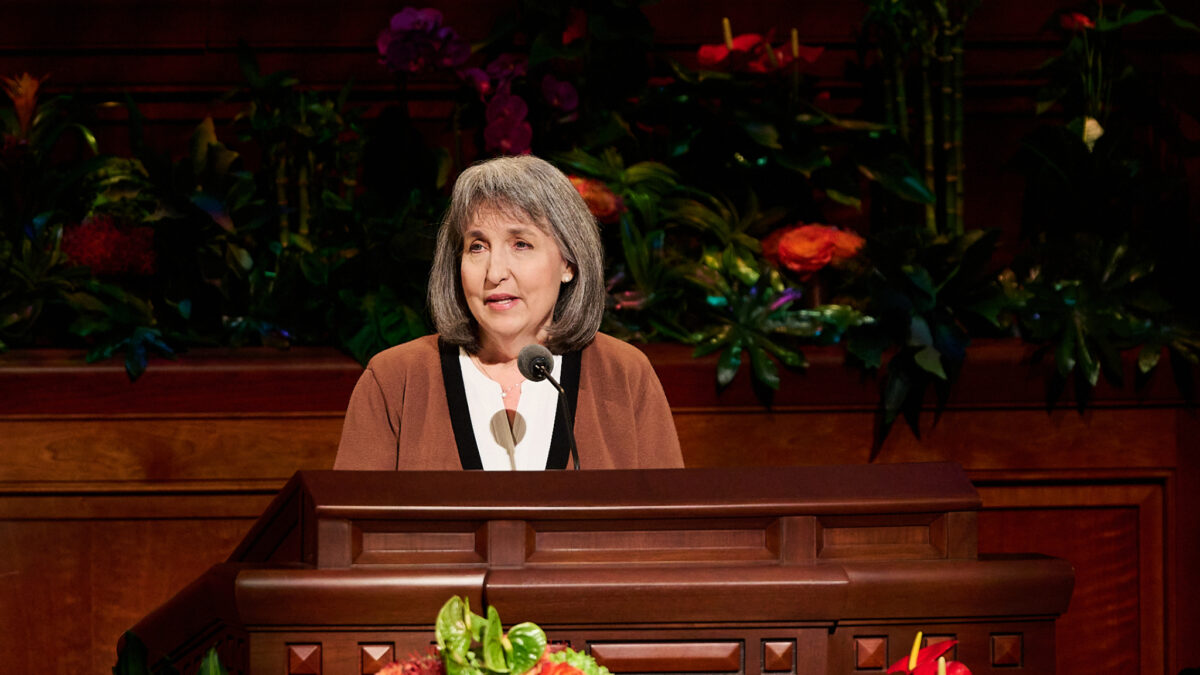
Photo supplied, Intellectual Reserve
Sister J. Anette Dennis, first counselor in the Relief Society General Presidency, speaks at the morning session of general conference at the Conference Center in Salt Lake City on Saturday, April 6, 2024.
I’m certain I’m not alone among members of The Church of Jesus Christ of Latter-day Saints living in Davis County when I say the recent completion of the Layton Temple, as well as the ongoing construction of the Syracuse Temple, have facilitated a lot more discussions about the temple in my home. In talking about the temple with my children, a 9-year-old and an 8-year-old, I’ve tried to keep it simple. In part, I tell them that in the temple we make promises with God.
These promises, called covenants, are important because as we keep and honor them, we become closer with Heavenly Father and Jesus Christ.
Sister J. Anette Dennis, first counselor in the Relief Society General Presidency of The Church of Jesus Christ of Latter-day Saints, explained the importance of covenants at the general conference of the church in April in the following way:
“Covenants create the kind of relationship that allows God to mold and change us over time and lift us to become more like the savior, drawing us closer and closer to him and our Father (Doctrine and Covenants 133:53) and eventually preparing us to enter their presence.
“Each person on earth is a beloved son or daughter of God. When we choose to be part of a covenant, it enhances and deepens our relationship with him. President Russell M. Nelson has taught that when we choose to make covenants with God, our relationship with him can become much closer than it was before our covenant, and it enables him to bless us with an extra measure of his mercy and love, a covenantal love referred to as hesed in the Hebrew language. The covenant path is all about our relationship with God — our hesed relationship with him.

Ryan Comer, Standard-Examiner
Ryan Comer
“Our Father wants a deeper relationship with all his sons and daughters (Jeremiah 31:33; 1 Nephi 17:40), but it is our choice. As we choose to draw nearer to him through a covenant relationship, it allows him to draw nearer to us (James 4:8; Doctrine and Covenants 88:63) and more fully bless us.”
What an opportunity for all of us. Can you see why temples are so important in the church? Can you see why there is such an effort to build as many of them as possible? I read a criticism a while back regarding a particular temple location. According to this criticism, the location selected didn’t need a temple because there was already a temple not too far away. But “not too far away” is a subjective phrase. Who are any of us to decide if a temple is “not too far away?” Speaking from my own personal experience, I have been to the temple more times in the last two weeks than I had in I don’t know how many months, or even years (not an admission I’m totally proud of). Even though there were temples “not too far away” in Bountiful or Ogden, they were still just far enough away to make it difficult for me given my particular life situation. But now that I am within a half-mile of a temple, I can go and be back home within an hour, depending on what I am doing at the temple, and I don’t even have to drive there. It is a tremendous blessing that I wish every Latter-day Saint could have.
Sister Dennis continued:
“God sets the conditions and obligations of the covenants we make. When we choose to enter into that relationship, we witness to him, through the symbolic actions of each covenant, that we are willing to abide by the conditions he has set. (Mosiah 5:5; Mosiah 18:8-10) Through honoring our covenants, we enable God to pour out the multitude of promised blessings associated with those covenants, including increased power to change and become more like our savior. Jesus Christ is at the center of all covenants we make, and covenant blessings are made possible because of his atoning sacrifice.”
Here are a couple scriptures that are favorites of mine that come to mind, both in the Doctrine and Covenants, after reading those words. The first is Doctrine and Covenants 130:20-21. It reads:
“There is a law, irrevocably decreed in heaven before the foundations of this world, upon which all blessings are predicated–
“And when we obtain any blessing from God, it is by obedience to that law upon which it is predicated.”
The other scripture is Doctrine and Covenants 82:10, which reads:
“I, the Lord, am bound when ye do what I say; but when ye do not what I say, ye have no promise.”
The Church of Jesus Christ of Latter-day Saints is often called a “high-demand church.” There’s this rule and that rule, this expectation and that expectation, and there are many people who say it’s all simply too demanding. I don’t consider The Church of Jesus Christ of Latter-day Saints a “high-demand church” at all. I consider it a “high-opportunity church.” There are so many blessings that await all of us, and each of those blessings is tied directly to a law that was irrevocably decreed in heaven. Whenever we are obedient to a law, we receive a blessing from God that is tied to that law. As we make and keep covenants with God, we, as Sister Dennis explained, “enable God to pour out the multitude of promised blessings associated with those covenants, including increased power to change and become more like our savior.” All of this is guaranteed because the Lord is “bound” when we do what he says. Ultimately, thanks to the atonement of Jesus Christ, if we keep the commandments and endure to the end, we can have eternal life, “which gift is the greatest of all the gifts of God.”
High opportunity, indeed. The highest opportunity imaginable.
With all that in mind, why would we ever want to complain about the strictness of laws and the difficulty in making and keeping covenants? We should all be excited because of all the blessings we have the chance to receive because of those laws and covenants.
Speaking of specific ordinances related to covenants, Sister Dennis discussed baptism and partaking of the sacrament.
“Baptism by immersion is the symbolic gate through which we enter into a covenant relationship with God,” she said. “Being immersed in the water and coming up again is symbolic of the savior’s death and resurrection to new life. (Romans 6:3-4; Colossians 2:12) As we are baptized, we symbolically die and are born again into the family of Christ and show we are willing to take his name upon us. (2 Nephi 31:13; Moroni 6:3; Doctrine and Covenants 20:77) We ourselves embody that covenant symbolism. In the New Testament we read, ‘For as many of you as have been baptized into Christ have put on Christ.’ (Galatians 3:27) With our baptism we symbolically put on Christ.
“The ordinance of the sacrament also points to the savior. The bread and water are symbolic of Christ’s flesh and blood shed for us. (Luke 22:19-20) The gift of his atonement is symbolically offered to us each week when a priesthood holder, representing the savior himself, offers us the bread and water. As we perform the action of eating and drinking the emblems of his flesh and blood, Christ symbolically becomes a part of us. (John 6:56) We again put on Christ as we make a new covenant each week.”
I’ve always remembered a woman from the ward I grew up in because of how she reacted whenever I passed her the sacrament. As a youth, I can’t say I was always focused on what I should have been focused on as I passed the bread and water to those in the congregation. What if I ran out of bread and water and had to go back up to the front? That would be kind of annoying. I didn’t want anyone to focus on me. What if I was the last one to finish my assigned area and everyone was waiting for me? All super valid concerns, I thought at the time. But when I reached this one specific woman and offered her the sacrament, she would always say with deep sincerity in her eyes and her voice, “Thank you.” I have always remembered that woman because she clearly knew the significance of the ordinance. It forced me to stop and think, “Here I am passing the sacrament, but do I appreciate it as much as I should? Is my mind really where it should be? When I go to church every Sunday, am I going out of a sense of duty or obligation, or am I going because by going I have an opportunity to renew my covenants with Heavenly Father and Jesus Christ?”
Sister Dennis also explained ordinances in the temple, saying:
“As we make covenants with God in the house of the Lord, we further deepen our relationship with him. Everything we do in the temple points to our Father’s plan for us, at the heart of which is the savior and his atoning sacrifice. The Lord will teach us line upon line (2 Nephi 28:30) through the symbolism of the ordinances and covenants as we open our hearts and prayerfully seek to understand the deeper meanings.”
A critical component of temple covenants is, as Sister Dennis called it, “the garment of the holy priesthood.” She said: “As part of the temple endowment, we are authorized to wear (it)” and called it “both a sacred obligation and a sacred privilege.”
Continuing to discuss the garment, speaking more in depth on it than I can recall hearing at a general conference, Sister Dennis continued:
“In many religious traditions, special outer clothing is worn as a symbol of a person’s beliefs and commitment to God, and ceremonial clothing is often worn by those leading worship services. Those sacred vestments carry deep meaning for those who wear them. We read in scripture that in ancient times, sacred ceremonial clothing was also worn in conjunction with temple rituals. (Exodus 28; Exodus 40:12-13)
“As members of The Church of Jesus Christ of Latter-day Saints, those of us who have chosen to make covenants with God in the house of the Lord wear sacred ceremonial outer clothing during temple worship, symbolic of the clothing worn in ancient temple rituals. We also wear the garment of the holy priesthood, both during temple worship and in our everyday lives.
“The garment of the holy priesthood is deeply symbolic and also points to the savior. When Adam and Eve partook of the fruit and had to leave the Garden of Eden, they were given coats of skins as a covering for them (Genesis 3:21). It is likely that an animal was sacrificed to make those coats of skins — symbolic of the savior’s own sacrifice for us. Kaphar is the basic Hebrew word for atonement, and one of its meanings is ‘to cover.’ Our temple garment reminds us that the savior and the blessings of his atonement cover us throughout our lives. As we put on the garment of the holy priesthood each day, that beautiful symbol becomes a part of us.
“In the New Testament book of Romans, we read: ‘The night is far spent, the day is at hand: let us therefore cast off the works of darkness, and let us put on the armour of light. … Put ye on the Lord Jesus Christ.’ (Romans 13:12, 14)
“I am so grateful for the privilege of wearing the garment of the holy priesthood to remind me that the savior and the blessings of his infinite atonement constantly cover me throughout my mortal journey. It also reminds me that as I keep the covenants I have made with God in the house of the Lord, I have symbolically put on Christ, who himself is an armor of light. He will protect me from evil (Ephesians 6:10-18), give me power and increased capacity (Mosiah 24:13-15), and be my light and guide (Psalm 119:105; 1 Nephi 17:13) through the darkness and difficulties of this world.
“There is deep and beautiful symbolic meaning in the garment of the holy priesthood and its relationship to Christ. I believe that my willingness to wear the holy garment becomes my symbol to him. It is my own personal sign to God, not a sign to others.
“I am so grateful for my savior, Jesus Christ. His atoning sacrifice for us became the greatest symbol of his and our father in heaven’s infinite love for each of us (John 3:16-17; John 15:12-13; Doctrine and Covenants 34:3), with the tangible symbols of that love and sacrifice — the marks in the savior’s hands, feet, and side — remaining even after his resurrection. (Isaiah 49:14-16)
“As I keep my covenants and obligations with God, including wearing the garment of the holy priesthood, my very life can become a personal symbol of my love and deep gratitude for my savior, Jesus Christ, and my desire to have him with me always.”
When thinking about the power of wearing the garment, I’m reminded of a story from the New Testament.
“And a certain woman, which had an issue of blood twelve years,
“And had suffered many things of many physicians, and had spent all that she had, and was nothing bettered, but rather grew worse,
“When she had heard of Jesus, came in the press behind, and touched his garment.
“For she said, If I may touch but his clothes, I shall be whole.
“And straightway the fountain of her blood was dried up; and she felt in her body that she was healed of that plague.
“And Jesus, immediately knowing in himself that virtue had gone out of him, turned him about in the press, and said, Who touched my clothes?
“And his disciples said unto him, Thou seest the multitude thronging thee, and sayest thou, Who touched me?
“And he looked round about to see her that had done this thing.
“But the woman fearing and trembling, knowing what was done in her, came and fell down before him, and told him all the truth.
“And he said unto her, Daughter, thy faith hath made thee whole; go in peace, and be whole of thy plague.” (Mark 5:25-34)
When we act in faith by making covenants with God in the temple, and keep those covenants by faithfully wearing the temple garment, we access the Lord’s healing power, just as the woman with a blood issue accessed the Lord’s healing power by touching his garment. This obviously does not mean that we will never have health challenges, or be healed from all health issues, but as Sister Cristina B. Franco, then second counselor in the Primary General Presidency, said in an October 2020 general conference address:
“As we come unto Jesus Christ by exercising faith in Him, repenting, and making and keeping covenants, our brokenness — whatever its cause — can be healed.”
Like that faithful woman, we can be made whole.
Elder David A. Bednar, a member of the Quorum of the Twelve Apostles in The Church of Jesus Christ of Latter-day Saints, said:
“As we honor the ordinances and covenants of salvation and exaltation (D&C 20:25), ‘press forward with a steadfastness in Christ’ (2 Nephi 31:20), and endure in faith to the end (D&C 14:7), we become new creatures in Christ. (2 Corinthians 5:17)”
Sometimes I think about my life and all my challenges and imperfections and I actually feel grateful. Not necessarily grateful that I have challenges and imperfections, but that I have all the help that I have from the Lord to deal with them because I am trying as hard as I can to be faithful to the covenants that I have made. I can’t help but shudder to think how much harder my life would be if I abandoned it all, how much help I would be depriving myself of. Elder Massimo De Feo said it well during his general conference talk address in April.
“The gospel is not a way to avoid challenges and problems but a solution to increase our faith and learn how to deal with them,” he said.
Extending an invitation, Sister Dennis said:
“If you have not yet done so, I invite you to choose a deeper relationship with God by making covenants with him in the house of the Lord. Study the talks of our prophet (including the beautiful teachings in the footnotes of his talks, which most conference talks have). He has spoken repeatedly about covenants for years and especially since becoming president of the church. Learn from his teachings about the beautiful blessings and increased power and capacity that can be yours through making and keeping covenants with God.
“The General Handbook states that it is not required to have a mission call or be engaged to be married to make temple covenants. A person must be at least 18 years old, no longer be attending high school or the equivalent and be a member of the church for at least one year. There are also standards of personal holiness required. If you have the desire to deepen your relationship with your father in heaven and Jesus Christ by making sacred covenants in the house of the Lord, I invite you to speak with your bishop or branch president and let him know of your desires. He will help you know how to prepare to receive and honor those covenants.”
She concluded:
“Through a covenant relationship with God, our own lives can become a living symbol of our commitment to and deep love for our father in heaven, our hesed for him, and our desire to progress and eventually become like our savior, being prepared to one day enter their presence. I testify that the great blessings of that covenant relationship are well worth the price.”
Contact Ryan Comer at rcomer@standard.net. Follow him on Facebook at https://www.facebook.com/
Faith
Coming together: President Oaks calls for peacemaking at G20 Interfaith Forum
COMER: Christofferson’s lesson – and a personal one – on gambling