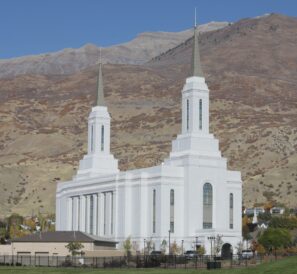
COMER: Compassionate and committed describe Elder Clark G. Gilbert
-
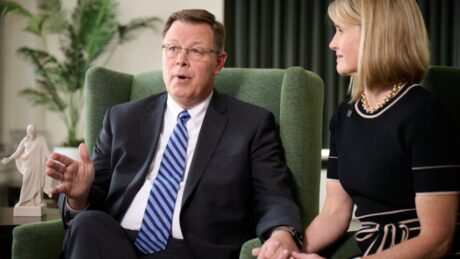
- Elder Clark G. Gilbert and his wife, Christine, speak about his new call to the Quorum of the Twelve Apostles from the Joseph Smith Memorial Building on Temple Square in Salt Lake City on Thursday, Feb. 12, 2026.
-
- Ryan Comer
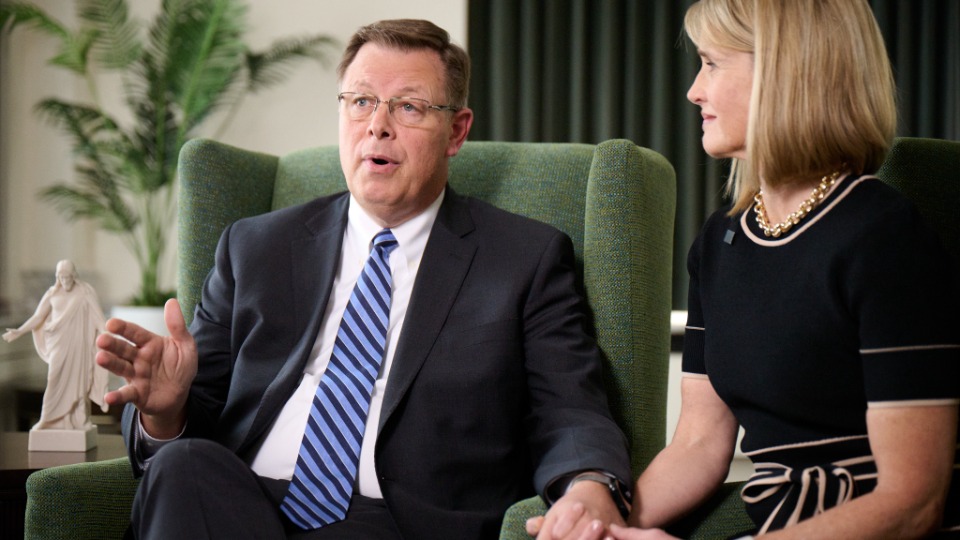
Photo supplied, Intellectual Reserve
Elder Clark G. Gilbert and his wife, Christine, speak about his new call to the Quorum of the Twelve Apostles from the Joseph Smith Memorial Building on Temple Square in Salt Lake City on Thursday, Feb. 12, 2026.
In an interview with Jane Clayson Johnson on an episode of “Deseret Voices” that was posted on YouTube, Elder Clark G. Gilbert, the newest apostle in The Church of Jesus Christ of Latter-day Saints, was asked what he would say to those who feel alone or on the margins or that they don’t belong in the church.
Elder Gilbert recounted an experience with a woman in Ogden.
“Left Utah as a young 20 year old, moved to California,” he said. “Terrible marriage, physical abuse, left the church, lost her faith, and in her 50s, moved back here to Utah. And she started having feelings that ‘the Lord wants me back,’ and she went to the Layton temple open house, parked her car there, and she just couldn’t get out of the car. She was paralyzed. Didn’t feel worthy. Didn’t feel like she should even be there. And she said in her heart, ‘Today, just being at the parking lot is gonna have to be good enough.’ And then the two sister missionaries knocked on her window and said, ‘Are you here for the temple open house? Can we take you through?’ And she didn’t feel worthy, and she didn’t feel like she belonged, but the invitation was there.
“And to those who struggle, I just say to them, we love you. We’re praying for you. God loves you. He wants you back. He’s beckoning you to come back.”
Two words come to mind when I think of what the apostolic ministry of Elder Gilbert will be like: compassionate and committed.
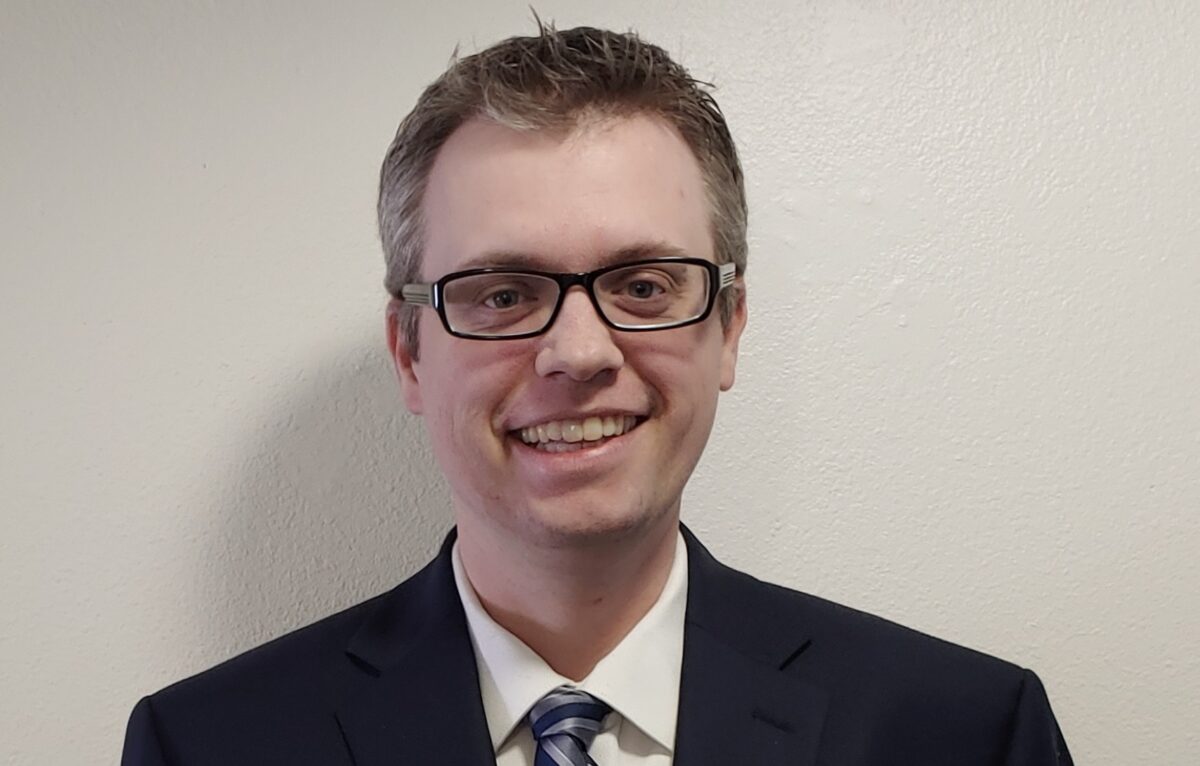
Ryan Comer, Standard-Examiner
Ryan Comer
He speaks genuinely with love about wanting people to feel like they belong in the church, but he is also clearly committed to upholding the doctrine of the church and not compromising on it.
“It is so hard,” he said about meshing the two concepts, “and I think it will be one of the great tests of disciples in the last days – standing for truth with love. And if we aren’t careful, we’ll equivocate on truth because we feel pressure. But, also, if we aren’t following the Savior, we’ll do it in a way that’s combative and not with love for others. And the Savior always, always forgave. He had an infinite capacity to forgive. But he never once said, ‘Because I love you, you’re free from following my commandments.’ And, you know, we’re tasked with that same balance.”
Later in the interview, he called it a misconception that moving away from light and truth will bring happiness.
“And so, if you really love someone who’s struggling, you’ll have empathy and care and concern, but you’ll also point them back to the words of the Lord, because it’s God who loves them more than we do. … And that’s our call, is to point people to the Savior, and the Savior wants them to find truth and light in their lives, and that will lead to greater happiness,” he said.
Elder Gilbert’s loyalty to doctrine and some of his decisions during his career – which includes having been the CEO of Deseret Digital Media, president of Deseret News, president of BYU-Idaho and commissioner of the Church Educational System – have been criticized, and those criticisms were addressed in the interview.
“You know, I think some of those criticisms really come from the fact that we had to do really hard things and often things that were very different than maybe those industries would do,” Elder Gilbert said. “I led a media organization. I led academic organizations. Those tend to be settings where the dominant framework is very much a secular framework. And so to have the audacity to say the dominant framework for us would be the gospel of Jesus Christ – I think that was really hard for a lot of people.
“And one of the blessings of the restoration is that brings with it a moral clarity. And … I have a book, Jane, sitting on my desk that has been there the whole time I’ve been the commissioner called ‘The Dying of the Light.’ And it’s the decoupling of higher ed from its religious moorings. And it goes through how all of these schools that started out as religious lost their way. And one of the things we really knew we could never let happen in the Church Educational System, and especially at BYU, was to walk away from our religious mission.”
Elder Gilbert also invoked President Jeffrey R. Holland, who died in December.
“BYU had slipped, and there were a lot of pressures for BYU to be just like the world,” Elder Gilbert acknowledged. “People would say, why do we have these religious standards? Why do we do all these things? And I remember I was talking to President Holland, and he was bemoaning that he could feel this drift happening to the university. And he’s like, ‘What have they done with our school that we love so much?’
“And I felt awkward. I wasn’t even the commissioner yet. And I felt like I needed to defend them. And I said, ‘Well, President Holland, you know, we have the honor code. We have devotionals. We have religion classes. We have the academic freedom policy.’ And I said, ‘They’re like bumper lanes, protecting us from bowling into the gutter.’ And he didn’t even let me finish, and he said, ‘That’s very different than bowling for a strike.’ And he said, ‘We need to bowl for a strike at BYU.'”
According to Elder Gilbert, there is an exit survey conducted at BYU that asks if people grew closer to Jesus Christ while at the school. The change over the last five years has been noteworthy.
He said five years ago, it was 75%.
“Much lower than the rest of our institutions,” Elder Gilbert noted.
The next year, he said, it was 77%. The year after, it was 83%. Last year, according to Elder Gilbert, it was 87%.
“And there’s real momentum there,” he said. “What’s remarkable, though, is the faculty. They wanted this. They live in the same pressures that we feel. And they wanted to stand up and be distinct and different. And with all of that change, over 90% of our faculty report high satisfaction and support as faculty at that university, higher than almost every other secular comparison. … And I’m sure there are a few who are like, ‘Well, I wanted this to be more like University of Pennsylvania or Cal Berkeley or some other school.’ But the majority came to BYU because they loved its mission and they wanted to be different, and when you have 90% of the faculty expressing satisfaction, that’s an amazing data point.”
Elder Gilbert mentioned that BYU had a record number of applicants this year.
“Students are thrilled,” he said. “I get letters from parents saying, ‘Thank you. This is the place I wanted my son to be. Thank you for letting it be different.’ And I love all of those, but our mark was set by the Lord and his prophets, and we’ve stayed true to that. And sometimes that isn’t always popular, but it was always in the end easy for me to come back to that because there’s clarity in setting your mark to those targets.”
Personally, I think back to the reason I went to BYU. I went to BYU specifically because I wanted to go somewhere unique, where I was going to be around people who shared my beliefs and standards.
I grew up in the Seattle area and was often the only Latter-day Saint in my classes at school. I knew all about what it was like to have people around me in school who didn’t share my faith and who thought my religious beliefs were strange, and the appeal of BYU for me was that I could finally feel what it was like to be around people who did share my faith, who didn’t think my religious beliefs were strange. I wanted to live my faith and not be treated as if there was something wrong with me for it. I didn’t want to deal with various pressures and temptations that I felt would be prevalent at another university.
At the end of the interview, Elder Gilbert was asked for his message to those both inside and outside the church.
To those outside the church, he emphasized the need to stand up with confidence for values, character and faith in public.
“Our nation needs faith,” he said. “The world needs faith. If you look at every measure of human flourishing, how correlated it is to faith practice and faith engagement. The world needs us; the nation needs us to all be engaged.”
To members of the church, he said it’s an “amazing” but “difficult” time, but the fact that it’s difficult isn’t surprising.
“Past and current prophets have told us before the Savior’s return that good would be called evil. Evil would be called good. The world would be in commotion,” he said. “I mean, you can see this from the Apostle Paul all the way back in 2 Timothy 3 when he was prophesying of the return of the Savior, Doctrine and Covenants 45, 1 Nephi, where Nephi’s seeing right before the return of the Savior that it would be a really hard time.
“But it also would be an amazing time. There would be more light and more darkness than ever in the history of the world. In some ways, that makes it really hard on us. We live in polarized, difficult times. In other ways, it makes the clarity of the gospel of Jesus Christ brighter than it’s ever been. And I would say to our members and to our nonmembers, look for the light of the Savior. He’s beckoning us all to come to Him, and He will return to the earth. This is a critical time in the history of the earth. As President Oaks says, this is real. Let us be part of it. What a time to be part of the gospel of Jesus Christ.”
Contact Ryan Comer at rcomer@standard.net.