COMER: Jeffrey R. Holland’s impact best told by his children
-

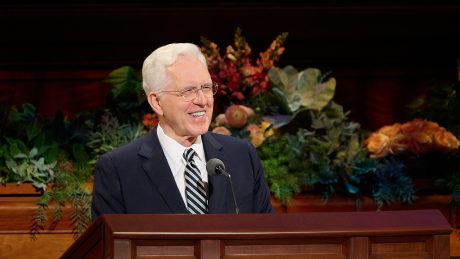
- President Jeffrey R. Holland, acting president of the Quorum of the Twelve Apostles, gives the first speech during the Saturday morning session of general conference at the Conference Center in Salt Lake City on April 5, 2025.
-
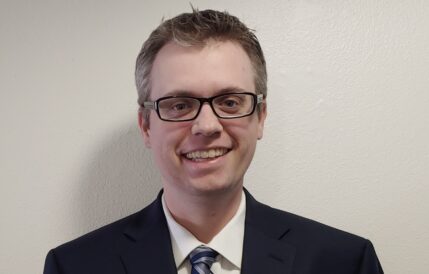
- Ryan Comer

Photo supplied, Intellectual Reserve
President Jeffrey R. Holland, acting president of the Quorum of the Twelve Apostles, gives the first speech during the Saturday morning session of general conference at the Conference Center in Salt Lake City on April 5, 2025.
Following the death of President Jeffrey R. Holland, president of the Quorum of the Twelve Apostles in The Church of Jesus Christ of Latter-day Saints, early in the morning on Dec. 27, the Daily Mail ran a headline that said, “Controversial leader of Mormon Church Jeffrey R. Holland dies aged 85.”
The justification for such a headline was explained using two words in big block letters at the top of the article in the headline space: defending marriage.
President Holland was apparently controversial because he defended marriage.
That’s where we are as 2026 starts.
If I wasn’t used to the despicable language and framing choices of much of the news media, I would be a lot more outraged.

Ryan Comer, Standard-Examiner
Ryan Comer
But instead of complaining, I wanted to take this opportunity to highlight who President Jeffrey R. Holland really was. Not according to some random person who almost certainly has no knowledge whatsoever, but according to his own children – the people actually raised by him.
I think what they have to say about their father is much more credible.
David Holland
Speaking about an incident during a family summer car trip in which there was a vehicle stalled in the road in a dangerous position, David Holland said his father came to the rescue of the elderly people inside.
“He reassured them, got in the driver’s seat of their stalled car, told my brother to watch for any oncoming semitrucks barreling around the bend, and as I recall, put the car in neutral, let it roll down the gully, popped the clutch,” David Holland said. “The engine roared, he reversed, shot back up onto the road, crossed two lanes of traffic backward, avoided the cliff on the other side and calmly returned it like a valet to the grateful owners, the formerly stalled engine now running.
“After watching this, I came to the only conclusion that a young boy in those circumstances could possibly reach: My dad is Superman.”
According to David Holland, his father had an “ever-optimistic determination to do good for those around him,” a “recognition that even the best of intentions have to contend with the gravitational forces of a fallen world” and “genuine joy in laughing at himself.”
Said David Holland:
“As it turns out, even in his limitations, or maybe especially in his limitations, my dad remained and remains my hero.”
Regarding President Holland’s public ministry, David Holland noted:
“I suppose that there have been weeks during which no one has approached me to tell me that his words had changed their lives, but I am sure I have never gone a full month without such a comment, and I never tire of hearing it. Because the truth of the matter is that as for so many others, his messages also powerfully rescued my faith and healed my wounds and renewed my hope and gifted me a redemptive vision of Christ’s love.
“I have sat in those congregations, I have watched those conference sessions, I have felt what you felt when he spoke.”
David Holland mentioned a few talks his father had given and noted a central detail connecting them that possibly spoke to the reason for their resonance.
“They each, I realize, rest on the image of a father literally running to embrace his child,” David Holland said.
He continued:
“This was, I believe, so much more than mere literary motif. This image contains both the essence of my dad’s approach to parenthood and his irrepressible testimony of the character of the God who is the father of us all.
“I say this as the child in need to whom he has both figuratively and literally run.
“I have spoken publicly before about the night my dad raced a thousand miles to knock on my door during a period of trial. Had I the time, I could recount to you a thousand other moments when he has heard my cry and come running.
“Many of those within the sound of my voice today know him as a gifted orator, an elegant writer, a deft leader, and a devoted minister. And he was all of these things to a remarkable, even astonishing degree. And he was an even better father, whose recurring image of the parent who runs to his children was not just a beautiful illustration for a sermon. It was the very spirit and substance of the dad I knew. It was the most important shared commitment of my mother and my father, this powerful pair of equally yoked servants who tirelessly made sure their children knew they were never alone.
“Unfailingly, when they ran to our need, they did so to point us to the source of strength far greater than even the greatest of earthly parents, a Heavenly Father whose defining quality is his love for his children.”
David Holland said his father “desperately wanted us to trust the God he knew so well and served so faithfully and loved so deeply,” and that “he taught us to find that succoring God in the life and love of Jesus Christ.”
Mary Alice McCann
President Holland’s daughter, Mary Alice McCann, spoke of her father’s compassion, awareness and testimony.
She called him her “physical, tangible evidence of divine love every day of my 56 years.”
She noted how when she was a child, she would be too frightened to go to sleep alone at night, so her father would lie on her bedroom floor, with his foot on the edge of her bed. She would hold his ankle, foot or big toe until she went to sleep.
“I remember once begging him not to leave until I was sound asleep,” she said. “He promised me he wouldn’t, but I asked him, ‘How will you know when I’m asleep?’ He said, ‘I know you. I know everything about you. I know simply by the way that you breathe when you are asleep and when you are peaceful.'”
She spoke of the things he knew about her.
“In my teenage years, he could tell by the way I held my shoulders whether he needed to take me on a drive, share a bowl of ice cream or hold me while I sobbed,” she said. “As an adult, even over the phone, he could hear the slightest catch in my voice, and ready with reassurance, he would not let me go until I felt peace. No matter my despair, my fear or my heartache, his consoling counsel would always end with, ‘Mary, be peaceful.'”
She added:
“It’s a somewhat frightening and lonely feeling to be left on this Earth without the man who has made the world safe for me. But like the Savior left his disciples with a comforter even greater than he, my father has left me with something even greater than his physical presence. He has left me with a testimony of and a relationship with the Savior Jesus Christ, who is my ultimate source of comfort and peace.”
McCann spoke of how “with all the blazing fire of his being,” her father loved the gospel of Jesus Christ and the church that administers it on the Earth.
“If my mother loved a testimony of the gospel into our hearts, he burned it into our souls,” she said. “His passion for the church of Jesus Christ was deep in the marrow of his bones. When he held my face in his hands, locked my gaze with his Irish blue eyes and testified to me of the love of the Savior, I simply had no choice but to believe. His conviction was contagious.”
Upon hearing that, I couldn’t help but think back to words shared by President Holland during an April 2003 general conference talk titled “A Prayer for the Children,” in which he stated:
“Nephi-like, might we ask ourselves what our children know? From us? Personally? Do our children know that we love the scriptures? Do they see us reading them and marking them and clinging to them in daily life? Have our children ever unexpectedly opened a closed door and found us on our knees in prayer? Have they heard us not only pray with them but also pray for them out of nothing more than sheer parental love? Do our children know we believe in fasting as something more than an obligatory first-Sunday-of-the-month hardship? Do they know that we have fasted for them and for their future on days about which they knew nothing? Do they know we love being in the temple, not least because it provides a bond to them that neither death nor the legions of hell can break? Do they know we love and sustain local and general leaders, imperfect as they are, for their willingness to accept callings they did not seek in order to preserve a standard of righteousness they did not create? Do those children know that we love God with all our heart and that we long to see the face–and fall at the feet–of His Only Begotten Son? I pray that they know this.”
Based on McCann’s words, and not surprisingly, President Holland practiced what he preached.
McCann also spoke of the emphasis her father put on hope.
“He believed in the redemption of Jesus Christ, and that through him and because of him all things would be made right – if not today, tomorrow. If not tomorrow, next month or next year. And if not in this life, then in the next,” she said. “But the promise of the atonement of Jesus Christ is that all things will be made right. So hold on. Hold on with all of your might until they are, and whatever you do, do not let go of the church that can bring you to him.
“My dad was able to succor the weak, lift up the hands which hang down and strengthen the feeble knees. But it was not because he could do the lifting and the strengthening. It was because he knew the sustaining powers of the Redeemer of the world, and his passion was to give that knowledge to all who are faint of heart.”
Speaking directly to her father’s 13 grandchildren, McCann made a plea, which she said could be applicable to every church member. As I heard her say it, I thought how proud he must be that this is the fruit of his ministry and efforts.
“While this is a very sad day for this family, there is only one thing that could make this day truly sad in any sort of an eternal way, and that would be for us to turn our backs on the gospel of Jesus Christ to which your grandparents dedicated their lives,” she said. “The only way we could break their hearts is to abandon the source of truth and light that they lived and died to show us. Now it is time for each of us to pick up their baton and to carry on the fire of faith that they’ve flamed within each of us.”
Matthew S. Holland
Matthew S. Holland, a member of the Seventy, said his father “was an irresistible force for righteousness.”
He added:
“His unique gifts for friendship, intellect, language and mirth disarmed and drew in virtually anyone who came within his orbit.”
Matthew S. Holland spoke of his father’s priorities.
“My father could have easily used his world-class gifts for world-class honors and riches,” he said. “Instead, across his entire career, he channeled virtually everything he had — those legendary gifts, plus his time, his astounding work ethic and his fierce sense of determination — into bringing people to Jesus Christ and his church.
“Except for spending time with his beloved wife and children, nothing brought him as much joy.”
Emphasizing his father’s determination, Matthew S. Holland expounded on his father’s lengthy stay in an intensive care unit two and a half years ago. President Holland has spoken a little of that experience, saying:
“Virtually all my experience in the hospital during that first period is lost to my memory. What is not lost is my memory of a journey outside the hospital, out to what seemed the edge of eternity. I cannot speak fully of that experience here, but I can say that part of what I received was an admonition to return to my ministry with more urgency, more consecration, more focus on the Savior, more faith in His word.”
Matthew S. Holland said that while in the ICU, his father awoke one morning at 4 a.m. due to thirst and called for juice. A young nurse responded, Matthew S. Holland said, and then a conversation ensued between the nurse and President Holland.
“After a few minutes, I sensed something important and personal was unfolding, and I stepped out,” Matthew S. Holland said. “Sometime later, the nurse emerged from the room crying. I asked if everything was OK. The nurse looked me in the eye and said, ‘I have to go back to church. After an experience like that, how could I not?’
“Again and again in the last two and a half years, I watched President Holland push past all of his own intense personal, physical challenges to bring love, laughter and the light of Jesus Christ to others in life-altering ways. This final and perhaps most admirable chapter of his life was a master class in being a disciple of Jesus Christ at all times and in all things and in all places.”
Matthew S. Holland spoke of his father’s faith and humility, highlighting that he never expressed an attitude that because of his ministry he was somehow entitled to a comfortable conclusion to his earthly life.
“In 30 straight months of kidney failure and nightly dialysis, leg-crippling neuropathy, searing shoulder pain from arthritis and difficulty in breathing, I never once heard him cry out that he felt unjustly dealt with by God,” Matthew S. Holland said. “Instead, I heard him regularly thank God and admonish trusting in God more frequently and fervently than ever before.”
Matthew S. Holland told of a parable his father shared on a Sunday night following a “Come, Follow Me” discussion that involved Matthew S. Holland, his wife Paige, a couple of their children and President Holland.
Recalled Matthew S. Holland:
“As we concluded, my father shared the following:
“‘Children, there was once a diligent farmer who tried to do everything right. He never worked on Sunday. He always paid his tithing. He regularly served others with kindness and generosity. But come October, his fall harvest was paltry. By contrast, his neighbor was a vain and worldly man. He worked every Sunday. He hoarded every dollar he ever made. He acquired additional lands through questionable means. Yet, come fall, the worldly farmer enjoyed a bumper crop. In his vanity, the worldly farmer gloated about this to his poor neighbor.’
“At this point in the story, my father’s voice broke and tears started to trickle down his face as he continued.
“‘The righteous farmer replied, ‘God does not settle his accounts in October.”
“Whatever other virtues my father had, the greatest source of his sweeping, righteous influence was his faith, his deep, rock-ribbed conviction that Jesus Christ is always and forever the unimaginably generous rewarder of them that diligently seek him. Nothing – absolutely nothing – could persuade him that God was anything other than a high priest of good things to come and that the restored gospel was a true gospel of happy endings, particularly for those who do their best to keep the commandments, receive their priesthood ordinances and honor their eternal covenants.
“Such faith is the thing we all most need and the thing he most wanted to share.”
Matthew S. Holland said that 3:15 a.m. on Dec. 27, 2025, marked “the beginning of the happiest endings” for his father, who he called “the most deserving man I have ever known.”
The positive and inspiring adjectives that could be used to describe President Jeffrey R. Holland based on his children’s words are numerous. How lucky we would all be if when we left this Earth, the people we were closest to described us in the way that President Holland’s children described him.
The most important thing that could be said about President Holland would be from the Lord, who I – and I’m sure every other faithful Latter-day Saint – can well imagine saying to President Holland, “Well done, thou good and faithful servant: thou hast been faithful over a few things, I will make thee ruler over many things: enter thou into the joy of thy lord.”
Contact Standard-Examiner editor Ryan Comer at rcomer@standard.net.
Faith
Raise your voice: Annual Ogden Interfaith Concert goes to new venue Sunday; continues emphasis on local talent
General conference: Dallin H. Oaks teaches that Jesus Christ’s invitation is for all; Uchtdorf highlights unity