COMER: President Oaks stresses the importance and necessity of humility
-
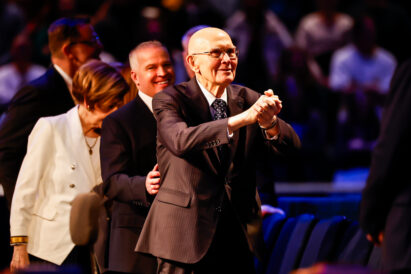
- President Dallin H. Oaks of The Church of Jesus Christ of Latter-day Saints, accompanied by his wife, Kristen, and Brigham Young University President C. Shane Reese, greets students and faculty in the Marriott Center in Provo on Tuesday, Feb. 10, 2026.
-
- Ryan Comer
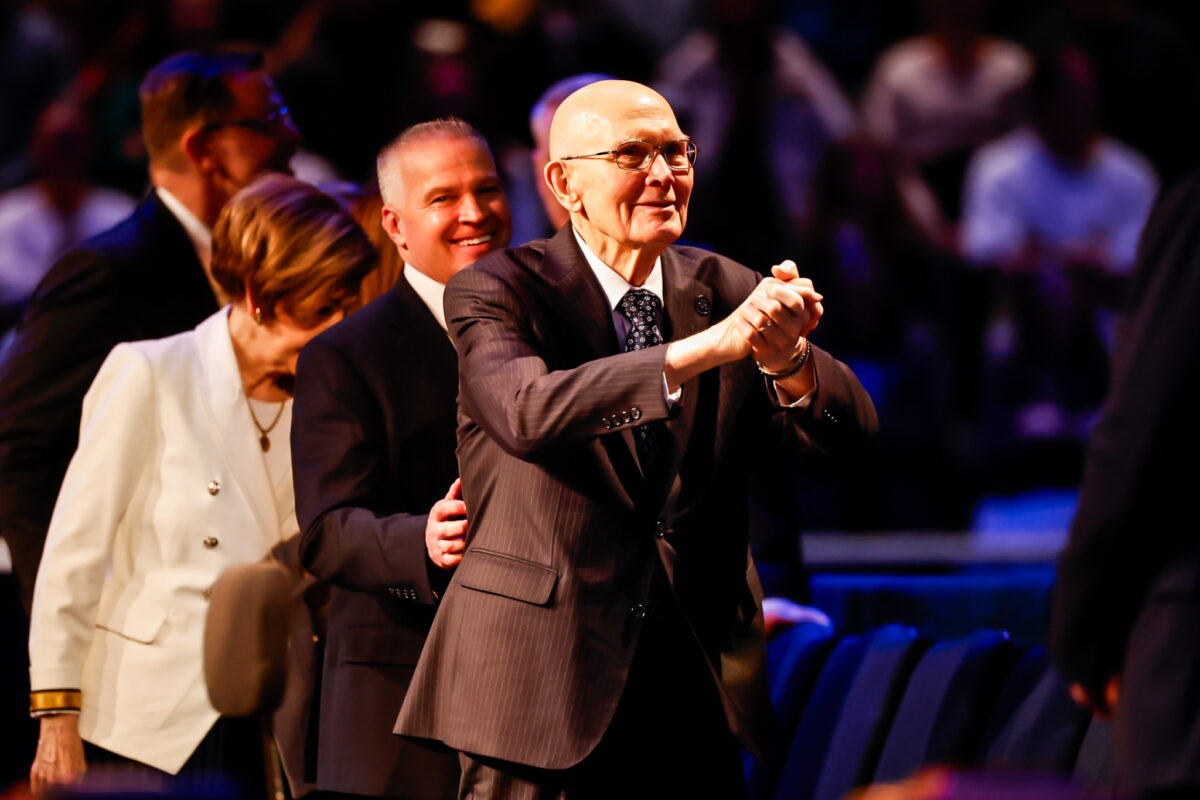
Photo supplied, Intellectual Reserve
President Dallin H. Oaks of The Church of Jesus Christ of Latter-day Saints, accompanied by his wife, Kristen, and Brigham Young University President C. Shane Reese, greets students and faculty in the Marriott Center in Provo on Tuesday, Feb. 10, 2026.
In talking about drawing closer to Jesus Christ in order to overcome doubts during a devotional at BYU in February, President Dallin H. Oaks, president of The Church of Jesus Christ of Latter-day Saints, shared four impressions.
A significant portion of his remarks were focused on the second impression: humility.
“When we are humble, we can more clearly hear the Lord’s voice,” he said.
Humility is a virtue that I think most people recognize as good and important, but I wonder if we might not quite understand just how necessary it truly is. I certainly gained a greater understanding of its significance after listening to President Oaks.
“Like faith in God, humility is a master virtue, given to help us learn other virtues necessary for us to become what our Heavenly Father and His Only Begotten Son created us to become,” he said.
Ryan Comer, Standard-Examiner
Ryan Comer
As I try and contextualize that in my mind, I think of a room, a place where I ultimately want to go. In order to get into that room, I have to go into another room and study. But in order to get into that room to study, I have to unlock the door. Humility is like the key that unlocks the door. Without humility, not only can I not enter the room where I ultimately desire to go, but I can’t even learn the important things I need to learn to get there.
So humility really isn’t optional. It’s not really a virtue that one can think about and say, “Well, I just don’t have that. That’s not me,” and hope it all somehow works out for us in the end. If we want to become all that we are created to become, we must have humility.
President Oaks quoted from a former president of the church, Spencer W. Kimball, who said humility was being able to be taught.
“Humility is … an ability to realize that all virtues and abilities are not concentrated in one’s self. . . .” President Oaks quoted President Kimball as saying.
“. . . Humility is never accusing nor contentious. . . .
“Humility is repentant and seeks not to justify its follies. It is forgiving others in the realization that there may be errors of the same kind or worse [that we ourselves commit]. . . .
“Humility makes no bid for popularity and notoriety; demands no honors.”
Following up on those remarks, and highlighting the necessity of humility, President Oaks said:
“To have humility is one of the powerful commandments we have been given to guide us in our mortal journey. It prepares us for our appointed meeting with our Savior and Redeemer, Jesus Christ. Take care not to become distracted. Remember His parable of the ten virgins. We want to be among the five humble ones who were admitted to the presence of the Lord.”
President Oaks acknowledged those who make choices not to grow spiritually and said people with “diminishing faith and activity in the restored Church are a major source of concern to your prophet leaders.” He said the leaders – and the Lord – love them.
“God is relentless in His loving pursuit of each of you,” he said. “Keep the commandments and be true to the covenants so many of you have made to guide you along the covenant path. Never let your secular learning limit your horizons.”
That last sentence dovetails with a key reason humility is important, which President Oaks addressed.
“We are grateful to know that there are two methods of gaining needed knowledge: (1) the evolving disclosures of man discovered by the scientific method and (2) the truths disclosed by the spiritual method, which begins with faith in God and relies on scriptures, inspired teaching, and personal revelation,” he said. “There is no ultimate conflict between knowledge gained by these different methods because God, our omnipotent Eternal Father, knows all truth and beckons us to learn by both methods.
“Those who don’t believe in God, who formally reject traditional religious morality, and who rely solely on the tests of scientific evidence fulfill a Book of Mormon description of those ‘who live without God in the world.’
“Elder Richard L. Evans had a good answer for those who are caught off balance by some scientific evidence that seems to be contrary to what we interpret from the scriptures:
“‘There may be some seeming discrepancies. Do not worry about them. Eternity is a long time. I have a great respect for learning, for academic endeavor and the university atmosphere. . . . I have a great respect for science and scientists and for the search for truth. But remember this: science after all (even when it is true and final and factual) is simply man’s discovering of a few things that God already knows and controls in his ordering of the universe. . . . God has not told us all he knows. We believe in continuous revelation. Be patient. Keep humble and balanced in all things.’
“Humility, faith, and trust in the Lord are the remedies for wavering. As the Book of Mormon teaches, the Lord ‘doth bless and prosper those who put their trust in him.’ Trusting in the Lord is a particular need for all who wrongly discount the commandments of God and the teachings of His prophets by measuring them against the latest findings and wisdom of man.”
If we knew everything that God knows, we would see no scientific contradiction in anything. It’s precisely because we don’t know all that God knows that we take certain scientific data and claim there’s a contradiction.
It takes humility to recognize that we don’t have all the answers, and it takes even more humility to acknowledge that the conclusions we think are obvious from what we do know from science may not be exactly what we think.
I have heard it said, “Well, that’s just not fair for God to expect me not to believe what science seems clearly to be telling me.” To that, I would say that if humility is what is required, and that it is a virtue of such critical importance that it’s what is required to unlock the ability to learn other virtues necessary to fulfill our divine potential, then we shouldn’t expect it to be easy. We should expect humility to be challenging, which means that we should be expected to possess it even in difficult circumstances, like when science leads us to a conclusion we think contradicts faith.
How badly do we want to return to Heavenly Father and Jesus Christ? How much are we willing to show them that we want to return to them? Are we willing to be humble even in extremely difficult circumstances?
President Oaks said we all need people to help teach us humility, and he recounted an experience he had during his first year as a professor at the University of Chicago Law School.
President Oaks said he had been asked to temporarily teach the classes of a famous faculty member who had died.
“The legal subject was one with which I was not very familiar, so I struggled hard and finally felt like congratulating myself on fulfilling the assignment,” President Oaks recalled.
“Afterward, a student gave me what I thought was going to be a compliment. He said, ‘Mr. Oaks, I was in that class you taught for Professor [so and so], and I must tell you I was really impressed. You will make a good teacher someday.‘
“Why did that experience help me? I was overly confident in my abilities as a teacher, and that student provided a perspective that has blessed me to this day.”
I think we all have experiences – rather frequently, actually – where our humility is tested. Someone says something or does something and we’re put in a position where we have to make a choice whether we want to react with pride or humility. If you’re like me, you may not even recognize these moments when they’re happening. They may be completely unexpected. Thus, I just react, and sometimes the result isn’t what I later realize was best.
But I’ve also noticed that humility is a mindset. If I’m looking to be humble, it’s easier to be humble when certain situations arise that test me.
President Oaks quoted another former prophet, Ezra Taft Benson, who said that “the antidote for pride is humility–meekness, submissiveness.” Continuing to quote from President Benson, he said, “Humility responds to God’s will–to the fear of His judgments and to the needs of those around us,” and “Let us choose to be humble.”
President Oaks said humility follows when you look to the needs of others.
Contact Ryan Comer at rcomer@standard.net.