UV Crew at work: Weber State group bringing awareness to the threat of skin cancer
Weber State group bringing awareness to the threat of skin cancer
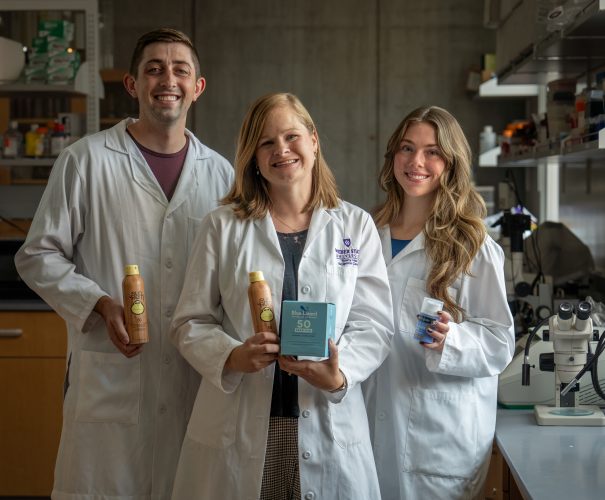
Photo supplied, Weber State University
Gennie Parkman (center), WSU human anatomy and physiology assistant professor, has begun gathering student researchers such as Matthew Farr (left) and Ashlynn Peterson (right) to form the UV Crew to help spread information on skin cancer and how to prevent it. (Photo supplied, Weber State University)OGDEN — Summer is in full force, but it’s not just the heat that people need to look out for.
A Weber State University press release recently led off by pointing out that Utah has the highest per-capita rate of melanoma in the country, but WSU is aiming to help curb this trend. The release introduces readers to the UV Crew, which aims to educate the public about the dangers of skin cancer, how to avoid it and counter misinformation that is building around the subject.
“I teach Biology of Cancer every fall at Weber State,” Gennie Parkman, WSU human anatomy and physiology assistant professor, told the Standard-Examiner in an email. “The course was started many years ago by my former colleague, Barb Trask, and as a cancer biologist, it’s probably my favorite class to teach. My PhD research focused on melanoma, so it’s a disease I’m particularly passionate about. Today, my research lab studies the genetic changes that drive melanoma development and why some tumors become resistant to treatment, and we have incredible collaborations with melanoma experts at Huntsman Cancer Institute and University of Washington.”
But one of the biggest collaborations has been between Parkman and her students.
“Every year, I have students who become interested in melanoma research and join my lab, and they are fantastic researchers,” she said. “But I also realized that while research is incredibly important, preventing melanoma before it ever develops can have an even greater impact. Last fall, I asked my students if they’d be interested in creating a public health initiative focused on skin cancer prevention. The response was overwhelmingly positive.
“We quickly realized it would take more than a single semester to build, so what started as a class project grew into a student organization. Students from that fall course continued meeting in the spring, recruited other Weber students who shared a passion for community service and science communication, and together we launched the Weber State UV Crew.”
According to the release, there are 10 students involved in Parkman’s research as part of the UV Crew. She said that the group came together this spring for the first time.
“So far, we have only had one big event, our outreach day at Lagoon, which we are hoping to make an annual event based on interest,” Parkman said. “We are now planning for many more starting next spring and have received many awesome suggestions for how we can partner with community and Weber State members, such as community health fairs, school outreach events, and local educational programs. We will also be at the Weber State Lab Safety Day on September 9.”
She said that several factors have combined to make Utah a melanoma hotspot.
“First, Utah receives a tremendous amount of sunshine each year, and many of our recreational activities (skiing, hiking, biking, climbing, boating, and running) take place outdoors,” she said. “The higher elevation also means we’re exposed to more intense ultraviolet (UV) radiation because there’s less atmosphere filtering the sun’s rays. Winter recreation also plays a major role. Many people don’t realize that fresh snow can reflect up to 80% of UV radiation, effectively increasing UV exposure during activities like skiing and snowboarding. People often think of sun protection as a summer issue, but Utah’s mountains can expose you to significant UV radiation, even on cold winter days.
“Utah’s climate also contributes to our high UV exposure. Our dry air, low humidity, and abundant clear, sunny days mean we receive high cumulative UV doses throughout the year. Even when temperatures are cool, UV radiation can still be quite strong. Finally, Utah has a predominantly fair-skinned population, and lighter skin naturally has less melanin to protect against UV damage. When you combine fair skin with high UV exposure and an active outdoor lifestyle, the risk of melanoma increases substantially.”
Parkman said that skin cancer hasn’t been spared an uptick in misinformation, especially online.
“I do think social media has made misinformation spread faster,” she said. “The challenge is that health information is often presented without context, and a confident voice online isn’t always an informed one. That’s why we focus on helping people understand the science in a practical, approachable way so they can make informed decisions for themselves.”
She said that examples of misinformation include the belief that having a “base tan” will prevent skin cancer, sunscreen contains harmful chemicals and that sun protection isn’t needed on cloudy days.
Parkman said she’s hopeful that the UV Crew can help break through some of this misinformation by building trust through conversation.
“When people ask questions, we don’t dismiss their concerns,” she said. “We listen first, acknowledge where the confusion comes from, and then provide evidence-based information in a way that’s approachable and easy to understand. Everyone’s questions and perspectives are valuable because they give us an opportunity to have meaningful conversations rather than simply telling people what to believe. That’s one of the reasons I love teaching. Education isn’t about lecturing people; it’s about helping them develop the tools to evaluate evidence, ask thoughtful questions, and make informed decisions.”
She said a big part of keeping that conversation going is making sue the next generation of students can have it.
“Perhaps most importantly, we train students to become effective science communicators,” she said. “Those conversations don’t stop at our outreach events. They continue with families, friends, future patients, and the communities they serve. Every conversation is an opportunity to replace fear or misinformation with understanding, and that’s how lasting change happens.”