Walking the tech tightrope: Tips for finding better life balance in a world inundated with digital technology


-

- Computer tablet stock photo
-

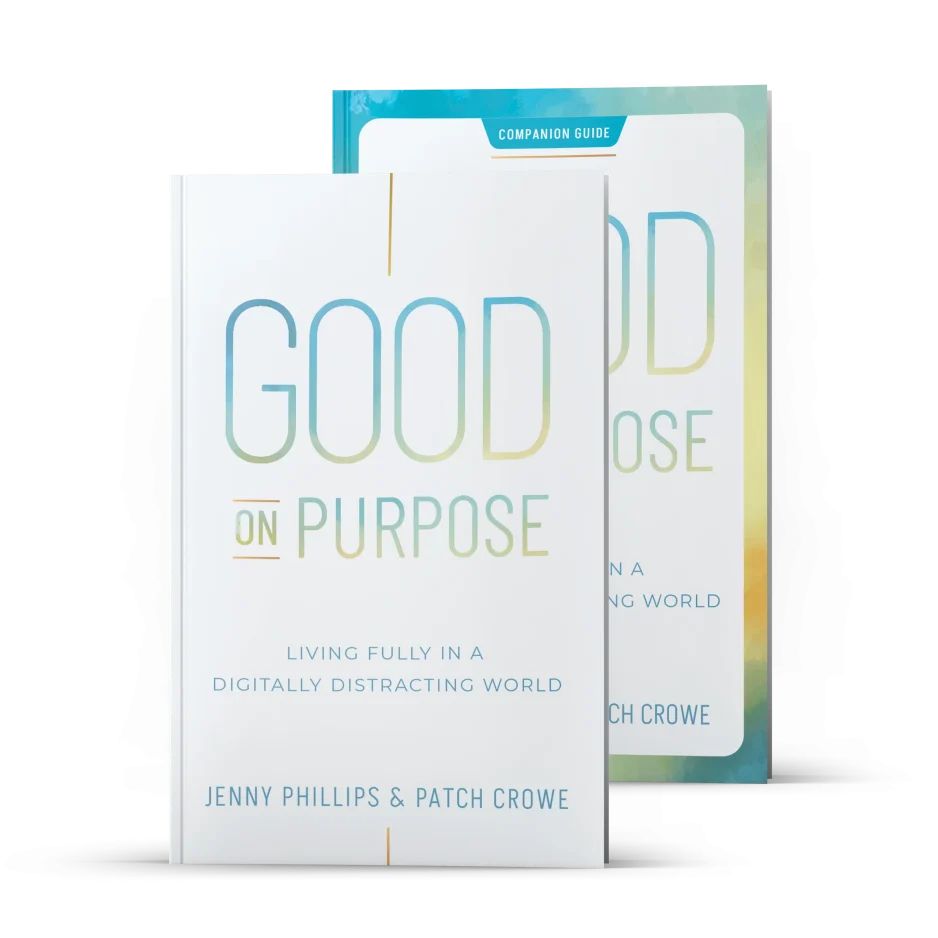
- Patch Crowe’s book is called Good on Purpose.

Ask people if technology has too much influence in their lives and the vast majority will likely respond with a resounding “Yes!”
But if you follow up by asking what they plan to do about it, the answer will likely be a lot less clear.
“We need to remember that we have created systems in our lives that are difficult for us to break out of,” said Patch Crowe, Senior Director of Media at Good and Beautiful Media and co-author of Good on Purpose. “Our brain may say we needed to break out of this, but that’s very different from the moments when we’re laying in bed at 11:30 p.m. and we feel an overwhelming urge to just doom scroll for a couple hours. We can see this this great movement and say, ‘I would love to be a part of it,’ but when it comes time to actually do it, that’s a really difficult thing.”
Crowe has spent recent years researching our relationship with technology and digital media, and now is working to help individuals and families find a better equilibrium in a world of cell phones, computers, tablets and other devices.
He explained how along the way he has come to see powerful personal realities that he wanted to address.
“I didn’t realize how much I was being controlled by my media,” Crowe said. “It’s not like I was opening up Instagram because I had a skill that I wanted to learn. I was stuck in the moment, lacking dopamine in that moment, and there was a trigger that pulled me into the media space to fill that. I think a lot of people don’t realize how deep they are in it right now.”
He saw the impact around his family and started to question what needed to change.
“I’m married and I have three young kids,” he said. “Like a lot of people, unfortunately, I have taught myself (or been taught by society) that my worth is directly tied to my output. It was really hard for me — once work was over — to just put my phone away and disconnect. Another email or message would come in and I started to see the real-life impact that that was having on my demeanor and the way that I interacted with my family. I wasn’t able to be present and intentional with them.”
On top of that, both the quantity of time and the quality of the content on digital platforms is getting more and more concerning.
“On average, someone in the U.S. is spending a little over seven hours a day on screens,” Crowe said. “We feel so attached to them, we feel such a desire and a pull to utilize them. But on the quality side, I don’t think it would be surprising to know that just the the quality of the type of media that’s being presented to us is just getting more sexualized. It’s getting more divisive. It’s getting more provocative. On the quality side as well, we do have to be aware of what is out there and put up correct barriers to allow us to be better at stopping and mitigating those things.”
Here are few ideas that Crowe recommends for everyone as they engage in the process of finding the right tech-life balance:
1. Reduce notifications
Crowe believes that notifications are ruling many lives right now — and it’s not easy to combat their incessant demands.
“I wrote a book on it and I’ve done a lot of research on it, and I still have way too many notifications,” he said. “I don’t need to know that my package just got delivered from Indiana to to Ohio somewhere. I don’t need all the notifications in my life.”
He recommends a notifications audit to see what has value.
“What are things that are actually important to you, and what are things that are giving the perception that they’re helping you, but actually, they’re just another distraction in your life right now?” he said. “That’s something I would definitely recommend.”
2. Remove apps to diminish convenient distratctions
Crowe discussed how easy it is to be manipulated to spend time on applications and social media when they are easily accessible.
“I would say recklessly go through and delete apps off of your phone,” he said. “We just don’t need everything. I have things that I need for work, and I have things that I need for my personal life. Those are the things that are on my phone. If I need to go on Instagram or if I want to go on Facebook or if I need to find tickets for the concert that I want to go to, I have an iPad and I have a computer. Those can be what I call them my intentionality devices. If I want to go on Instagram, I have an intentionality device. I can purposefully go to my iPad, and I can choose to go on Instagram.”
He said he realized it was a problem when he would be answering a text from his wife, only to start scrolling through Instagram and discover 20 minutes had past.
“I’ve purposefully made that separation so that I don’t fall into those traps,” Crowe said.
3. Find places of refuge from technology
While Crowe doesn’t advocate eliminating digital devices, he does recommend being specific about when and where they are used.
“I was intentional about specific areas in my home that we refer to as ‘no phone zones,'” he said. “Dinner time is one area that’s a no phone zone. Bedtime, when I’m putting when I’m putting my kids to sleep at night, those are no phone zones.
Crowe feels like such a simple step has made a big difference with his family relationships.
“It feels a little bit like hyperbole to say this has changed my life, but honestly, I do believe that these tiny, tiny little adjustments that I made have changed my life and have changed the relationship that I have with my kids by being more intentional,” he said.
4. Tailor needs to individuals
Crowe talked about how many parents would love to know the “right” age to give a cell phone to a child, but the reality isn’t that simple.
“Like with 98% of everything about parenting, like there just isn’t a clear-cut answer, and and that’s frustrating for a lot of us,” he said. “Everything is new, and everything is different, and everything is changing, and everything is expanding.”
He believes the key is having open, honest conversations to recognize what is right for different individuals in the family.
“I would have check-ins with them on a regular basis, talking about what are they consuming, how are they feeling, whether there are areas that they want to improve, and when we specifically about media habits,” Crowe said. Then I would create specific boundaries that allow them to grow and progress and work within it.”
He hopes that in the next five years having a family media plan is common everywhere so individuals and families discuss how to find the right balance.
5. Embrace the process
As he said at the beginning, Crowe sees himself as still working to find the right balance despite all of his learning and research.
It’s not that these issues have correct answers as much as it is important to be mindful of the pluses and minuses. Crowe said is what has resonated with people he has talked to.
“The responses that we’ve got have overwhelmingly been in support of something like this,” Crowe said. “I think people have seen a need in this area for so long, and have felt have felt like they weren’t getting the support that they wanted and that they needed.”
For more ideas and information on Crowe’s efforts and the company he works for, visit GoodandBeautifulmedia.com.
Home And Family
Walking the tech tightrope: Tips for finding better life balance in a world inundated with digital technology

Prince Harry warns that AI chatbots may be more dangerous than social media for young users