ATV or UTV? Let a test drive answer the question
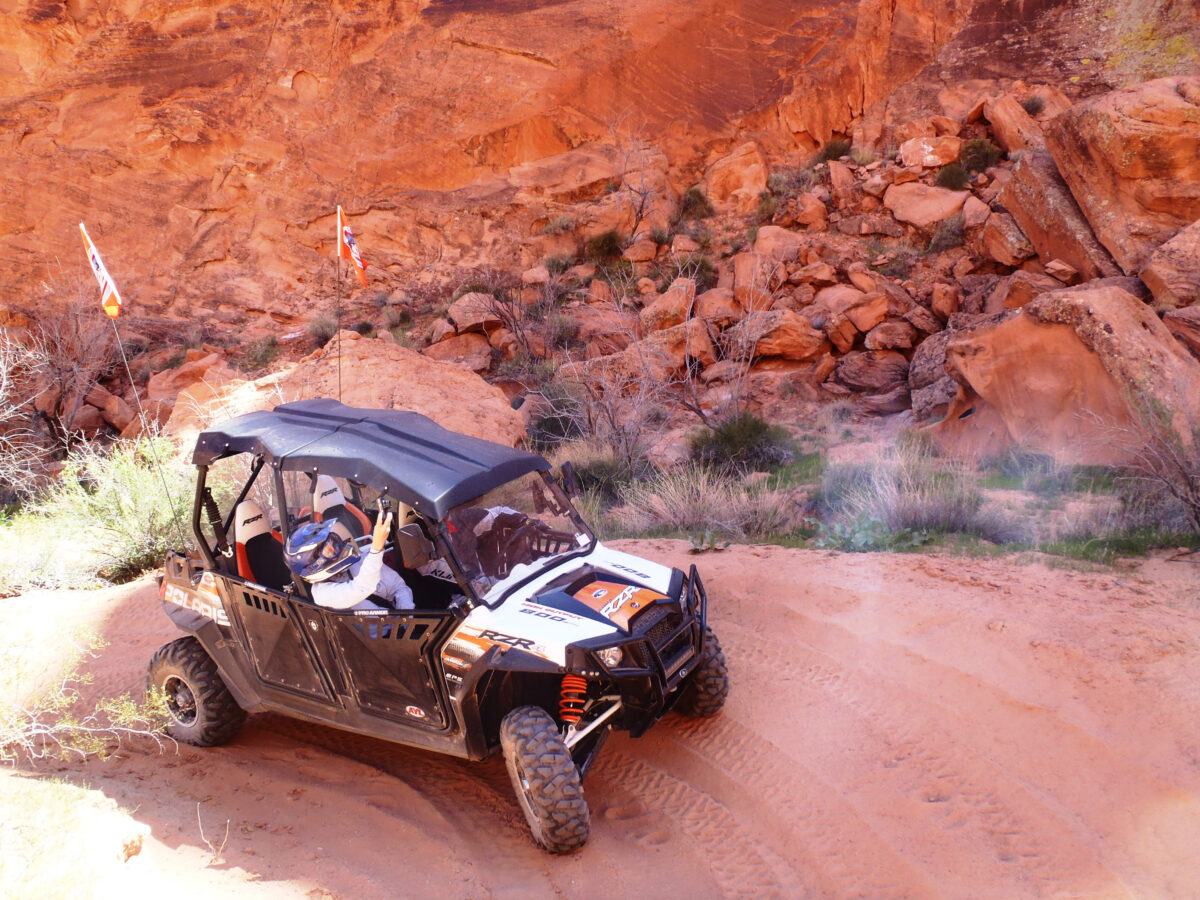
Larry and Carol Sanders ride an RZR4 on the Logandale Trails.
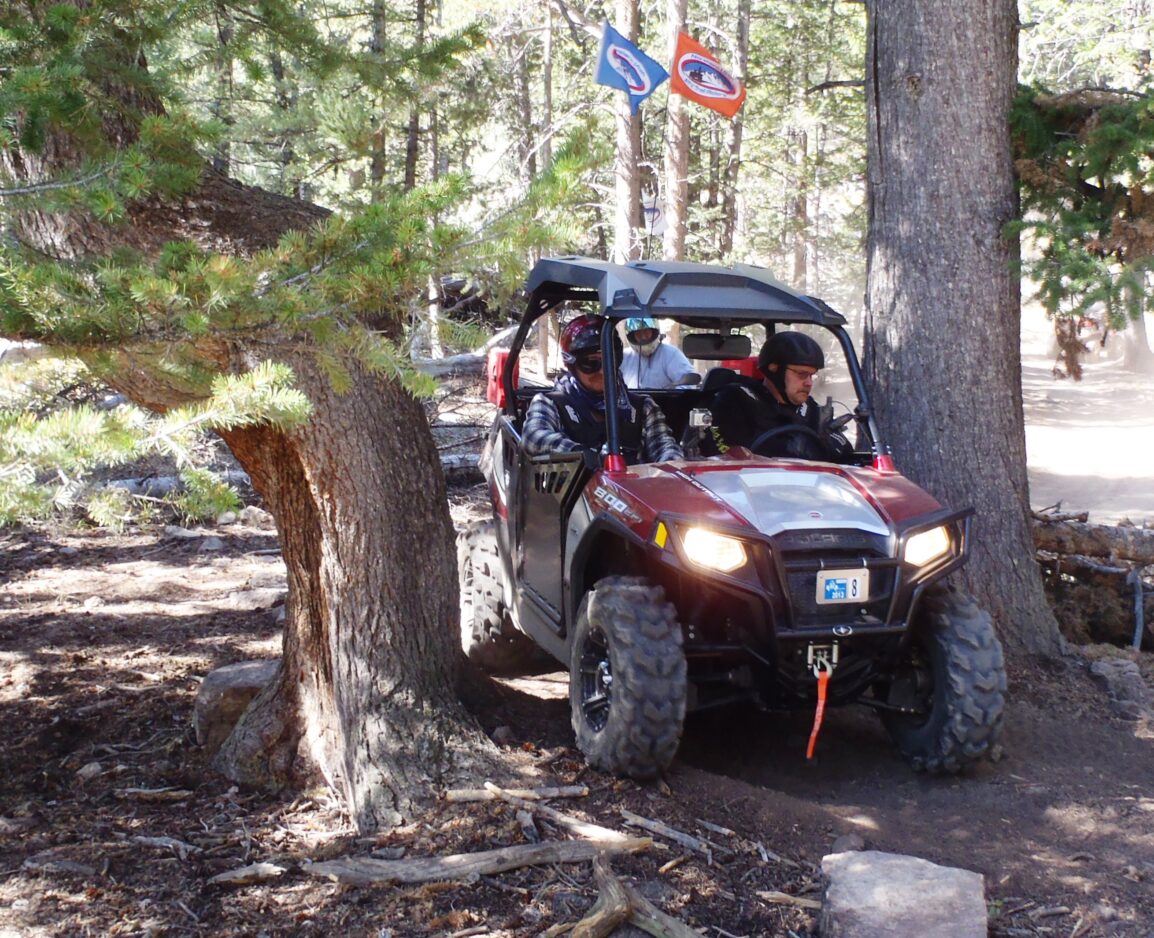
A Polaris RZR negotiates a tight spot on the Highland Trail in Franklin Basin.
It all began in 1970 when Honda introduced the first three-wheeler, called an All-Terrain Cycle. It had no suspension, balloon tires and 90 cubic centimeters of power. It became popular almost immediately and was featured in the James Bond movie “Diamonds Are Forever.”
In 1981 Honda came out with the ATC250R, the first high-performance three-wheeler. Because of patents on design and engine placement, Honda created a virtual monopoly in this recreational vehicle market.
The first four-wheeled All-Terrain Vehicle was developed by Suzuki in 1982. The QuadRunner LT125 had a speedometer and five forward gears, plus reverse. It was designed as a recreational machine for beginners.
In 1987, due to safety issues, ATCs were banned from production in the United States. Legal battles between consumer groups, manufacturers and the Consumer Product Safety Commission caused the industry to switch to four-wheeled vehicles.
The following year, ATV distributors entered into a 10-year agreement with the CPSC called the Final Consent Decree. As a part of the agreement, the ATV industry made a $100 million commitment to expand safety programs, offering free training and incentives to owners and purchasers of new ATVs. In addition, distributors agreed to stop marketing ATCs.
This decree is the reason that every machine sold today comes plastered with safety warning stickers.
As I remember, the industry was very quiet during this 10-year period. It seemed that money was going into this agreement instead of research and development. Honda had the most popular ATV in its four-wheel drive Forman 300 Fourtrax, introduced in 1988. Yamaha had the largest power displacement with the 400 Big Bear.
I purchased my first four-wheeler in 1993 in the middle of this quiet period. I had considered the Honda 300, but settled on Suzuki’s 300 King Quad because it had more bells and whistles. I thought the Big Bear had way too much power.
I was offered a $100 incentive to take a training class when I bought my new machine. The class was $50, and I knew that I would have to buy a helmet, which would use up the rest of the money. I wasn’t going to ride crazy, so I thought I didn’t need it. The accident I had a couple of years later in the Hurricane Sands brought me to my senses. I bought the helmet, took the course and became a strong safety advocate.
The year 1998 was when the engine-size wars began. The 10-year agreement had ended and the ATV community was watching to see what would happen.
Polaris threw down the first challenge by introducing the Sportsman 500 — the first large-bore four-stroke engine. Yamaha answered with the Grizzly 600. Kawasaki offered a twin-cylinder motor in its Prairie 650. Polaris came back with an electronic fuel-injected twin-cylinder Sportsman 700. Can-Am introduced the Outlander 800 in 2007, and Arctic Cat grabbed the top spot the following year with its Thunder Cat 1000.
Today, the 500-class ATVs are considered the midrange choice and the 400-class is the entry level. Although ATVs are divided into two categories — sport and sport-utility, Utah is predominantly sport-utility.
Although improvements in the modern ATV have become very sophisticated, power steering is one improvement that deserves attention. Some riders might discount the value of this upgrade, but the most important part is not the power steering, but the anti-kickback feature that comes with it. If you have ever hit a rock and had the handlebar jerk, causing a wrist injury, you will appreciate the power-steering option.
Then came UTVs.
It has been said that UTVs were never introduced — they evolved.
The first side-by-side was the four-wheel-drive jeep. Introduced in 1941, this UTV handled the battlefield terrain so well that it was offered to the public in 1945. The rest is history.
Dune buggies came out in the ’50s as cars stripped down and rebuilt for off-road use, usually on the beach. Later, kits could be purchased to make your own. They were offered commercially in the ’60s.
The ’60s also saw a brief boom in amphibious vehicles. Although they can be classified as UTVs and they can cross an extensive variety of terrain, their market is limited to those with unique needs.
Later, after the public had experienced affordable off-road vehicles and discovered their versatile recreational and utility purposes, the UTV was set to evolve again. In 1988, Kawasaki introduced the MULE (Multiple-Use Light Equipment). More useful than a utility ATV and more versatile than a truck, the MULE became standard equipment for farming, park management and sports facilities.
Competitive products came out to fill the demand for more versatile utility, including the Polaris Ranger and the John Deere Gator. The public, however, still turned to the ATV for recreation.
In 2004, Yamaha turned the UTV world upside down with the introduction of the Rhino, a machine designed with recreation in mind. The Rhino came on quietly; magazines referred to it as another farm machine and then the magazine writers drove it. That was all it took to realize that this was no farm machine.
Although the Rhino had enough utility value to justify purchase, it was a recreational beast and a huge success. The year 2004 was the first year that consumer purchases of UTVs surpassed commercial sales.
Yamaha’s lead in the market was challenged by Arctic Cat’s Prowler in 2006, but it was Polaris that came up with the winner the following year. The RZR (pronounced “razor”) was designed purely for recreation. It didn’t even look like other UTVs. Being 50 inches wide, it could fit through 50-inch gates placed on many ATV trails. The RZR launched Polaris into the lead position, which it still holds today.
UTVs became the vehicle of choice for families to enjoy the backcountry. Machines were modified with after-market seats and roll bars to hold more people, and the industry has responded with three-, four- and six-passenger models.
When I helped organize the Northern Utah ATV Trail Riders in 2008, it was an ATV club. We should probably take the ATV out of the name and put UTV in its place. ATVs are becoming the exception. Greg Belnap, of Triple S Polaris in West Haven, said, “Our UTVs are outselling ATVs 10 to 1.”
The popularity of UTVs has come about for more than one reason. A growing number of people who have ridden ATVs are switching to UTVs because they feel safer driving them. Though Arctic Cat, Honda and Polaris offer 50-inch trail models, most of the machines are from 60 to 64 inches wide, providing a greater measure of stability.
Another important reason is that the driver wants to take a friend. The social aspect of riding together has contributed to the boom in UTV sales.
People have come to me worried about not being able to ride trails in their wider-stance UTVs. We are fortunate to have over 50,000 miles of trail to ride in Utah. Eighty percent of those miles are open to the wider UTVs. I tell them, “When you have ridden the 40,000 miles of trail open to you, come and talk to me about the other 10,000 miles.”
If you are trying to decide whether to buy an ATV or a UTV, go in and talk to a dealer. Many of them have special riding areas set up so you can ride and decide. The test tracks are designed to give you a pretty good idea of which you will enjoy most in the backcountry.
Dealers will usually have incentives that will make your purchase easier on your budget. An entry-level 400-class ATV will run about $5,200 to $5,500. The big-bore machines will run a little over $9,000.
You can get into a UTV like a Honda Pioneer 500 50-inch for about $8,500. Hold on to your wallet, however, because people get bitten by the “bug” and are paying up to $24,000 for a UTV with accessories they can’t live without. It has been said that the purchase of a UTV is an investment in accessories.
Renting a machine is also a good option. You can rent at some trailheads like Marysvale or rent from a dealer and drive to the trail you want to take. At Piute Rental in Marysvale, an ATV will run $100 for six hours and a RZR 570 will be $135.
Renting from a dealer like Triple S Polaris in West Warren, the RZR 570 will be $175 per day and the ATV will be $100, but if you rent for three days, the third day is free.
Each option has its own benefits. When you go, take plenty of water, keep the rubber side down and enjoy the backcountry on the machine of your choice.
Information for this article was gleaned from www.atvinfo.com, a history of UTVs by Jeff Baker at www.rockymountainatvmc.com, and Lynn Blamires’ 22 years of ATV/UTV experience.
Lynn Blamires
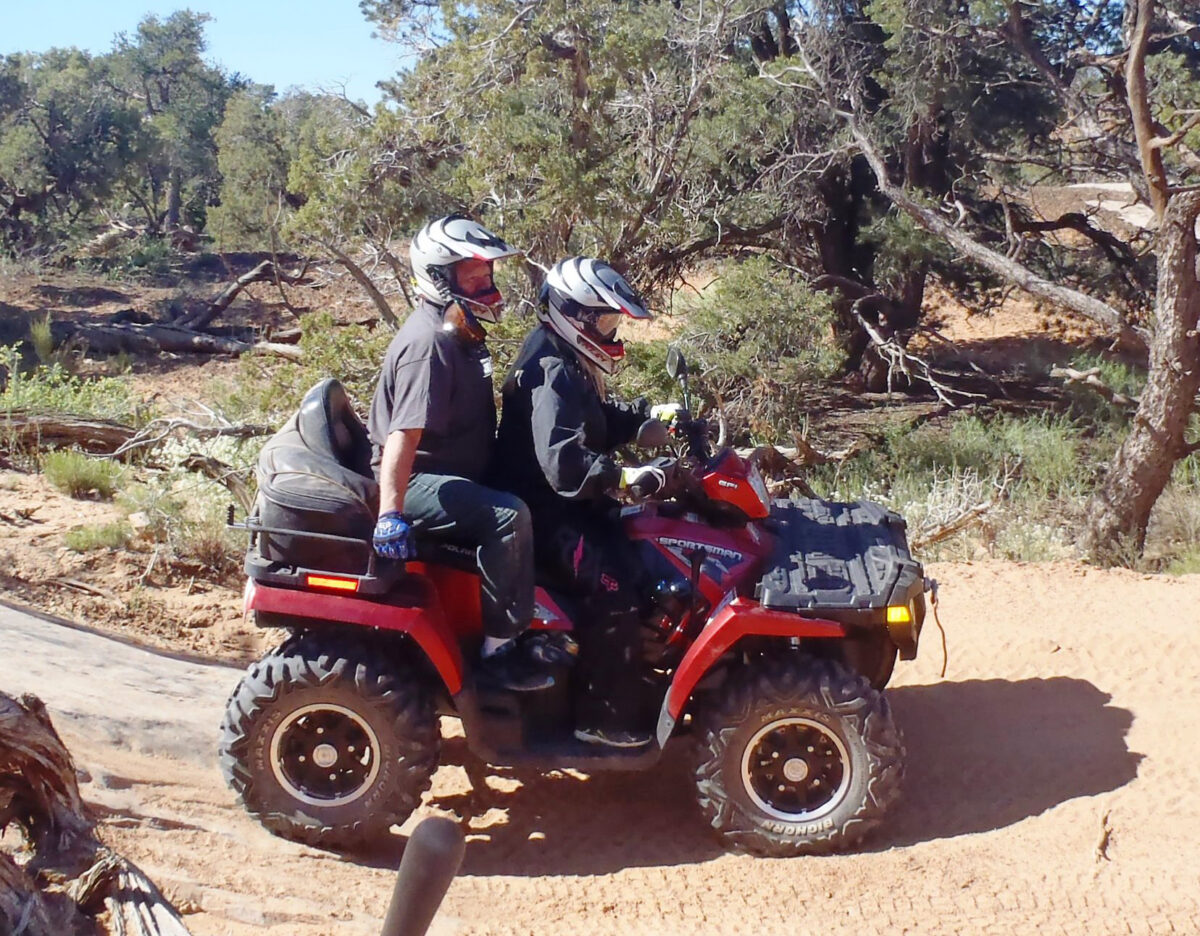
Fred and Becky Newton have just descended the trail to Uranium Arch in Moab.
TRAIL RULES AND ETIQUETTE
Tread lightly — stay on designated trails.
The only place that allows cross-country riding is the sand dunes. Research the trails you want to ride before you go; it will make all the difference. Joining an ATV club is a good way to learn about where to ride.
Never ride alone.
Help is close when you are riding with a buddy.
Pull off the trail when you stop.
Allow plenty of room for other riders to pass through safely. Choosing a spot to stop is critical. Coming over a hill or around a blind curve and finding a group of riders blocking the trail is not a pleasant surprise.
Downhill riders yield to uphill riders.
If you are descending a trail and meet an uphill rider, pull over and let him continue. He has the momentum and if he has to stop, he is at greater risk of an accident by trying to restart.
The last six riders in a group need to know their position.
When meeting other riders, indicate your position with hand signals. The last rider should show a closed fist indicating that he is the last rider in your group.
When approaching horsemen, think about how you look to a horse.
With a helmet riding on a machine, you don’t even look human. Pull over, turn off your machine, take off your helmet and speak in a normal voice. Ask the rider how he would like you to proceed. When approaching cows, slow down, pass slowly and don’t purposely annoy them.
Be prepared to help other people on the trail.
Courtesy photo
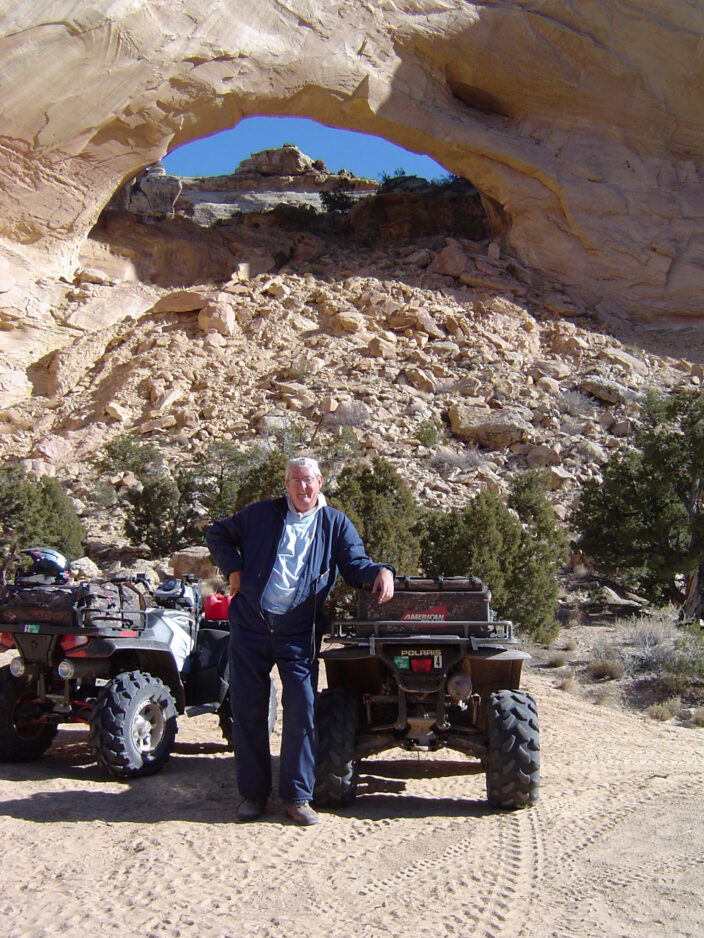
Lynn Blamires takes a moment at Slipper Arch in the San Rafael Swell.
BEST PLACES TO RIDE AROUND NORTHERN UTAH
The Shoshone Trail System
The Shoshone system has several access points. Consisting of a variety of dirt roads and two-track trails, the Shoshone can be reached within an hour of Davis and Weber counties. Popular places to visit include Old Ephraim’s Grave, a rare monument to a grizzly bear, and Peter Sinks, where some of the coldest temperatures in the state are recorded.
Put a little adventure into your ride by taking the trail down into Garden City. Spend the night at the KOA or one of the nearby motels. There are also places to eat a Bear Lake raspberry shake for a treat. You can ride to Randolph and have a burger at The Gator Drive-Inn.
Maps of this trail system are available at the Ogden Ranger District. If your machine is not street legal, you can’t ride on the highway, but you can ride the city streets. The best time to ride the Shoshone is from May through October.
Bountiful Peak
The Skyline Trail has trailheads at Farmington Canyon and below the Bountiful “B.” I like to stage at the latter and ride the Skyline over to the Bountiful Peak Campground. The trail extends farther just below the radar towers and to each of the three Smith Creek Lakes. Trails are available to explore on top with views of the valley that are worth the ride. With few exceptions, the trails are open to wider machines. Bountiful Peak is open from June to October.
State Road 150
Also known as the Mirror Lake Highway, this road has many trailheads good for launching great rides. Starting from Kamas and heading east, the first one is the Taylors Fork ATV Campground and trailhead. This system includes Taylor Fork, The Coral Loop, The Moon Springs Trail, Cedar Hollow, Beaver Creek, and The Red Pine Trail. Beaver Creek is the only trail that has a 50-inch gate.
The Upper Setting Trail is across the road north of Taylor Fork. The Norway Flats Trail is farther east on the left and climbs up to Little Elk Lake. The next trailhead is Soapstone on the right and will take you into Soapstone Basin or east to Iron Mine Lake.
Across from the Duchesne Tunnel, you can access the Spring Canyon Trail that approaches eight lakes in the Uinta Mountains. Farther up on the right is the Murdock Basin System, providing access to four more lakes. These trails are open from late June through October and are suitable for wider machines.
Winter riding
If you are looking for places to ride in the winter, the only sure bet is Mesquite, Nevada, and points south. I rode the Logandale Trails in January this year in very pleasant temperatures. Trails abound in this area; a sure way to find them is to consult one of their ATV dealerships.