This damsel is not a lady in distress: a good beginner fly tie pattern

These damsel flies show nymph and adult patterns. The one on the top right is tied with a blue newspaper bag, recycled from the Standard-Examiner delivery one morning.
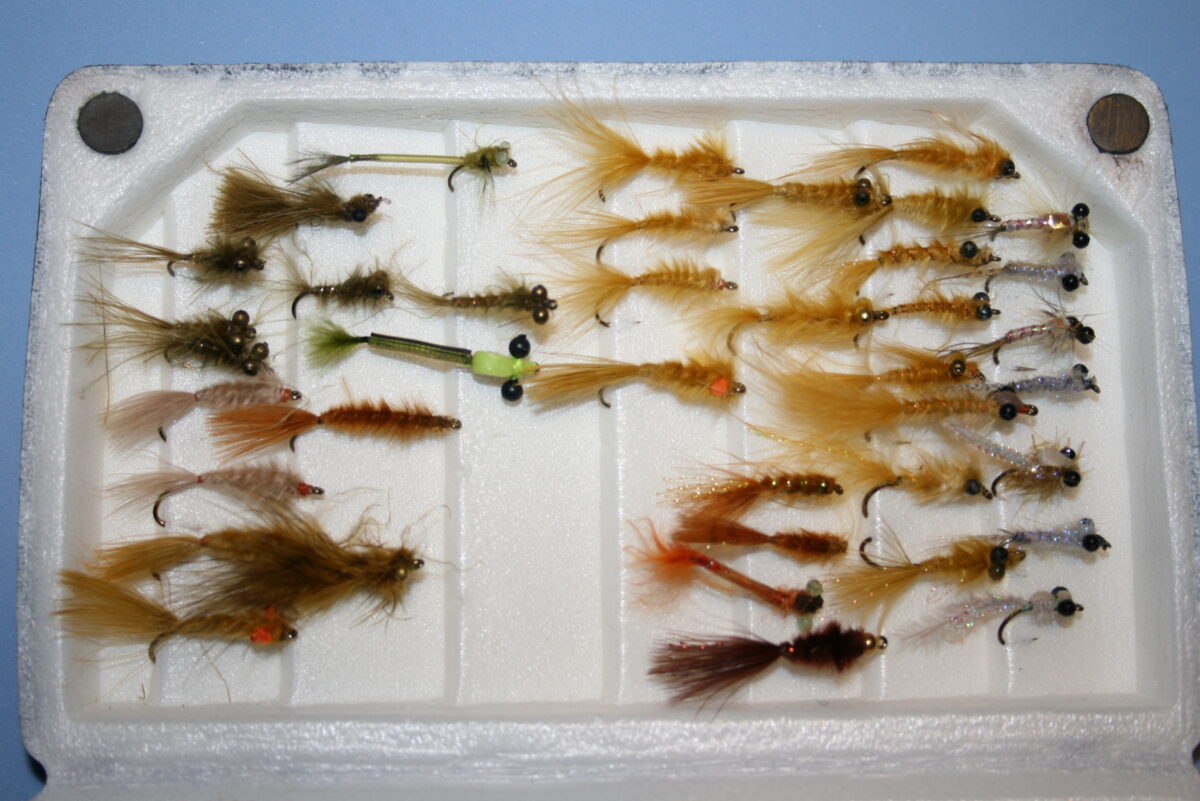
The damsel nymph is one of the easiest flies to tie and is a great pattern for a beginning fly tier to start with. Various color and size variations of the damsel nymph are shown here.
It had been a dark and stormy night, and when I retrieved the Standard-Examiner that morning from the paper box it was enclosed in a blue plastic bag. Now what has that got to do with fly tying? Well, when you are looking for different material to use when tying a fly – everything! Especially when it comes to damsel flies.
Two stages of the damsel flies’ life are of interest to fly fishers: nymph and adult. The nymphal stage is spent in and around moss and weed beds of water bodies, generally less than 10 feet deep. They may also be found in the backwater or slower sections of streams. The nymph will lie in wait around weed beds for its prey to swim by, then dart out to grab it with its forelegs. Damsel nymphs feed on mosquito and midge larva and other small aquatic insects.
Damsels can live up to three years in their nymphal stage and will molt many times a year as they outgrow their exterior skin. Around the middle of June the nymphs begin their migration. They will swim with a ‘snake-like’ squiggly motion, searching for emergent vegetation, rocks and sticks to help them crawl out of the water that has been their habitat for years. They will even crawl onto the shore; here you will see many birds gorging on them.
There have been many instances where anglers were fishing from a float tube or kick boat during this migration to suddenly notice masses of damsel nymphs crawling on their tube or boat; even crawling up the back of their neck. This migration can produce some of the fastest action on any lake or pond as trout begin to stuff themselves on the nymphs.
The damsel nymph is one of the easiest flies to tie and is a great pattern for a beginning fly tier to start with. Coloration of the nymph varies from a light olive to gray to light brown. Materials consist of gray, light brown or light olive marabou feathers, a pair of brass/gold beads snipped from a light switch chain, and small copper or brass wire. A size 8 to 12 hook that is listed as being 2x or 3x in length, that has a natural or stimulator type bend is exceptional for the nymph.
Begin tying a damsel nymph using 6/0 or 70 denier thread that matches the marabou feather used to tie the nymph. Wrap the thread from the eye of the hook about half way back and then forward to about a fifth of the way back from the eye of the hook; this is where you will tie in the beads. The beads represent the eyes of the damsel and also give some weight to the fly to get it below the surface of the water.
Wrap the thread back to the beginning of the bend on the hook. Tie in a length of wire that is about 3 times the length of the hook. Next tie in the end or butts of the marabou feather, leave some of the plume extending about a quarter hook length behind the bend of the hook; this represents their gills. Wrap the thread back to just behind the brass “eyes.” Twist the marabou plumes and begin wrapping them forward. If you find that you are short of the ‘eyes,’ tie off the plumes and wrap in a few more till you get just behind the ‘eyes.’ Tie the plumes off, but do not trim. Wrap the thread to eye of the hook.
Clasp the wire with a pair of hackle pliers and begin wrapping forward, going in the opposite direction of how the marabou was wrapped, Space the wraps of the wire to give a segmentation appearance to the marabou body and it holds the marabou in place if frayed. Once you get to just behind the eyes wrap the rest of the wire in tighter loops and tie off. This will give some added weight to the nymph.
Now take the remainder of the marabou plumes and wrap in an X-pattern around the brass eyes. Tie off the ends of the plumes at the eye of the hook. Then make a few extra wraps to secure the head of the fly before whip finishing.
Some common variations to the damsel nymph include: 1) Leaving off the beads if you want the fly to swim in or just below the surface of the water. 2) Substitute a brass bead for the gold chain eyes. 3) Tie in some tips of the plumes on top of the eyes to represent a wing case. 4) Add a few strands of clear crystal flash to the tail or under the wing case plums.
To fish the damsel nymph throughout the spring use a floating or intermediate sink tip line with an extra long (12 foot) leader and tippet. Make your cast toward the edge of a moss bed, count to five and begin a slow retrieve. Damsel nymphs are not fast swimmers, so use a very slow but steady retrieve; or slowly strip in six to nine inches of line, then pause a second or two and strip again. The fly should be somewhere in the top few inches of water.
On numerous occasions I have observed trout downwind of a moss bed cruising in a circle about six to eight feet across as they slurp damsel nymphs in the surface film. I will normally cast to the middle of the circle and wait for the trout to start to come to my side of the circle. Just before it reaches my side of the circle I will begin slowly stripping the fly so that it will pass near the nose of the trout. This is the time to be prepared for the trout to take the nymph.
Once the nymph reaches a place where it can crawl up a stick, rock or other dry area it will rest before molting. As it begins to dry its back will begin to split open and the adult damsel will emerge from the nymphal shuck. Here it will rest while it wings unfold and dry in the sun before it flies off in search of its first meal as an adult. Damsel adults will feed on gnats, midges, mayflies, and mosquitoes that they catch in midair.
The adult damsel will normally be just over two inches in length. At rest their translucent wings will lay straight back, above and parallel to their bodies. In Utah there are normally two color variations of adult damsels. They body will be either a bright blue or olive drab color.
The most common material for the adult damsel includes the following:
Tail: Rainy’s blue or olive foam damsel lined body, Hareline braided blue or olive damsel body, Nature Spirit elk rump hair dyed blue damsel;
Wings: Numerous types of material can be used for wings; white or dun hackle, foam that is used to wrap electronic parts, Hareline No-Fray wing material, Medallion sheeting or white antron yarn – just to name a few. You can also enhance the wings by adding a few strands of clear or light blue crystal flash;
Thorax: ¼ inch wide piece of 2mm blue foam (this also provides excellent flotation). One type of foam that I have found very useful is the one carpenters use between a foundation and a sill plate, this is called Sill Seal;
Body: Blue dubbing;
Hackle: Grizzly hackle, which will also represent the fly’s legs;
Eyes: Small black plastic or monofilament.
At any time you may substitute olive for blue. I have even found olive Standard-Examiner newspaper bags to be the perfect coloration for olive damsels.
Back to the “dark and stormy night”; a couple of years ago I was teaching a fly tying class at the big box outdoor store in Riverdale. While on the subject of damsel flies Wayne Berndt asked if I had ever used a blue plastic bag to tie an adult damsel. I was intrigued. Take a blue plastic bag, lay it flat and using a razor blade cut about a half-inch wide piece from the open end. Take care to keep it in a connected circle.
Place one end of the bag over a round dowel or similar object. Put you finger through the other end and begin twisting. Once you have a tightly wrapped piece of plastic move the two ends together and the wrapped section will twist around itself. Grasp both ends in one hand and twist the plastic tighter with your other hand, this will enhance the tail.
To start tying an adult damsel I use a size 10 or 12 standard dry fly hook. For thread I use 6/0 or 70 denier in either peacock or damsel blue. Begin your wraps near the center of the hook shank. Tie in your tail material so that you have about 1 1/2 long tail extending beyond the bend on the hook.
Next tie in the material you choose for the wings with it extending to the end of the tail. Now tie in a ¼ inch wide piece of foam with it facing the tail of the fly. Wrap the thread forward to the eye of the hook and then back to about a ¼ inch from the eye of the hook. Place your eyes on top of the hook at this point and make some x-wraps to keep the eyes in place – a little dab of super glue will help.
Wrap back to the base of the foam and spin some dubbing material Dub in some blue dubbing for the body and wrap forward to just behind the eyes. Pull the foam forward and wrap it in place just behind the eyes. Tie in a grizzly hackle and wrap it around the foam forming a hackle. Now pull the remainder of the foam over the top of the eyes and tie off behind the hook eye. Trim off the excess foam and whip finish.
To fish the adult damsel look for a trout cruising the shallows near some moss beds or other emergent vegetation. Quite often if there is a damsel fly resting on cattail or reed a trout will slowly rise out of the water an take it. Most of the damsels taken by trout are those that have become ‘swamped’ in the surface of the water. They will lay there with their wings askew and try to right themselves. This presents an easy meal for a trout. Cast your fly near the vegetation and allow it to rest in the surface of the water. A few slight twitches of the fly will bring a trout to it. Often a trout will stop short of the fly to give it the once over before slurping it in.
Tying and fishing both the nymph and adult damsel can be quite rewarding. Adults and nymphs can be present at the same time. I keep a foam fly box with one side for damsel nymphs and the other side for adult damsels. One thing to remember is that most of the trout taking damsels will be in excess of 20 inches in length, so be sure you are using 6-pound (3X) or heavier tippet.
Some of our local waters that have very good damsel migrations are: Lost Creek, Mantua, Pineview, East Canyon, Rockport, Willard Bay and many of the local urban fisheries. Damsels are not just a fly to use for trout; many bluegill, crappie, and small bass will readily take a damsel fly. A bluegill on a fly rod is quite an experience.
Wes Johnson has been fly fishing and tying for over 50 years. You can contact him at utahtu@gmail.com