
Utah companies championing women advancement lag on child care benefits, study finds
Most companies studied by the Utah Women and Leadership Project had good numbers on family-friendly policies, but some are lower than last year’s analysis
Kevin Hagen, Associated Press
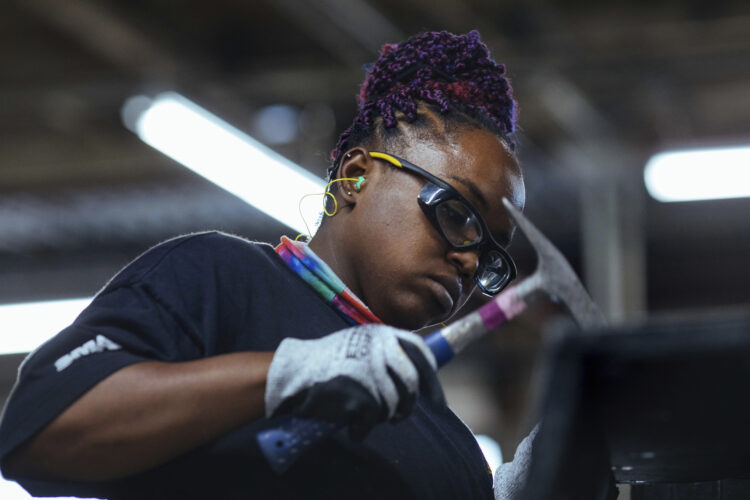
Sheet metal worker Carey Mercer assembles ductwork at Contractors Sheet Metal on Aug. 3, 2021, in New York.Utah has landed the first spot in a ranking for worst states for women’s equality for 11 consecutive years. According to the financial consultant WalletHub, Utah places last on metrics measuring income disparity, and inequality in the state’s share of executive positions.
The Utah Women and Leadership Project at Utah State University in partnership with the state published a brief studying 100 Utah companies that have implemented best practices that allow Utah women to succeed in the workplace. A fundamental one is the implementation of flexible work hours in addition to other family-friendly policies.
“Research on the importance of implementing flexible and family-friendly policies, programs, and practices in workplaces has been well documented,” the brief says. “In fact, there is a clear, direct link between companies that implement such strategies and the retention and advancement of women.”
The researchers have been measuring family friendly and women-focused initiatives in different workplaces in the state for three years, including paid and unpaid family leave, back-to-work maternity support, child care support, and adoption and fertility benefits. This year fewer companies reported offering those perks.
While 71% had unpaid family leave available — more than the 64% recorded in 2024 — only 63% offered paid maternity leave, less than the 69% reported in 2024. Also, 20% had adoption and fertility benefits, less than the 27% seen last year.
Susan Madsen, director of the Utah Women and Leadership Project, said she was particularly surprised to see a lower percentage of child care support, which went from 34% in 2024 to 25% this year.
“We’ve been talking about that more the last three years here in the state of Utah,” Madsen said. “And women and families need child care support most. In most families, if there’s two parents in the home, both of them are working, and so child care is really important.”
The benefit doesn’t necessarily translate into a child care center in the workplace, or stipends to cover day care expenses, Madsen said.
“There’s a lot of other things that could be possible in helping and trying to support parents, not just women, with child care,” she said. “Sick days, letting people do remote work when their kids are sick, or various things like that.”
There was still a good number of companies that offered flexible hours in the list the researchers studied, though it went from 98% last year to 94% in 2025. Remote work was also available at 83% of the workplaces this year, less than the 91% seen in 2024.
“These are some of the top companies or top organizations. It’s just interesting to see what they’re doing and what things are jumping to the top of the list,” Madsen added. “For women, flexible work hours and some options for remote work just continue to be absolutely critical.”
Another popular initiative among the 100 companies was an annual review of pay equity, with 82% of the organizations reporting they conduct studies on everyone’s salaries.
“We can’t generalize it to the rest of the population. I’m sure there’s a lot of workplaces that don’t do these things and are not really concerned about doing things,” Madsen said. But it gives us as companies and workers a good look at what people are doing. What should we look at doing more in our organizations?”
The report encouraged other organizations to open opportunities to make a more inclusive workplace for women. It also recommended that state legislators consider and support policies that will help Utah to host more family-friendly workplaces.
“When businesses consider organizational-level strategies, initiatives and programs, including family-friendly practices and policies that support all employees and help them thrive, Utah can increase the representation of women in businesses around the state, which is important to ensure more women and their families can thrive,” researchers wrote.
Local News

The Wild Calls: Anthro Weekend Utah co-founder discusses ins and outs of setting up state’s largest furry convention as registration opens to the public
Clark G. Gilbert ordained as apostle in The Church of Jesus Christ of Latter-day Saints
