Utah Forward Party’s first-of-its-kind preference poll picks a winner to replace Sen. Thatcher
Emily Buss, of Eagle Mountain, wins. Utah GOP chair says party won’t challenge appointment, but will put forth a challenger in 2026
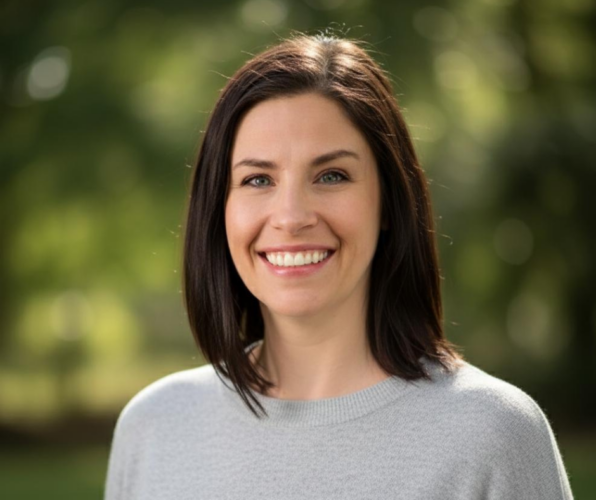
Photo courtesy of the Forward Party of Utah
Emily Buss won the Forward Party of Utah’s preference poll on Dec. 12, 2025.The Forward Party of Utah’s unprecedented midterm preference poll has picked a winner to replace outgoing Sen. Dan Thatcher, of West Valley City, the state’s only third-party lawmaker, after he announced earlier this year his departure from the Republican Party.
The party announced Friday — the same day Thatcher’s retirement from his District 11 seat became effective — that Emily Buss won the party’s preference poll. Party officials have formally submitted her name to Gov. Spencer Cox for official appointment.
Buss, of Eagle Mountain, describes her background as “rooted in advocacy, policy, and research, with a focus on child welfare and social impact,” according to her candidate bio on the party’s website.
“I’ve spent my life fighting for families and building programs that serve real needs in real communities,” her bio says. “Whether it’s creating resources for underserved youth, expanding access to support services, or partnering with local organizations, I know how to turn ideas into action, and action into outcomes.”
The Forward Party of Utah — a centrist party with the slogan “Not left. Not right. Forward” that coalesced when the state’s two centrist groups merged earlier this year — is an affiliate of the national Forward Party.
To fill Thatcher’s midterm vacancy, the party held a first-of-its kind online voting system that used the approval voting method, which allows voters to vote for more than one candidate. The candidate with the highest number of total approvals is declared the winner.
Uniquely, the Forward Party of Utah held an open election — allowing all registered voters in District 11 to vote, regardless of their party affiliation. Eligible candidates needed to pass a party background check, agree to sign a pledge supporting the Forward Party’s values, and commit to running for reelection in 2026 as a Forward Party candidate.
Buss won the preference poll — which included online and paper voting — with 625 votes, or 47.21% approval percentage. A total of 2,308 votes were cast in the election by 1,324 voters.
Approval percentage is calculated by dividing the number of approvals a candidate received by the total number of ballots cast. It represents the percentage of voters who approved that candidate. Because voters may approve more than one candidate, total approvals across all candidates will exceed the number of ballots cast.
Buss, in a prepared statement, expressed gratitude for voters’ support.
“I am honored, surprised, and grateful to the voters of District 11 for placing their trust in me,” she said. “But this isn’t about me, this is about the people I represent. Together, we will work toward common sense solutions that will strengthen our communities, support our families, and bring a brighter future for District 11 and all Utahns. There is a lot to be done. Let’s get to work.”
Thatcher said representing District 11 Utahns for the past 15 years “has been my honor, and I am deeply grateful for the trust and partnership of my constituents.” He also thanked the party for “facilitating an open, transparent, and historic process with more participation than any replacement process in Utah history.”
“Seeing every registered voter in this district invited to participate gives me tremendous confidence in the future of our community and its leadership,” he said, while congratulating Buss and her constituents.
Utah Republican Party won’t challenge mid-term appointment
In October — when Thatcher first announced his planned retirement — Utah Republican Party Chair Rob Axson indicated that the GOP took issue with Thatcher’s party switching, and he did not rule out challenging the Forward Party of Utah’s first-of-its-kind replacement process.
Prepared to fight if necessary, Thatcher and Forward Party leaders said Utah law is clearly on their side. When a midterm vacancy occurs in the Legislature, the law says “the governor shall fill the vacancy until the next regular general election by immediately appointing the person whose name was submitted by the party liaison of the same political party as the prior senator.”
Reached Friday, Axson told Utah News Dispatch the GOP would not challenge Buss’s appointment, though he said in a text message “there are certainly concerns to the process and situation which created this moment.”
“We disagree with Thatcher’s action of pulling a fast one on voters by changing his affiliation,” Axson said. “We also disagree with the process used by the Forward Utah party but respect the law allows them to be the party filling the vacancy.”
So while Buss is set to become the Utah Legislature’s only third-party candidate during the 2026 general session scheduled to begin Jan. 20, the Utah GOP will be putting forward a Republican challenger in the 2026 election, when the remainder of Thatcher’s and now Buss’ term ends.
“The Utah Republican Party looks forward to our Republican candidates engaging with voters this next year and for the district to have a chance to have a senator who represents the principles and preferences of the district,” Axson said.
Phil Boileau, spokesperson for the Forward Party of Utah, told Utah News Dispatch that “we look forward to the competition in 2026.”
“If the people of the district choose that they prefer a Republican candidate at that time, then they will make that selection under the democratic system that we cherish and revere,” he said.
To Axson’s comment about “pulling a fast one,” Boileau noted that while the Republican Party uses a “closed” system to pick its nominees (with only registered Republicans able to vote in the primary and delegates picking nominees during caucus meetings), the Forward Party of Utah opened its preference poll to all District 11 registered voters.
“Considering we had a process where literally everybody in the district could cast their vote and participate … I’m not sure that you can reasonably say that we pulled the fast one on the people,” he said. “We followed the law, and we created a system that was more inclusive, including the Republicans who were more than welcome to participate in the voting for this.”
Boileau said leaders of the Forward Party of Utah were “thrilled” with how the election went, with more than 1,300 voters participating, which he said far exceeds the number of caucus delegates that likely would have participated in a typical party midterm replacement, which he estimated would have been up to 150 delegates.
He said he hopes the party’s preference poll can set an example for future elections, both in and outside of Utah.
“As a new and upstart party, we took a big swing by doing this, but we followed state statute and protocol to the letter, so we fully expect not only that the state will accommodate the decision that we made,” he said. “We hope that people all around the country will look at this as an opportunity to maybe revise their midterm replacement processes as well.”