First three months of water year slosh from high moisture to dry extremes
Rob Nielsen, Standard-Examiner
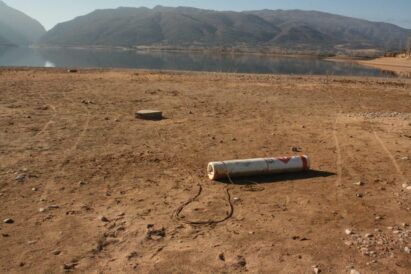
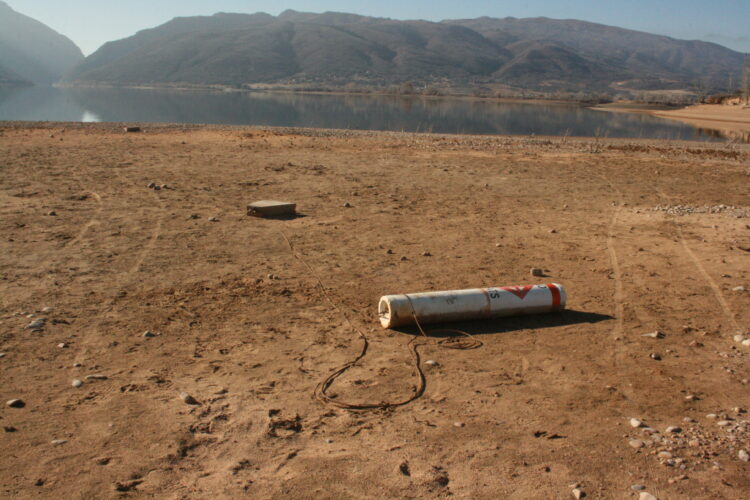
Not anticipating many violators for the moment, a buoy warning against boating in a section of Pineview Reservoir rests on the lakebed during a period of low water on Saturday, Nov. 22, 2025.WEBER COUNTY — The first three months of the 2025-2026 water year have sat on the extremes for the region, but officials say there’s still a lot of winter to go.
Darren Hess, COO and assistant general manager of the Weber Basin Water Conservancy District, told the Standard-Examiner on Wednesday that the beginning of the water year, which started at the beginning of October, has left a lot to be desired.
“We’re definitely not excited about where the water year is at right now,” he said. “October was great, but then November was terribly dry and December has been terribly dry as well.”
He said while October’s moisture broke records in the area, snowpack in the Basin was only about 48% of normal as of midweek.
“We just haven’t seen the snow that we typically see in December,” he said. “So that’s really dropped off our snowpack.”
In a Dec. 18 press release from the Utah Division of Water Resources, it was noted that the region is seeing the brunt of the sparse beginning to the water year.
“The northern half of the state is experiencing the poorest conditions,” the release said. “Early snow helped the southern Utah basins. After a record-setting month in October for precipitation, Salt Lake City followed up with another record-setting month, but this time for the highest November average temperature. Halfway through this December, the average monthly temperature of 42.2°F was a staggering 8.6°F above average.”
The release noted that 93% of the state is currently experiencing some form of drought versus 19% of the state at the same time last year.
However, not all is doom-and-gloom, according to Hess.
“The good thing is that soil moistures were relatively high going into the winter,” he said. “October really helped us with that. We’re much better, soil moisture-wise, going into winter than we were last year. That freezes so soil moistures stay kind of where they’re at now, which is nice.”
He said that if snowpack starts to materialize in greater amounts as the season continues, more runoff will make it into the area’s reservoirs and the Great Salt Lake.
“It’s early in the season,” he said. “There’s still going to be a lot of snow come January-March.”
Hess said the Basin’s reservoirs are largely around where they would normally be this time of year.
“The reservoirs have kind of just stayed steady,” he said. “Once the irrigation season shut off Oct. 15, the reservoirs have stayed pretty steady and even risen a little bit.”
He estimated most are around 51% of capacity at the moment.
Hess said it’s hard to predict where the rest of the season will go, but that there is still reason for hope.
“It’s always really hard to say 10 days out what the weather is going to do,” he said. “I’ve heard some long-term forecasts that say that December and January would be quite dry and then February and March, we’ll see more storms coming our way. But I don’t know how much stock you put in those. … It’s still early in the water season. We’ve got a lot of winter left and let’s keep our fingers crossed. Eventually, we will see winter here in Utah like normal, but so far, it’s been pretty sparse as far as the storms.”