Utah redistricting: Judge allows Legislature to appeal one of her rulings to Utah Supreme Court
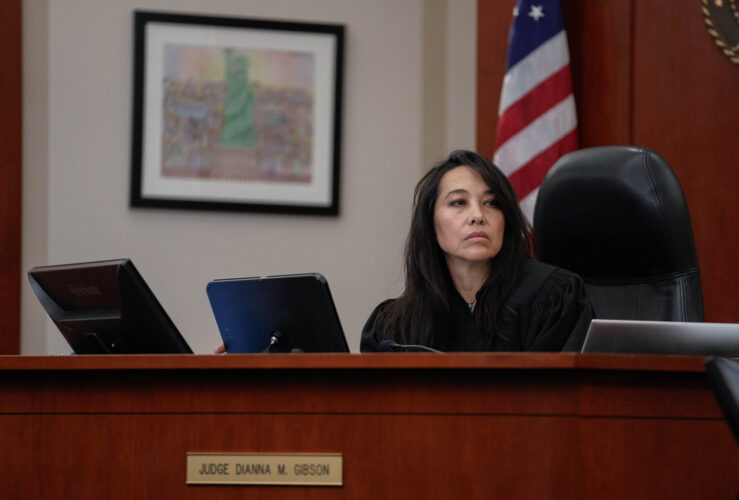
Pool photo by Francisco Kjolseth, The Salt Lake Tribune
Third District Judge Dianna Gibson listens during a hearing in Utah’s court-ordered redistricting process in Salt Lake City on Thursday, Oct. 23, 2025.Despite calling out the Utah Legislature’s attorneys for failing to appeal her previous redistricting rulings at more appropriate junctures, 3rd District Judge Dianna Gibson has issued a ruling allowing lawmakers to appeal one of her decisions throwing out the state’s 2021 congressional map.
Gibson, in a decision issued late Friday, denied the Legislature’s attorneys’ request that she issue a final judgement on the entire lawsuit challenging redistricting in Utah — which would have finalized the whole case.
Instead, she decided to allow a narrower appeal specifically for her Aug. 25 ruling, which preliminarily voided Utah’s 2021 congressional map as the result of an unconstitutional process and blocked a law that lawmakers approved that year, SB200.
That law repealed and replaced a 2018 voter-approved ballot initiative known as Proposition 4 that enacted an independent redistricting process — a move that Gibson decided violated Utahns’ constitutional right to alter and reform their government.
Depending on the outcome of the 2026 midterm-elections, Utah’s redistricting lawsuit could potentially tip the scales on which party controls the U.S. House. But that also depends on whether Utah’s current court-ordered map with one Democratic-leaning district and three Republican districts stands — or if the Legislature successfully appeals Gibson’s order tossing out the voided 2021 congressional map, which included four Republican districts.
A request for comment to House and Senate Republican legislative leaders wasn’t immediately returned Monday.
‘This was not an easy call’
In her ruling issued Friday, Gibson said she’s leaving it up to the Utah Supreme Court to decide whether the Legislature’s appeal is proper.
“This was not an easy call,” the judge wrote.
The Legislature’s attorneys “had a direct, non-discretionary right to immediately and directly appeal to the Utah Supreme Court” both Gibson’s Aug. 25 order, as well as another order she issued Nov. 10 that blocked the Legislature’s preferred remedial map, known as map C, and instead picked a map drawn by the plaintiffs to be used in the 2026 elections.
That ruling was celebrated by the lawsuits’ plaintiffs — including voting rights groups the League of Women Voters of Utah and Mormon Women for Ethical Government — and the anti-gerrymanding group Better Boundaries, which successfully pursued Proposition 4.
The resulting new, court-ordered congressional map was also celebrated by Democrats because it created one compact district around northern Salt Lake County that leans Democratic. Previously, all four of Utah’s congressional districts leaned Republican.
The ruling angered Republicans, with some GOP lawmakers accusing Gibson of violating the Utah Constitution by picking a map that wasn’t drawn or approved by lawmakers. Last month, top Republican legislative leaders vowed to appeal the case to the Utah Supreme Court.
However, lawmakers’ attorneys haven’t yet appealed any of Gibson’s rulings — even though the judge said they could have for both the Aug. 25 ruling and the Nov. 10 ruling.
“While it was the Legislative Defendants’ duty to seek appellate review of these decisions as soon as possible (if in fact that is what they wanted), they have offered no legitimate explanation for failing to do so when they had the chance, either by interlocutory appeal or by exercising their statutory right to immediately appeal an injunction of a state law,” Gibson wrote. “Nonetheless, this Court still believes that there is no reason to delay appellate review.”
So Gibson decided to grant the Legislature’s attorney’s motion for a Rule 54(b) certification on her Aug. 25 order. A Rule 54(b) certification allows some of her rulings to be certified as final for immediate appeal if the court has decided that there is no reason for delay.
“This case is unique,” she wrote. “Most cases before district courts involve private parties and private transactions. Redistricting cases are the exact opposite. They are very public and have a state wide impact. Every Utah voter, every Utah congressional candidate and arguably every Utah citizen is impacted by this case.”
Issuing a final ruling on even just a portion of the case, she wrote, “ultimately serves the public’s interest and will lead to a faster resolution of the entire case.”
Gibson acknowledged that if she doesn’t certify her Aug. 25 ruling as final now, “any appellate review will have to wait until the end of the case, which could be months to years away.”
So, Gibson said she’s leaving the question to the Utah Supreme Court.
“Until there is a final decision on these legal issues from our Supreme Court, there will be a cloud (over) Utah’s congressional elections and an open question regarding the power of the Legislature and the power of the people,” she wrote.
The Utah Supreme Court, she added “can decide now if the Legislature is the sole and exclusive authority over redistricting in Utah or if it shares that responsibility with the people.”
“It can decide if the people of Utah, through the exercise of their right to alter or reform government through a citizen initiative, can also pass binding laws regarding how the Legislature performs its redistricting duty,” Gibson wrote. “And the Utah Supreme Court should decide now if the order granting the permanent injunction of S.B. 200 and the 2021 Congressional Map should stand or if it should be vacated.”
Gibson added that there is “no just reason to delay the Utah Supreme Court’s review of those legal rulings” in the Aug. 25 order.
“There is no reason to delay bringing some finality on these important issues to the people of Utah,” she wrote.
Why hasn’t the Legislature appealed yet?
That’s a question Gibson’s Friday ruling raises, pointing out the Legislature’s attorneys had multiple opportunities to do so.
A clarification hearing held on Dec. 22, “confirmed what the court suspected,” Gibson wrote.
“With election deadlines imminent, the Legislative Defendants repeatedly stated they intended to appeal but then intentionally elected not to utilize the more appropriate appellate tools available to them,” Gibson wrote, adding that they could have petitioned to appeal any one of her interlocutory orders within 21 days of any of her previous three orders.
She also wrote they could have filed a direct appeal to the Utah Supreme Court within 30 days of each other and obtained an expedited appellate ruling based on her Aug. 25 ruling that blocked the 2021 congressional map and her Nov. 10 order that blocked the Legislature’s remedial map submission, known as map C.
“Instead, the Legislative Defendants attempt to argue to this Court that this entire case and Plaintiffs’ Count V are ‘essentially’ final,” she wrote. “That is, they contend all of the relief that can be given in this case has been, and we are ‘close enough’ to call this case done.”
In her ruling, Gibson expressed frustration with the position she’s been put in.
“Quite literally – this Court is between the proverbial rock and a hard spot,” she wrote. “This entire case is not ‘final.’ … But the Court agrees that the important legal issues decided by this Court and reflected in each of its rulings … should be reviewed by the Utah Supreme Court as quickly as possible. But this Court and the Utah Supreme Court are bound by the law and by procedure on how we proceed.”
She wrote that the proposed final judgement submitted by the Legislature’s attorneys “does not actually reflect the legal status of this case or the status of the various claims in the case.”
“This case is far from over and is not yet final,” Gibson said.
She added that there are several unadjudicated claims in the case, and it continues to be actively litigated.
“Utah law does not authorize this Court to just ‘deem’ that issues are effectively resolved or enter a proposed final judgment because some relief has been granted,” she wrote.
While the Legislature “would like this case to be over, there is no legal basis supporting entry of a final judgement,” she wrote, denying the motion to issue a summary judgement on Utah’s ongoing redistricting lawsuit.
Local News
Utah redistricting: Judge allows Legislature to appeal one of her rulings to Utah Supreme Court

Mayor gives a glimpse of upcoming State of the City address; Union Station and community engagement high priorities