Closing chapter: Retiring Davis County sheriff Kelly Sparks discusses 44-year career
Ryan Comer, Standard-Examiner
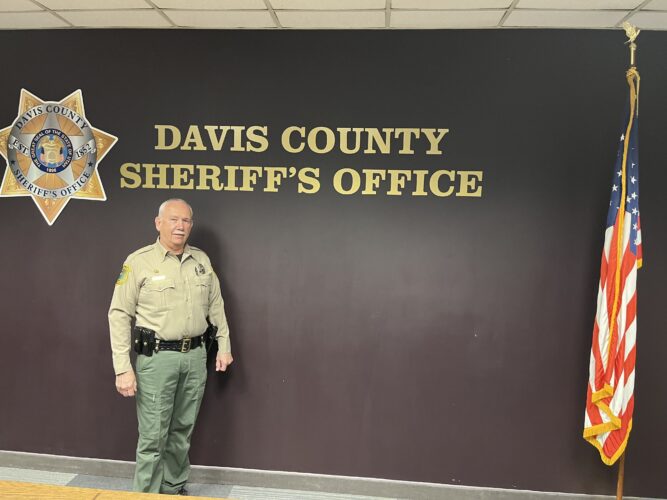
Davis County Sheriff Kelly Sparks stands for a portrait inside the Davis County Sheriff's Office in Farmington on Monday, March 30, 2026.Davis County Sheriff Kelly Sparks remembers an experience from years ago when he was a patrol officer.
He was sitting in a restaurant having lunch and across the street from him was a bank.
He started to see police officers arriving at the bank and later found out that there was a reported bank alarm.
Sparks, who was with another deputy, didn’t know the full details because they were on separate dispatch centers.
Sparks mentioned that experience to highlight the potential problems that can arise from not having consolidated dispatch centers.
“Once you consolidate them and you have all of that information and dispatchers can share the information in real time, it makes it a much more effective, a much more efficient process,” he said.
Consolidating dispatch centers is just one accomplishment Sparks highlighted in an interview with the Standard-Examiner as he prepares to conclude his second and what will be his final term as the sheriff.
Sparks is retiring, bringing an end to a 44-year career in law enforcement.
“I’m really happy that we’ve been able to work so well with all of the other cities in Davis County to come up with what is really going to be a much better plan for our dispatch services,” he said.
Traditionally, Sparks explained, Davis County has had four dispatch centers. He said they all do a great job and historically have been really good, but he’s realized that there are some “important efficiencies” that come from consolidation.
He cited Weber County as an example of a model that Davis County learned from and he said the county also looked at other models. He said meetings were held “with every city in the county, with the city administrators, police chiefs, fire chiefs, starting several years ago…” to work toward consolidation.
First, Clearfield consolidated with Layton, and later this year, Sparks said the Davis County Sheriff’s Office will consolidate with the Layton-Clearfield center. Bountiful, he said, continues to run a dispatch center in the south end of the county.
“Having the larger dispatch center gives more depth to their capability,” he said. “It also keeps us in much better unison.”
Among other accomplishments Sparks discussed were: culture, the medical service in the jail, mental health services for staff and an emergency operations center.
Culture
Culture was the first thing Sparks mentioned as he discussed accomplishments over the past two terms.
“We have some great employees who do good work every day, and we’ve been able actually to hire a lot of employees from other agencies in the last three years,” he said. “We’ve been able to bring on about 30 laterals … folks who have experience at various other departments that they’ve worked in.
“I always sit down with them after they’ve been here for a few weeks and they’ve got through their initial training and ask them how they feel about things and how it compares to previous places that they’ve worked, and inevitably they’ll say that it’s great, that they just love being here, that it’s much better than where they come from, often. So, I feel really good about the people that work here at the sheriff’s office and the culture that we’ve been able to develop.”
Health at the jail
Sparks acknowledged the Davis County jail’s previous record of “a high incidence of people dying” and said it was “a very serious concern.”
He said his goal was to figure out why that was happening and what could be done to make a difference. He said “some really significant improvements” have been made to the functions.
Specifically, he highlighted the success in procuring funding for and constructing a new medical wing onto the jail.
“When I first became sheriff, we were suffering really from pretty inadequate medical service that was being provided in the jail,” he said. “Our jail, when it was originally built, was not built for the type of jail population that we have today. The medical needs had become much greater, but we had a really small medical area in the jail that was really insufficient.”
Additionally, Sparks noted a conversion to a contracted medical service.
“And so the medical attention that inmates are getting in the jail now is very much better than it was when I became sheriff,” he said.
He also said he put together a community council comprised of deputies and staff from the sheriff’s office, retired corrections managers, a medical doctor and a licensed psychologist.
He cited telemedicine efforts, which he said was beneficial and saves a lot of time and taxpayer dollars, and a medical assisted treatment program for those recovering from addictions.
Mental health for staff
One “great” thing Sparks said that has been accomplished is “to really take a strong focus on the mental health of our first responders, our deputies in the jail, of all those who work in … what can be a very difficult profession in law enforcement.”
He said “a really robust peer support program” has been developed, which he credited one of his chief deputies, Andy Oblad, as “instrumental” in getting up and running. Additionally, he said a partnership was formed with Davis Behavioral Health to have a mental health counselor at the office three days a week. He said the counselor is available to all employees and only works with law enforcement employees.
“And so that’s been something that I’m really happy about,” Sparks said. “A lot of our employees have embraced that and taken advantage of those services and really improving their mental health.”
Emergency operations center
Sparks said the sheriff’s office recently opened a new emergency operations center, which he said had been under construction for 20 months.
Emergency management, which Sparks said is planning and preparing for manmade disasters and natural disasters, was something he realized needed to be improved when he became sheriff. He said Davis County was one of the only major counties in Utah to not have a dedicated emergency operations center and called it “a real deficit” for the county.
“We had been using our auditorium here at the sheriff’s office, which is a multipurpose room,” Sparks said. “If we had a major disaster, like a major windstorm or a major wild landfire or even the pandemic or the earthquake, we would have to set up folding tables in the auditorium and bring out phones that we would plug into the jacks that we had in the floor and it would probably take us half a day to get the emergency operations center set up, and it was just not where we ought to be as the third-largest county in Utah.
“So the commissioners, who were at the time Bob Stevenson, Lorene Kamalu and Randy Elliott, realized that that was a need for the county as well.”
In a follow-up email, Sparks also credited Curtis Koch, the county controller when construction began, for being “instrumental in obtaining the funding” and said the big takeaway was that it was built without using any Davis County taxpayer money.
Sparks also said he realized a dedicated emergency manager who had a career in emergency management was necessary, so now there is a civilian emergency manager that is a professional emergency manager.
“Previously, the sheriff’s office, probably for the last 40 years, has been overseeing emergency management for Davis County, which is a county service,” Sparks said. “I think the sheriff’s office over those years has done a great job. Most of the emergency managers during that time were deputy sheriffs who took that responsibility on at some point in their law enforcement careers, but they were really law enforcement officers.”
Calling it a career
Sparks was born in Layton and graduated from Layton High School. He graduated from Weber State University with a bachelor’s in sociology and also has a master’s of criminal justice from Weber State. He said he also has an associate’s degree in paramedics. He has been in law enforcement for 44 years, a career that started at the Davis County Sheriff’s Office in January 1983.
Sparks worked at the jail for about six months, then worked in patrol and went to paramedic school at Weber State. At the time, Davis County Sheriff’s Office was the only paramedic provider in the county.
He worked as a deputy sheriff paramedic for much of his early career and also was a flight paramedic for a few years with LifeFlight.
He became a patrol sergeant and helped develop a SWAT team at the sheriff’s office.
He spent 12 years as the SWAT commander and then became a hostage negotiator for the sheriff’s office.
He was a public information officer for the sheriff’s office and eventually became lieutenant over the investigations bureau, supervising detectives, the crime lab and the Northern Utah bomb squad.
He served as assistant emergency manager and also chief deputy.
After about 23 years in Davis County, he left the sheriff’s office and became the director of Weber State University’s police academy and later was the deputy director at Peace Officer Standards and Training, or POST, the latter which he did for about 10 years.
He currently serves as the chairman of the Utah POST Council.
Future of the sheriff’s office
Oblad, Jon Atkin, Aaron Perry and Zach Van Emmerik are running to become the next Davis County sheriff. Sparks has endorsed Oblad.
Sparks said he did not know Oblad when he became sheriff, but he did a nationwide search for chief deputies in an effort to “bring the best people” he could.
Oblad applied and Sparks said he was “very impressed” with Oblad’s knowledge and experience.
“And I’ve been able to work with him very closely for the last seven years as one of my chief deputies,” Sparks said. “He’s been instrumental in a lot of the improvements and advancements that we’ve made. He’s been able to work in the law enforcement bureau, in our administrative bureau — which is all of the business arm of the sheriff’s office, the finance and the grants and contracts and all of those things — and now he works in corrections.”
Sparks said the candidates are all great but Oblad is who he has experience working most closely with.
“I’ve been able to get to know him, get to know how he makes decisions, get to know what’s in his heart and how much he cares about Davis County, how much he cares about the sheriff’s office,” Sparks said. “So he’s the one that I have confidence will continue to progress in the way that we’ve gone, continue to maintain the culture that we’ve been able to develop, continue to hold probably what is the most important factor to me — and that is the interests of the people of Davis County.
“You know, I take very seriously the fact that I am elected by the citizens of Davis County to be their sheriff. This office belongs to the people. And I want to make sure that we take care of those people.
“I’m very passionate about that. I want the people of Davis County to know that they can have confidence that the sheriff’s office is doing the right things, that we’re following the law, that we’re upholding their constitutional rights. Those things are really important, and I feel really confident that Andy can continue to lead that and we’ll continue that progression.”
Contact Standard-Examiner editor Ryan Comer at rcomer@standard.net.
Local News
Closing chapter: Retiring Davis County sheriff Kelly Sparks discusses 44-year career
Standard-Examiner experiencing production delays; delivery disrupted