Two Wasatch Front cities help conserve water for the Great Salt Lake in a first-of-its-kind deal
Trip Armstrong/National Audubon Society
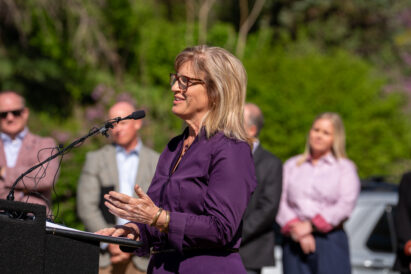
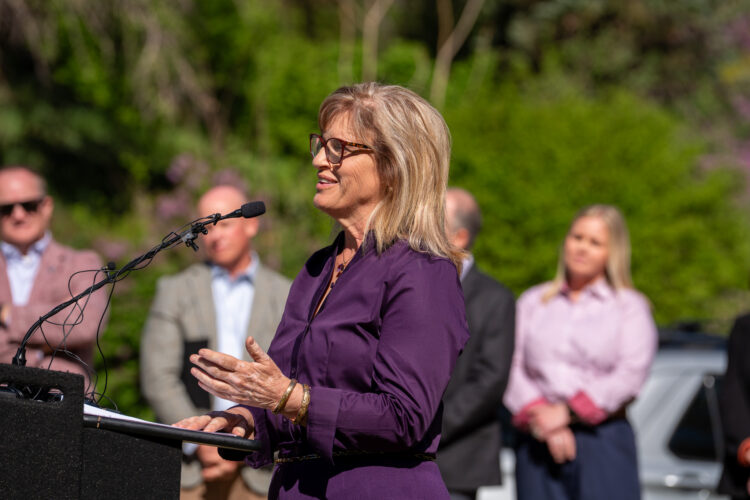
Sandy Mayor Monica Zoltanski talks about her city’s conservation efforts on Monday April 6 , 2026, at a news conference in Salt Lake City.Utah is breaking records for alarming reasons, with its hottest winter and flimsiest snowpack on record. But officials from the state and two cities see something to celebrate.
They announced a new deal Monday to get more water to the drying Great Salt Lake, saying homeowners and businesses in Sandy and Salt Lake City conserved enough to make it happen.
Hannah Freeze, deputy Great Salt Lake commissioner, called it “proof that we are all in this together, and that as we collect our efforts and continue to conserve, we can have an impact on Great Salt Lake.”
A conservation trust is paying the Metropolitan Water District of Salt Lake City and Sandy an undisclosed sum to send 2,500 acre-feet of water to the lake each year for up to a decade. It’s a tiny fraction of the annual boost of 800,000 acre-feet that’s needed to restore the lake to good health, but supporters see it as a blueprint for a bigger solution.
“If we were to implement this and duplicate this across the Wasatch Front, the difference it would make would be incredible,” said Joel Ferry, executive director of the Utah Department of Natural Resources.
The government leaders joined conservation and philanthropic groups involved in the project Monday with a message that every drop helps. They emphasized that the kind of broad collaboration on display at the news conference is key, along with help from individual Utahns who can opt for low-water landscaping.
This sort of deal wasn’t always possible. In 2022, Utah established the Great Salt Lake Watershed Enhancement Trust and changed state law to allow for this sort of water lease. The trust went on to make several deals to help the lake, but this is the first stemming from homeowners and businesses conserving more in cities, said Shaela Adams with the National Audubon Society.
Sandy Mayor Monica Zoltanski said her city has taken several steps to conserve, including changing its water rates to hit “superconsumers” with surcharges. It also introduced a water alert system notifying people in real time if there’s a leak or a spigot left running.
The Great Salt Lake has shrunk after years of drought, climate change and redirection of water for farming and other uses, reaching a record low in 2022 and ending last year at its third-lowest level since 1903.
In the Great Salt Lake Basin, agriculture remains the biggest consumer of water, at 65%, according to state data. That’s followed by municipal and industrial uses at 26.8% and mineral extraction at 5.7%.
State lawmakers this year streamlined a program paying farmers to leave some fields dry, allowing them to participate for shorter stretches to entice more to participate.
The exposed lakebed contains metals like arsenic and lead. As the state sets up a monitoring system to track the concentrations of those metals drifting into communities, some families aren’t waiting to see what the data reveals. A couple in Orem told Utah News Dispatch they’re making the decision now to leave the state because of the pollution and the health risks it may carry.
A terminal saline lake like Utah’s has never been fully restored after this sort of decline, but the coalition said steps like those announced Monday are moving in the right direction.
“Utah’s proving over time that this is doable, this is solvable,” said Tim Hawkes, a member of the trust’s advisory board. “But it’s going to take the kind of creative partnerships that we see showcased today.”