
University of Utah’s ‘AI supercomputer’ set to come online this summer
The system is expected to advance health care and environmental research breakthroughs, officials say
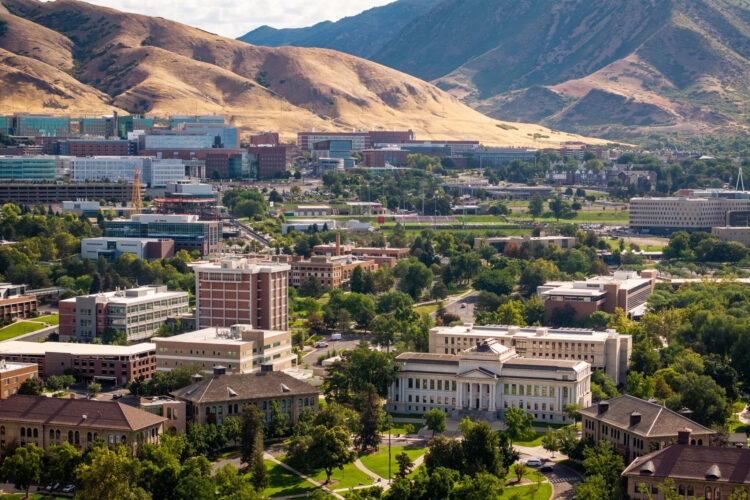
Photo by Spenser Heaps for Utah News Dispatch
The University of Utah campus, with Presidents’ Circle in the foreground, is pictured in Salt Lake City on Saturday, Aug. 23, 2025.As Utah pushes to become a force in the artificial intelligence industry, its flagship university is quickly working on developing a supercomputing system researchers hope will accelerate cancer, Alzheimer’s, mental health, and genetic and environmental discoveries.
The system being built at the University of Utah is slated to come online this summer, and it’s projected to increase the institution’s computing capacity 3.5-fold, according to the university.
Some officials and communications from the university describe the project as a “supercomputer,” but Manish Parashar, chief AI officer at the University of Utah, prefers another term — ecosystem.
“The physical computer is one part of it, but it is everything together that allows the innovation to happen,” Parashar said.
The ultimate goal for the system is to provide the computational power for researchers to run AI to crunch data and analyze models simultaneously.
That is expected to extend beyond health care research, with university leaders hoping to also make breakthroughs on “environmental modeling, clinical decision support, and large-scale analysis of historical and textual datasets in the humanities,” according to a release from the university.
“In the past researchers at the U. have found genes related to breast cancer, to Alzheimer’s. You can also look at how you find drugs that might be responsive to different types of diseases, or using AI to help physicians better analyze imaging,” Parashar said. “We’ve had many examples of researchers doing things like that at the U. What this will do is to be able to provide them with additional capacity to amplify and accelerate their research.”
In a brief presentation of the project to lawmakers in February, University of Utah President Taylor Randall said the system will be available to all educational institutions in the state to train students, as well as to startups.
“This is just a fundamental, I call it, shared service that we can share across industry and other institutions to make sure that we are at the forefront of artificial intelligence,” Randall said.
In total, the full project, including physical infrastructure, computing, storage and software systems and their operations are expected to cost $50 million, a tab that’s being divided between philanthropists and the public sector. During their legislative session that concluded last month, lawmakers approved a one-time $15 million allocation for the endeavor.
A memorandum of understanding the state and higher education institutions signed with chipmaker NVIDIA to advance AI research and workforce in Utah is also playing a role in this development, Parashar said, with the company providing chips and expertise on the hardware.
The university also has an agreement with Hewlett Packard Enterprise (HPE) to assemble and operate the system, Parashar said.
While state leaders, including Gov. Spencer Cox, have been keen to accommodate the AI industry in Utah, some have also spoken in support of regulating the technology and have argued that AI must be “human-enhancing.”
That’s something that the university’s Responsible AI Initiative, also led by Parashar, is taking into consideration while working on the supercomputer.
“We want to make sure that when we address and use AI as a solution, we not only consider the technical dimensions, but also consider the ethical and social technical dimensions,” he said. “What are the implications? And how do we bring that expertise, that training to our researchers, to our students?”