Utah now ‘epicenter’ of U.S. measles outbreak
As South Carolina cases taper, Utah’s 583-case outbreak is now the most active in the nation
McKenzie Romero, Utah News Dispatch
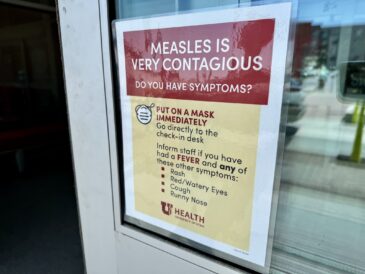
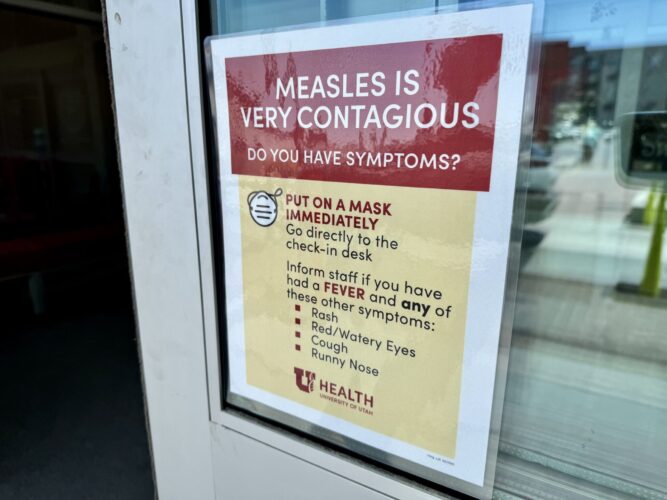
A University of Utah health clinic with a sign warning of measles is pictured in Salt Lake City on June 30, 2025.With more than 121 measles cases reported in the last three weeks while South Carolina hasn’t seen any new cases, Utah’s measles outbreak is now the most active in the U.S.
In total, 583 confirmed measles cases have been reported to Utah health officials since the outbreak began last year. Of those, 386 have been diagnosed in 2026 to date, while 197 were diagnosed in 2025, according to the latest numbers posted on the Utah Department of Health and Human Service’s website on Tuesday.
While South Carolina’s outbreak has seen a total of 997 cases since October of last year, the state hasn’t had any new cases reported since March 17. Utah, however, has seen 24 new cases in the last five days, making its ongoing outbreak now the “epicenter” of the country’s measles outbreaks, the University of Minnesota’s Center for Infectious Disease Research and Policy reported Wednesday.
According to Utah’s measles tracker dashboard, the biggest hotspots in the state include:
- The Southwest Utah Public Health Department‘s jurisdiction, which includes Washington, Iron, Kane, Beaver and Garfield counties. There, 249 cases have been reported.
- Utah County, with 93 cases.
- Salt Lake County, with 62 cases.
- The TriCounty Health Department‘s area, which includes Daggett, Duchesne and Uintah counties, with 59 cases.
- The Central Utah Public Health Department‘s area, which includes Juab, Millard, Piute, Sanpete, Sevier and Wayne counties, with 50 cases.
Of the state’s 583 confirmed cases, 47 people have been hospitalized. About 383 are under the age of 18, while 200 are adults.
About 485 Utahns who have been diagnosed with measles were not vaccinated, while 59 were, and 39 have an unknown vaccination status.
During the 2024-2025 school year, about 10% of Utah’s in-person kindergarten students had an exemption for the measles, mumps and rubella (MMR) vaccine or were missing documentation, according to state data. About 9% of in-person kindergarten students had an exemption to any school-required vaccine.
Last week, when Utah’s outbreak stood at 559 cases, Utah epidemiologist Leisha Nolen said the state hasn’t seen such a high number of cases in more than 40 years.
“The fact that now we’re seeing 20 people every week — in fact, probably more like 35 people every week get measles — is amazing and terrifying,” she said.
The concentration of the first measles cases were located in southwest Utah, but sometime in February infections started to spread to other areas of the state.
On the state’s website, Utah health officials maintain a running list of “exposure locations” where Utahns may have come into contact with a person infected with measles.
How to recognize measles and what to do
Measles symptoms usually appear seven to 14 days after exposure, according to health experts. Early symptoms include a high fever (of 101 degrees Fahrenheit or higher), cough, runny nose, or red eyes. A rash will also usually appear after four days of fever.
State health officials encourage anyone who develops symptoms to stay away from other people and call your health care provider before going to a clinic or a hospital to prevent others from being exposed.
Health officials also encourage parents to talk to their doctors about giving an early, extra dose of the MMR vaccine to their infants who are older than 6 months and younger than 12 months to protect them amid the outbreak, even if they haven’t been exposed to someone with measles.
Health officials usually recommend that infants who are 6 months to 12 months old get an early, extra dose of the vaccine if they are traveling internationally or to an area where measles is spreading.
But “given the high levels of measles in Utah, it is now appropriate to consider this early, extra dose for all Utah infants of this age,” state health officials say on the health department’s website. “Any infant who gets a dose before 12 months old will need to get 2 later doses in accordance with the standard vaccination schedule at 12-15 months and then a dose at 4-6 years.”
State health officials are urging all Utahns to make sure they are protected against measles, which can be deadly, especially for unvaccinated children. If you’re unsure about your vaccination status, talk to your doctor.