Symposium keynote speaker, panel discuss getting students, workforce into the nuclear energy sphere
Rob Nielsen, Standard-Examiner
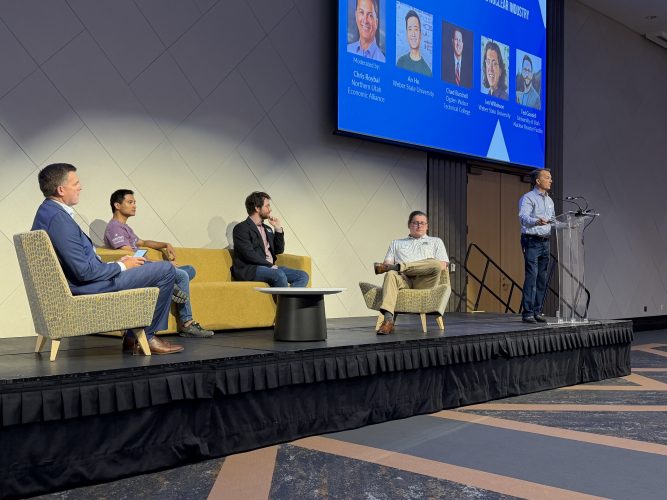
A panel speaks during the Weber County Nuclear Energy Symposium on Wednesday, Aug. 5, 2026.Editor’s note: This is the second of two stories covering the Weber County Nuclear Energy Symposium, held Wednesday in Ogden.
OGDEN — Is nuclear energy cool?
Dr. Matthew Memmott, associate professor of chemical engineering at Brigham Young University, is pretty clear about his feelings.
“Nuclear has always been cool,” he said as he opened his keynote address at last Wednesday’s Weber County Nuclear Energy Symposium. “Everybody else is just finally catching up.”
He said that while he thinks it’s cool, there is a reality to the matter.
“The reality is, nuclear energy has a really bad rap, and there’s reason for this,” he said. “The way it was introduced was tragic. Wartime destruction was an awful way to introduce this power to the public. Further, it’s not well understood. We have this mentality, this idea that radiation is bad, that it’s the silent killer. Any radiation is unacceptable. The problem is the science and the facts don’t bear that out.”
During his speech, Memmott discussed what radiation is, waste challenges and the economics of nuclear energy, as well as designs for advanced reactors that are safer and less wasteful designs than those of the past.
Education
The second panel, titled “Workforce Development for the Nuclear Industry and facilitated by Northern Utah Economic Alliance President Chris Royball, featured:
- Chad Burchell, Ogden-Weber-Technical College Vice President for Instructional Services;
- Dr. An Ho, assistant professor and Energy Engineering Program coordinator at Weber State University;
- Dr. Ted Goodell with the University of Utah reactor facility;
- Ian Wilkinson, instructor of energy engineering at Weber State University.
Burchell said tech colleges could play a huge role in providing workforce for the nuclear energy sector.
“It’s not just about nuclear engineers,” he said. “We know that it’s built on skilled trades, and that’s what we do. And whether it’s electricians, plumbers, nondestructive testing or examination or inspectors, operators, control operators and automation, we are prepared in the technical space to continue to provide that training. And in most cases, that training is provided in less than a year for our workforce.
He said programs will be adaptable as they’ve always been.
“Our students are trained in industry-specific required certifications,” he said. “So as those evolve, we are able as a tech college to change and evolve rapidly. Right now what we’re doing is we’re putting out those skilled trades now, and as this industry continues to evolve and come forward in the state, those skilled trades will be adaptable and ready to meet that need when that need comes. And whether it’s building these facilities or maintaining these facilities, that’s backbone — that’s what we’re going to need in the state is these skilled trades. So we’re excited to provide that. We’re poised to provide that.”
When asked what he thought will be different about nuclear energy careers and the education path to get people ready for it, Wilkinson said the industry will see some rapid reorganization and rewriting of the rules.
“I think the biggest change is going to be on the technical operational level,” he said. “Once we are starting to really build a lot of these new reactors — SMRs, molten salt reactors, so on and so forth — they’re going to require a different set of operational manuals and operation techniques and procedures than our massive current fleet does, which is all really old light water reactors. We know how to run those very well — we’ve been doing it for 60, 70 years — but the biggest change is going to be once we start operating all of these new reactor types on a wide scale, because then we’ll learn how to operate them.”
He said this won’t always be the easiest process.
“There’s probably going to be some mistakes along the line,” he said. “We had Three Mile Island. That’s a pretty big mistake, right? But we have learned from them very well and been able to create both an industry culture and a set of rules to follow that helps prevent far more mistakes from having happened in the future. So the core of training on a technical side, I think, will largely stay the same.”
In closing, all of the panelists were asked to bring in students and get them interested in the nuclear energy field as they’re beginning to contemplate careers in high school.
Ho said that students understanding their strengths will help them find what part of the nuclear industry fits them the best.
“Almost all prospective students that came to me and asked about the energy engineering program, the number one thing they (say) is, ‘I’m interested in nuclear engineering. I’m interested in nuclear power. It’s clean. There’s a Wikipedia article about how safe it is and all that.’ The question I always ask them is, ‘OK, that’s great, And I’m very glad you have that interest.’ And I would ask them, ‘What are your strengths? Look back into yourself first and be able to answer that. Are you more of a hands-on person? Do you like to work with hands? Do you like to work in a lab and be able to be experimental when you run a machine? Or are you more of an analytical thinker? Do you like to work with numbers? Do you like to be able to manipulate equations and play with those?’ Because nuclear engineering and energy engineering in general, it is a field, but it is a very broad field.”
Goodell touted the industry’s accessibility to multiple skill levels.
“You don’t need a Ph.D. to go into nuclear,” he said. “You don’t need a master’s degree. You don’t even really need a bachelor’s degree. If you want, you can actually get a license from the Nuclear Regulatory Commission to operate a nuclear reactor with just a high school diploma. And so I think a lot of people really underestimate how accessible this field is.”
Next steps
Following the symposium’s conclusion, Weber County Economic Development Director Stephanie Russell told the Standard-Examiner that the conversation on nuclear energy is only beginning in Weber County.
“We’re going to do a follow-up, probably either in December or January, where we do more of a listening session where we can actually have our community members come,” she said. “It will be focused on just asking questions about the direction we’re considering going. … This is just the first of many events to come, we hope.”