Utah’s intense, dangerous fire season could be its most expensive
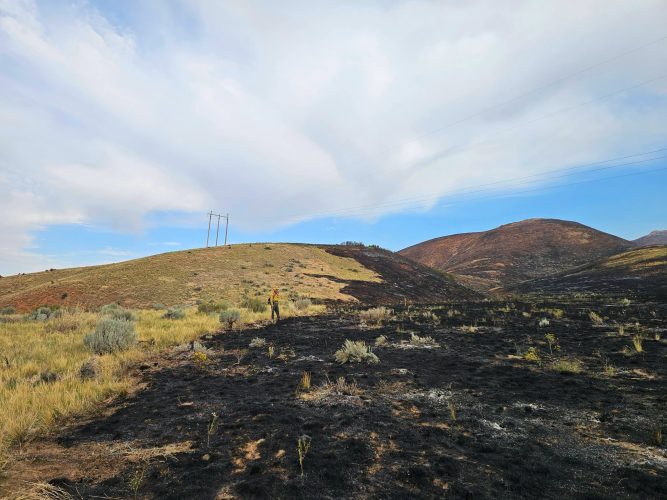
A firefighter looks over a burned area from the Rocky Canyon Fire near Henefer in a photo shared by fire officials on Tuesday, Aug. 11, 2026. (Photo by Samuel P Barlow Jr via Utah Fire Info)
Utah has burned through an estimated $33 million to fight raging wildfires this year, putting the state on track to outspend last year’s record total.
Inflation is partly to blame. But the rising cost also reflects the sheer size of this year’s fires, their encroachment on communities and the intense heat, drought and wind making them more resistant to containment, said Wade Snyder, deputy state fire management officer with the Division of Forestry, Fire & State Lands.
Then there’s the fact that it’s only August, and firefighters often battle fires into September.
“We’re not out of the woods yet,” Snyder said Monday. He said the estimated $33 million spent so far may grow by another third. He also cautioned that the numbers are preliminary and the exact costs won’t be sorted out for some time.
So far this year, more than 532,000 acres have burned across the state, making it Utah’s second-biggest wildfire year on record. In 2007, the season topped out at about 629,200 acres.
This year has been a perfect storm. Record-low snowpack, warm winter temperatures and stubborn drought primed forests to burn hot and fast, state officials said. They were alarmed when a forest fire was smoldering in the Uinta Mountains in March, noting slopes there are usually covered in snow that early in the year.
Gov. Spencer Cox has noted Utah’s been saving up for big years, building up its wildfire fund to more than $120 million. He and other state officials are floating the idea of freeing up other sources of state funding.
Utah Rep. Carl Albrecht, chair of the House Natural Resources Committee, told FOX 13 he’s been speaking with legislative leaders about opening up “rainy day” funds for firefighting, flood mitigation and aiding in community recovery.
The federal government picks up most of the state’s firefighting costs. Updated totals from the Division of Forestry, Fire and State Lands put last year’s overall firefighting cost at roughly $240 million, with the state’s share at $36 million, Snyder said.
Already this summer, federal funding is on the way, including to offset costs of battling the Cottonwood Fire near Beaver and the Cherry Fire in Juab and Tooele counties. On Monday, the Federal Emergency Management Agency announced it approved Utah’s request for aid in battling the Rocky Canyon Fire in Morgan and Summit Counties, which was burning Tuesday at more than 14,000 acres and was 23% contained after forcing evacuations in Henefer.
While FEMA didn’t say how much money it anticipates sending, the agency pledged to cover 75% of firefighting costs it deems eligible, noting individual homes and business owners don’t qualify.
And under an agreement signed by Cox and the U.S. Forest Service Chief Tom Schultz last week, the state and feds will both chip in more than $9 million to help with the aftermath of the Cottonwood Fire that torched more than 97,000 acres east of Beaver in July. Utah’s share will come from the state’s wildfire fund, according to the governor’s office.
And that’s to say nothing of the human cost. Two pilots died in a helicopter crash last week, while fighting the Widemouth 2 Fire in southern Utah. In an earlier tragedy in June, three members of a “helitack” crew died when they were trapped in a burnover incident on the Utah-Colorado border, and a fourth later died of the burn injuries. A surviving crew member was hospitalized.
“There’s a lot of people grieving right now,” Snyder said. “When we have a loss, it impacts us all.”