Fed Chair Warsh signals rate hikes may be needed with inflation still elevated
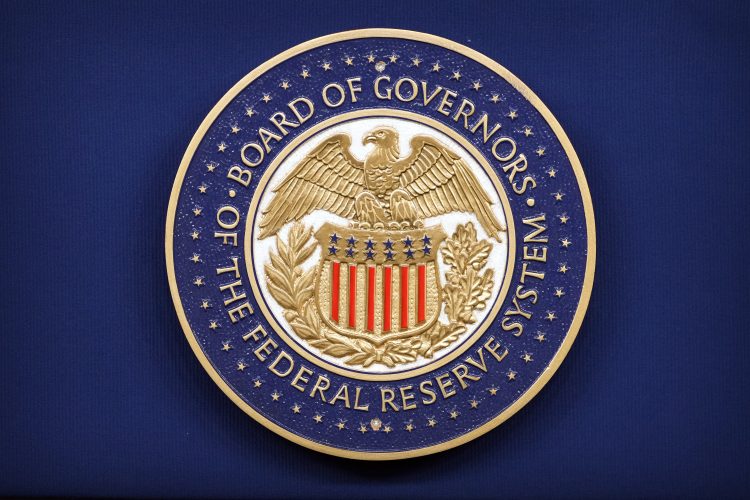
The logo of the Federal Reserve Board of Governors is seen before a news conference with Federal Reserve Board Chairman Kevin Warsh at the Federal Reserve in Washington, Wednesday, July 29, 2026. (AP Photo/Mark Schiefelbein)
JACKSON HOLE, Wyoming (AP) — Federal Reserve Chair Kevin Warsh said Friday that inflation is still too high and suggested the central bank may have to raise interest rates in the coming months to bring it down, a clearer signal than he had sent previously about his economic outlook.
In his first high-profile speech at the Fed’s annual conference at Jackson Hole, Wyoming, Warsh acknowledged that recent U.S. data show inflation has cooled a bit, but “they do not tell me that underlying trends have meaningfully improved.”
“We must be confident that underlying inflation is moving to our objective, clearly and at sufficient speed,” Warsh said. “Otherwise, we have work to do.”
The Fed chair, who replaced his predecessor, Jerome Powell on May 22, faces high stakes with his speech as questions swirl around Wall Street about his focus on fighting inflation.
Those concerns may have contributed to rising bond yields, which can increase the cost of borrowing for the government and everyone else. Yet Warsh has said he doesn’t want to provide what analysts call “forward guidance” about whether the Fed will hike or cut rates or stay on hold at upcoming meetings. He argues that it limits the Fed’s flexibility by committing it to a specific policy.
Yet some economists have argued that he could say more about his views on Fed policy without tipping his hand about future actions.
Warsh on Friday reiterated his skepticism about providing such guidance or even outlining his broad approach to interest-rate policy.
But he did suggest that interest rates currently aren’t restricting economic activity, pointing to robust business investment in AI equipment and infrastructure and strong consumer spending. As a rule of thumb, interest rates often need to be high enough to limit borrowing and spending to cool inflation.
The Fed next meets September 15-16, and Warsh’s remarks don’t necessarily signal the central bank will raise rates then. But his speech indicated that rates may not be high enough to bring inflation down to the Fed’s 2% target.
Warsh said inflation data “are more concerning” than trends on the job market, where the unemployment rate is low. He also argued that inflation is unlikely to move back to the target on its own.
Warsh noted that in the past year, 54% of goods and services tracked by the government have seen price increases of 3% or higher. While that is down from the pandemic peak, it is “well above” the 32% that saw such increases in the two decades before the pandemic.
Inflation cooled in June and July after spiking in May from soaring gas prices, yet it remains above the central bank’s target. According to the Fed’s preferred measure, it was 3.7% in July.
Warsh also sought to clear up some areas of confusion that arose after his remarks at a July 29 news conference. He specified that short-term interest rates are the “predominant tool” the Fed can use to lower inflation.
Previous Fed chairs have often used speeches at Jackson Hole to address broad questions about interest-rate policy and the economy, or to signal upcoming changes in their approach. In 2022, with pandemic-era inflation having soared to 9.1%, Warsh’s predecessor Powell signaled the Fed would continue to sharply raise interest rates in a fight against runaway prices, and he acknowledged that such maneuvers would bring “pain” to consumers and businesses.
Most analysts expect the Fed will keep rates unchanged when it meets next in mid-September. Wall Street investors, however, are betting the central bank will hike rates by December, according to futures pricing tracked by CME FedWatch.
Questions about Warsh’s approach have intensified amid President Donald Trump’s continued calls for lower interest rates. While Trump has continued to defend Warsh, whom he appointed, the president has criticized other Fed officials for supporting higher rates.
Trump has also renewed his efforts to remove Fed governor Lisa Cook, who was appointed by former President Joe Biden. Replacing Cook would enable Trump to appoint a majority of the seven-member board. Trump tried to fire her last year but was temporarily blocked by the Supreme Court.
If Warsh does assuage some of these concerns, longer-term interest rates could decline slightly. Those rates have steadily risen in recent weeks because of a range of factors, including burgeoning U.S. government deficits and outsize borrowing by tech firms building AI infrastructure.
The rate on the 30-year Treasury bond reached the highest level in 19 years last week, prompting an unusual effort by Treasury Secretary Scott Bessent to buy back bonds and push the yields lower.