Utah State Bar warns against lawmakers’ ‘aggressive’ moves to change courts
Attorneys worry legislators are spending millions on Utah Supreme Court expansion while lower courts need more resources. Meanwhile, other bills are piling up that they say could jeopardize safeguards against political influence on judges
Katie McKellar, Utah News Dispatch
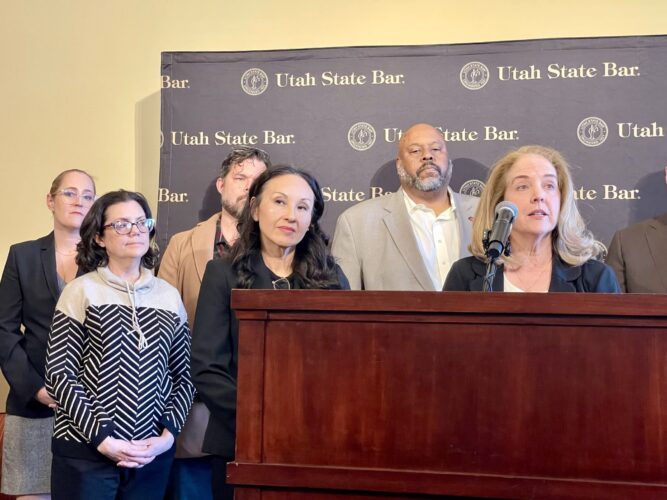
Utah State Bar President Kim Cordova, front left, and executive director Elizabeth Wright, right, hold a news conference at the Utah Capitol in Salt Lake City on Tuesday, Feb. 3, 2026.Days after Utah Gov. Spencer Cox swiftly signed a bill Utah lawmakers sent to his desk to expand the Utah Supreme Court by two justices — while also adding five lower-court judges — leaders of the Utah State Bar expressed concerns about the timing of that expansion while reiterating their opposition to a flurry of bills being considered by the 2026 Utah Legislature that would make a variety of changes to the state’s court system.
Utah State Bar President Kim Cordova and executive director Elizabeth Wright held a news conference at the Utah Capitol on Tuesday, after Cox signed the court expansion bill Saturday. It was among the first bills to win approval during the Legislature’s 45-day session that began just two weeks ago.
The Legislature approved SB134 last week despite objections from legal professionals urging lawmakers to use the more than $3 million slated to expand the Utah Supreme Court on other needs that Chief Justice Matthew Durrant highlighted in his State of the Judiciary Speech — especially more resources for the district courts.
That bill did include about $3.2 million for two additional Court of Appeals justices and three district court judges, which the Bar is supportive of. But it’s not enough for lower-court needs, especially judicial assistants, Cordova said.
“What we want to make clear is that the justice system and the judiciary and the courts desperately need resources, but they need them on the bottom end,” Cordova said.
Cordova said the court expansion comes after the state’s judiciary has been told “year after year that the budget is going to be tight.”
“But then to create a bill that’s going to cost citizens millions and millions of dollars in maybe a way that isn’t the most useful, you know, is concerning,” she said.
Retaliation or reform?
The timing of the expansion, Cordova said, is “interesting” given it comes “immediately after a number of controversial judicial decisions.”
It’s the second year the Utah Legislature has eyed changes to the judiciary after Republican lawmakers have clashed with the courts over several rulings, especially in the state’s redistricting lawsuit which recently led to a court-ordered map that includes one Democratic district and three heavily GOP districts.
Republican legislative leaders have said the expansion of the Utah Supreme Court isn’t political or “court packing” to get more favorable outcomes from the state’s highest court, but rather to get “more eyes” on complex state issues while also bringing Utah in line with other similarly-sized states’ supreme courts. They’ve noted that the judges will go through the same appointment process as those currently sitting on the bench, with the governor picking a nominee subject to confirmation by the Senate.
Republican legislative leaders have also argued that they “listened” to Durrant’s requests for more resources for the lower courts by providing the biggest funding boost to Utah’s judiciary in years — while also saying it’s rare for lawmakers to fully fund state departments’ budget requests.
In a brief published last week, the Brennan Center For Justice pointed to Utah as an example of a state where “courts that have ruled against legislative majorities in cases about redistricting in particular are met with retaliatory legislation.” The brief also highlighted Utah as being among multiple states where legislation has been considered “attacking judicial independence.”
Wright said it’s “healthy” to have a natural tension between the legislative and judicial branches.
“But if there’s retribution or other things involved, it’s clear the system is breaking,” she said. “We need to respect when one branch acts and makes a check, or when another branch passes a law, and that’s the sign of a healthy democracy.”
Last year, many controversial bills fizzled after lawmakers announced a compromise with the judiciary. But one bill to take away the Utah Supreme Court’s ability to select its own chief justice eventually became law after Gov. Spencer Cox vetoed an initial version of the bill.
This year, however, Cordova said lawmakers have been “a lot more aggressive,” adding that the Bar has received “a lot less advance notice” on bills impacting the courts.
“They’re more determined this year to make changes,” Wright said.
Other proposals — including one sponsored by Rep. Matt MacPherson, R-West Valley City, to create a new, three-judge “constitutional court” to hear lawsuits challenging Utah laws — also worry the Utah State Bar.
Cordova said taken together, all of the bills would have a “compounding effect” that would add up to major structural changes to the state’s court system in a way that could jeopardize the judiciary’s safeguards meant to prevent political influence.
“If you put them together, what it creates is an attack on the rule of law and a separation of powers issue,” Cordova said.
Utah’s current judicial nominating and retention process is “merit-based, and is one of the best models in the country,” she said, and it’s “something that needs to be fought for and needs to be protected.”
The Utah State Bar, according to its website, is opposing several bills, including:
- HB262, sponsored by Rep. Jason Kyle, R-Huntsville, which would increase the percentage of the vote required for a judge to win retention from 50% to 67%. “This would be the highest retention percentage in the nation,” the Bar said on its website. “We oppose this bill because it threatens the independence of the judiciary by creating greater opportunities for disgruntled litigants or political interest groups to impact judicial retention elections. This adversely impacts public trust and confidence in a judiciary system that can be so easily politicized.”
- HB274, sponsored by House Speaker Mike Schultz, R-Hooper, would change the makeup of the Utah Sentencing Commission by removing all defense lawyers from the commission and replacing them with more members from law enforcement. The Bar said it “strongly” opposes the bill because it “politicizes” the commission by restructuring it in a way that “favors law enforcement and partisan viewpoints.”
- HB366, sponsored by Rep. Jordan Teuscher, R-South Jordan, would change how district court cases involving cities are assigned and managed. The Bar said it opposes the bill because it “disrupts established court management practices, burdens district courts with justice court infractions and misdemeanors alongside serious felony cases and raises serious constitutional concerns regarding judicial independence.”
- HB392, MacPherson’s bill to create a “constitutional court.” The Bar said it “raises serious concerns about judicial independence by allowing the executive and legislative branches to appoint judges who may later hear cases involving those same branches,” while also diverting “taxpayer dollars and limited judicial resources to create a new court structure that is unnecessary and risks undermining public confidence in the judiciary.”
- HJR5, a proposed constitutional amendment sponsored by Kyle that would fundamentally change how judges are nominated in Utah. It would allow the governor to request a list of nominees from the Judicial Nominating Commission, but enable him to appoint any qualified candidate, even if they’re not on the commission’s list. “We strongly oppose this constitutional amendment because it fundamentally weakens Utah’s merit-based judicial selection system, which is heralded as a model for the nation,” the Bar said. “It undermines judicial independence by granting the governor unchecked authority to bypass nominating commissions and appoint judges of the executive’s choosing.”
- HJR13, a proposed constitutional amendment sponsored by Rep. Walt Brooks, R-St. George, which would allow the Legislature to initiate a “special retention election” for judges lawmakers determine are “unfit or incompetent.” The Bar said it opposes it because it “injects the Legislature directly into the judicial retention process, threatening the separation of powers.”
Changes to ‘constitutional court’ bill
Though the Utah Supreme Court expansion bill moved quickly through the legislative process, the other bills still face plenty of legislative hurdles — and some haven’t received a public hearing yet.
While the Utah State Bar expressed its concerns Tuesday, some Republican legislators signaled they were open to making changes to their proposals.
MacPherson, notably, changed his “constitutional court” bill on the House floor Tuesday afternoon to allow judges that would serve on the court to be “randomly” selected from judicial districts across the state rather than being directly selected by the governor and confirmed by the Senate.
“This represents a broad change of direction, but I think (it) brings us to a good compromise, (and) still gets us in a position where we’re able to have these cases heard quickly and better from the get go,” MacPherson said.
When asked about the Bar’s concerns in a media availability with reporters Tuesday morning, Senate Majority Leader Kirk Cullimore, R-Sandy, acknowledged that the collective impact of the bills being considered would be significant.
“In the aggregate, it is a lot,” he said, though he added “we’re going to take a look at these policies as they come across.”
It remains to be seen how many of these bills survive the 2026 Utah Legislature.
Local News
Utah State Bar warns against lawmakers’ ‘aggressive’ moves to change courts

60 years of helping: Ogden non-profit celebrates milestone, continues to support community mental health