Economists see decent year ahead for Northern Utah’s economy despite some labor market cooling
Rob Nielsen, Standard-Examiner
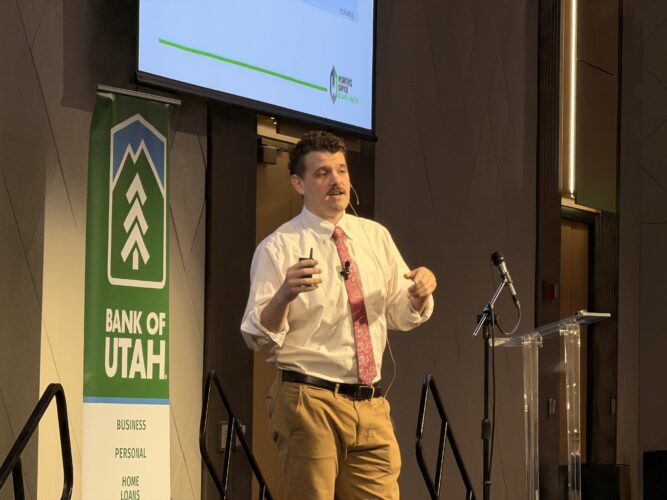
Michael Jeanfreau, senior economist with the Utah Department of Workforce Services, speaks at the Bank of Utah's Economic Forecast event in Ogden on Tuesday, Feb. 10, 2026.OGDEN — Economists are seeing some concerning trends for the state of Utah, but overall, they are confident 2026 will end on a positive economic note.
Tuesday morning, interested parties gathered at the Ogden Eccles Conference Center to hear local and national economists discuss their forecasts for the year at the Bank of Utah’s Economic Forecast event.
This included Michael Jeanfreau, senior economist with the Utah Department of Workforce Services, who said Utah is continuing to outperform the nation in many metrics.
“We’re, I believe, fifth right now for job growth year-over-year,” he said. “We’re doing pretty well, especially compared to some of our neighbors who are slowing down a little bit. Although, ‘slowing down’ is a little bit of the name of the game right now.”
He noted that unemployment statewide at the end of December 2025 was 3.6% compared to the 4.3% unemployment of the entire country.
However, Jeanfreau said there is a caveat.
“Utah’s labor market is cooling,” he said. “When they raise the federal funds rate — usually in this case to combat inflation and in 2022 we had that historically high inflation — they raised rates really quickly and the idea is they increase the cost of doing business. As they increase the cost of doing business, businesses change their behavior and you can see these job openings start to fall. … You see job openings decline a lot. Recently, they’ve gone down quite a bit. That’s not historically abnormal as you saw the longer view of this, but it is different than the market conditions that we saw for the few years after COVID.”
Jeanfreau said that there are far fewer opportunities for those looking to switch jobs.
He noted another metric that the department has seen trending upward over the last few years is the overall number of unemployment insurance claims.
“We’re not seeing waves of people being let go, but what you can see is a consistent upward trend — seasonality aside — in our continued claims,” he said. “The implication being there while we don’t have huge droves of people being fired from their jobs, people that are letting go are having a harder time getting back into the labor market and finding a new position for themselves. … Opportunities are decreasing a little bit for the average employee.”
Jeanfreau said that continued claims are around 16,000, the highest since the COVID-19 pandemic.
He also pointed out that several counties in Northern Utah are hovering around the state average for nonfarm job growth, including Weber County (0.9%), Morgan County (8.9%) and Box Elder County (2.5%). However, Davis County registered a 1.3% decline in growth.
“Davis is the one I’m a little sad about,” Jeanfreau said. “One-point-three isn’t a big decline, but we have seen losses within different industries up there, particularly government and manufacturing.”
In a brief overview of the year ahead, Jeanfreau said things are still trending in a positive direction for the most part, citing the Utah Economic Council’s predictions.
“We’re confident that a year from now, the living situation will be better than it was,” he said. “Total nonagricultural employment should increase by 1.5% — that’s faster than this last year. Average home prices should increase — that’s the one we disagree about the most.”
Jeanfreau was also joined by Tim Mahedy, founder and chief economist for Access/Macro who discussed the national economy.
The Bank of Utah will be holding similar private events throughout the remainder of the week in other cities along the Wasatch Front.
Business
Economists see decent year ahead for Northern Utah’s economy despite some labor market cooling

2026 Nissan Armada NISMO Edition — Big, bold and surprisingly nimble in Utah Valley