Utah’s redistricting fight heads to federal court; anti-gerrymandering plaintiffs ask to intervene
McKenzie Romero, Utah News Dispatch
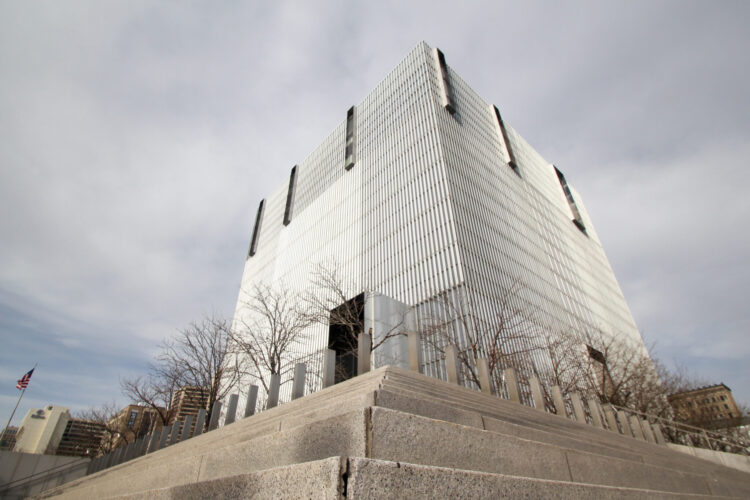
The Orrin G. Hatch United States Courthouse is pictured in Salt Lake City on Wednesday, April 9, 2025.A federal court has agreed to hear a lawsuit that two of Utah’s U.S. representatives have filed in hopes of blocking the state’s court-ordered congressional map from being used in the 2026 elections.
A three-judge panel is scheduled to hear Reps. Celeste Maloy and Burgess Owens’ request on Feb. 18 at the Orrin G. Hatch U.S. District Courthouse in Salt Lake City.
The lawsuit — filed by Maloy, Owens and nearly a dozen local leaders and sheriffs from across the state — names the state’s top election official, Lt. Gov. Deidre Henderson, as a defendant. It asks for a three-judge panel to void the state’s court-ordered map, which created one Democratic and three Republican districts.
The lawsuit argues the map was “unconstitutionally imposed and agreed to by state actors — specifically a state district judge and the lieutenant governor — with no authority” under federal or state law to impose a map “other than one adopted by the Legislature.”
The lawsuit’s arguments align with what Utah’s Republican legislative leaders have long contended in a separate anti-gerrymandering lawsuit that’s spent years winding its way through Utah’s state-level courts — that the Legislature has the sole authority to set the state’s political boundaries.
That’s despite recent court rulings that have determined the GOP-controlled Legislature overstepped its constitutional authority when it undid a 2018 voter-approved anti-gerrymandering ballot initiative known as Better Boundaries’ Proposition 4, which sought to create an independent redistricting process with neutral map-drawing standards.
Now the plaintiffs in Utah’s yearslong redistricting lawsuit — which ultimately led to the court-ordered map currently in place — are moving to get involved in the federal lawsuit, too.
Earlier this week, the League of Women Voters of Utah, Mormon Women for Ethical Government, and a handful of Salt Lake County voters filed a motion to intervene in the federal court case. If allowed by the court, they plan to file a motion to have the case dismissed, according to a news release issued by the Campaign Legal Center on Monday.
“This federal lawsuit has no merit and is the latest attempt to silence the voices of Utahns,” said Mark Gaber, senior director for redistricting at the Campaign Legal Center, which is part of the group’s legal team. “Instead of accepting the will of Utah voters and the judgment of Utah courts to allow a fair voting map to take effect, partisan actors are going to extraordinary lengths to put a gerrymandered map back in place. Elections should be determined by voters, and not by politicians who draw maps to skew outcomes.”
Katharine Biele, president of the League of Women Voters of Utah, said she and the other plaintiffs were “saddened by the lengths these desperate elected officials are going to overturn the will of Utah voters.”
“They have a fundamental misunderstanding of the state constitution and the rights it protects,” she said. “We are eager to continue to fight for Proposition 4 and the rights of Utahns to fair maps and to have their votes respected.”
Utah’s courts have so far resoundingly sided with the plaintiffs in the redistricting legal battle. The rulings have made clear that the Legislature doesn’t have unfettered power to change ballot initiatives — but that lawmakers must show a compelling government interest and not undermine voter-approved “government reform” laws when changing them.
Leaders of Utah’s Republican-controlled Legislature have disagreed with the Utah Supreme Court’s interpretations of the Utah Constitution, arguing that the Legislature has always had the sole authority to redistrict.
Senate President Stuart Adams, R-Layton, has said that the Utah Supreme Court’s ruling has created “chaos” in Utah’s legislative process and now threatens the state’s republic. He has also argued that the court-ordered map created four non-competative districts with high partisan skews, calling it the “most gerrymandered” map in Utah’s history.
The anti-gerrymanding lawsuit’s plaintiffs, however, argue that the court-ordered map they proposed to the judge as an alternative to one submitted by the Legislature best complied with Proposition 4’s neutral map-drawing criteria, which first and foremost prioritizes minimizing county and city splits.
They have also argued that one compact district concentrated around northern Salt Lake County is the natural result of Utah’s “political geography,” with a majority of the state’s population concentrated along the Wasatch Front.
“Utah’s voters and courts have made it clear: the people want fair maps,” said Caren Short, director of legal and research for the League of Women Voters. “Instead of respecting the will of the people, the legislature is now seeking to push a rejected legal theory in federal court. The League is proud to fight back to protect voters and fair maps.”
Local News
Utah’s redistricting fight heads to federal court; anti-gerrymandering plaintiffs ask to intervene
Blaming broken promises for Great Salt Lake, lawmaker threatens to block homeless campus