
After abuse, this dog spent 3 years in legal limbo. Now Utah shelters are backing ‘Biscuit’s Bill’
HB87 narrowly survives committee vote and now heads to Utah Senate floor. Animal shelters across Utah are urging lawmakers to pass it for Biscuit — and other abused dogs that wait years for loving homes
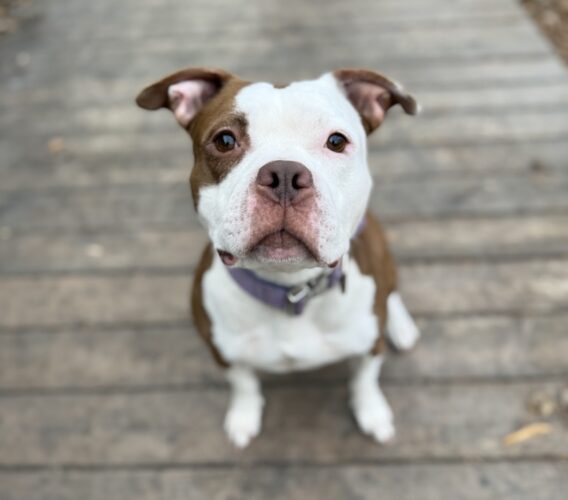
Photo Courtesy of Alexis Schulof
After being confiscated from a previous owner who was charged with animal abuse, Biscuit spent three years in a Salt Lake County animal shelter on a court hold before she was eventually allowed to be adopted.Biscuit was still a puppy — just 1 year old — when her owner at the time was charged with animal abuse.
“Her kennel mate did not survive the animal cruelty, but she did,” said Talia Butler, division director of Salt Lake County Animal Services.
But even after Biscuit was confiscated while her owner’s criminal case wound through the justice system, that wasn’t the end of her suffering.
Caught in legal limbo because she was considered property under a court hold, Biscuit spent more than half of her life — three years — living most hours of her days in a kennel at Salt Lake County’s animal shelter.
Now the 4-year-old pittie with a wide smile (sometimes called “piggy girl” by her new mom) has a new lease on life. Alexis Schulof, who volunteers for Salt Lake County’s animal shelter, was able to adopt her after Biscuit’s court hold was eventually lifted. But not until after years of waiting that left Biscuit with lasting emotional scars.
Biscuit’s story has a happy ending. But that hasn’t always been the case for other dogs who have been seized from abusive situations and spent years waiting to be eligible for adoption. Some die waiting or are euthanized before they can find homes.
A bill to change that, HB87 — nicknamed “Biscuit’s Bill” — is making its way through the Utah Legislature. It narrowly survived its second committee hearing on Tuesday, on a 3-2 vote, and now heads to the Senate floor.
The bill, sponsored by Rep. Verona Mauga, D-Taylorsville, has already cleared the House on a 40-24 vote, but it still needs to make it through the full Senate.
A similar bill Mauga ran last year made it through the House but died in the Senate when time ran out on the 2025 session.
This year, Mauga’s trying again.
Biscuit’s story
Schulof, who volunteered at Salt Lake County’s animal shelter, said she first met Biscuit when she organized dog playgroups.
“She was a rock star. Social and resilient,” Schulof told lawmakers during a Senate committee hearing Tuesday morning. “It was as if she understood that playgroups were one of her few chances to be outside of her kennel. But even being a rock star couldn’t save her from the reality at hand.”
For the other 20 hours of her day, Biscuit sat solitary in her kennel, “not because she was unadoptable, but because she was stuck in legal limbo,” Schulof said. “We cannot call that humane.”
Despite the challenge of spending much of her life in a cage, Schulof said she “witnessed a dog, who after three years of confinement following abuse, still showed us who she wanted to be: a good dog.”
“Three years in a kennel doesn’t just disappear overnight. Healing takes time,” she said. “But when Biscuit finally became available, I took her home because I wanted to show her that her fight wasn’t for nothing.”
Schulof brought Biscuit home on Christmas Eve last year.
But had Utah law provided a way to allow dogs like Biscuit to be eligible for adoption, rescue organizations or foster homes, she could have left the kennel behind years earlier.
That’s what Mauga is trying to do with HB87.
It’s being supported by animal shelters across the state, including Salt Lake County Animal Services, and by volunteers like Biscuit’s new mom.
“Biscuit isn’t just a name on a bill,” Schulof said. “She represents thousands of dogs who have survived abuse, only to be failed by the system meant to protect them.”
For animals that are “lawfully impounded” in connection with criminal animal cruelty cases, Mauga said her bill would create a court process to allow a judge to review an animal’s custody while the criminal case plays out, “so the court can address placement rather than requiring the animal to wait for the entire case to be resolved.”
“When someone is charged with animal abuse, the criminal case can take months or even years to resolve,” Mauga said. “During that time, the animal involved often remains in a shelter with no clear legal mechanism to determine long-term placement. This places a strain on already overcrowded shelters, impacts the well-being of the animal, and can become a significant burden on taxpayers.”
Had Mauga’s bill been law when Biscuit was confiscated, the shelter could have filed a motion for a judge to review whether she should be forfeited or transferred to alternative care “in the first hearing,” Butler said.
“This would have saved Biscuit over 1,000 days at the shelter and over $20,000” in taxpayer dollars for Biscuit’s three years of care, Butler said.
While HB87 is named after Biscuit, it could be named after many other dogs, Butler said, like “Blue’s bill or Bunny’s bill.”
“There’s so many,” she said.
The dogs suffer. So do shelter staff
A shelter is “meant to be a short-term refuge, not a permanent home,” said Michelle Hicks, director of Davis County’s Animal Care program. “After months in a kennel environment, even the most resilient dogs begin to deteriorate mentally and physically.”
One dog named Frostbite, she said, had been held in the shelter for more than 80 days, “and he was losing his mind in his kennel. Eating everything, eating the walls. … Delaying this only further hurts them.”
She said Mauga’s bill would also help relieve what’s become a morale issue for animal shelter workers and volunteers. She said it “fuels compassion fatigue and burnout amongst the most dedicated public servants.”
“It is heartbreaking to explain to a staff member that we cannot move a dog into a loving home or a rescue, and not because we don’t have one ready, but because the law views the dog as an inanimate piece of evidence rather than the victim needing resolution,” Hicks said.
“Our team members enter this profession because they care deeply about animals, yet they are the ones that must witness this legal limbo every single day,” she said. “Watching dogs like Frostbite and Piranha lose their spirit and their strength over the course of several months takes a devastating toll.”
These dogs “aren’t just property,” Hicks said.
“Their lives are being spent in suspension while the legal system grinds slowly,” she said. “While we wait, they take up kennel space that could be used for other animals in need. And we are essentially just providing indefinite boarding for defendants, who in many cases are intentionally trying to delay justice.”
Hicks urged lawmakers to support the bill “to ensure that no more animals and no more shelter teams have to endure the indefinite suspension of justice.”
Salt Lake County Council member Dea Theodore, a Republican, also supported the bill, saying it’s the “humane thing to do” while also saving taxpayer money.
Bill barely survives committee
Ultimately “Biscuit’s Bill” advanced out of the Senate Judiciary, Law Enforcement and Criminal Justice Committee on Tuesday by one vote.
But one lawmaker, Sen Brady Brammer, R-Pleasant Grove, expressed concerns that its language was “a little loose” and created ambiguity when it came to “animals associated with a crime.” He questioned whether it would apply to dogs, for example, that were trained to attack.
“I also think the policy is quite cumbersome,” Brammer said. “I would probably prefer something that says you have to give notice to the owner and their household, and if nobody picks it up, it’s forfeited. Or they have to pay the bill to pay for the animal.”
Brammer and Sen. Heidi Balderree, R-Saratoga Springs, voted against the bill, but three other lawmakers voted to endorse it and advance it to the Senate floor.
Sen. Todd Weiler, R-Woods Cross, encouraged Mauga to amend the bill on the Senate floor to address concerns, but he voted in favor of it.
“This looks like a really good bill,” he said. “I’m surprised we left this many gaps in the law.”
Local News
After abuse, this dog spent 3 years in legal limbo. Now Utah shelters are backing ‘Biscuit’s Bill’
State exploring moving offices located in Ogden Regional Center from downtown Ogden to new location on 12th Street