
In new redistricting lawsuit, federal panel weighs whether to overturn Utah’s court-ordered map
U.S. District Court judges hear arguments from 2 sitting Utah members of Congress to toss the state’s court-ordered congressional map and revive 2021 boundaries. Lt. Gov. says she needs a ruling by Monday
Katie McKellar, Utah News Dispatch
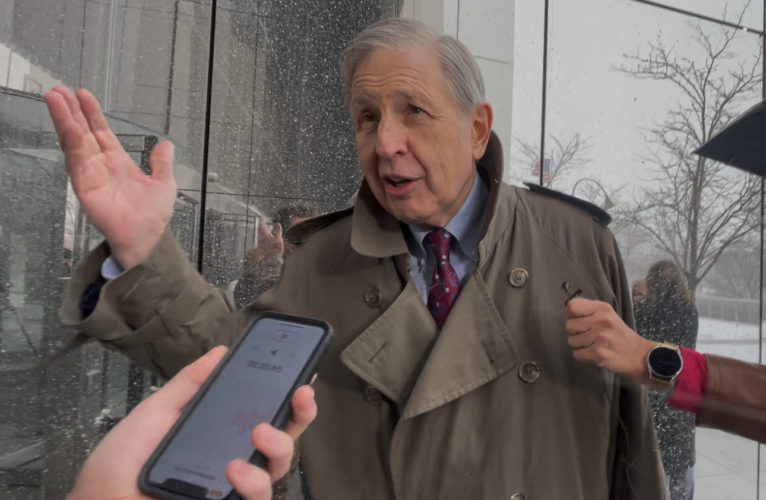
Attorney Gene Schaerr representing the plaintiffs in the federal case seeking to overturn Utah’s court-ordered congressional map speaks to reporters outside the Orrin G. Hatch U.S. District Courthouse in Salt Lake City on Wednesday, Feb. 18, 2026.As a blizzard descended on Salt Lake City on Wednesday, a federal three-judge panel spent hours grilling attorneys on opposing sides of a new redistricting lawsuit seeking to throw out a state judge’s earlier decisions that voided Utah’s 2021 congressional map and ordered a remedial map that created one Democratic and three Republican districts.
After three hours of arguments and questioning, the judges did not issue a decision from the courtroom at the Orrin G. Hatch U.S. District Courthouse but took the case under advisement.
What they ultimately decide will have major implications for Utah’s 2026 congressional elections.
Will the court-ordered map imposed by 3rd District Judge Dianna Gibson stand? Or will they reinstate Utah’s 2021 congressional boundaries? Gibson previously ruled the 2021 map was the result of an unconstitutional process after the Utah Legislature drew it in the wake of undoing a 2018 voter-approved anti-gerrymandering law known as Proposition 4 that she’s since reinstated as Utah law.
Attorneys for Utah’s top election administrator, Lt. Gov. Deidre Henderson, said her office needs an answer on which congressional map will govern the 2026 elections by Monday in preparation for candidate filing deadlines that the Utah Legislature have already pushed until mid-March.
Two members of Utah’s current all-Republican congressional delegation — Reps. Celeste Maloy and Burgess Owens — along with nearly a dozen local leaders and sheriffs filed the lawsuit earlier this month against Henderson.
They’re asking the federal panel to declare the state’s court-ordered map as “unconstitutionally imposed and agreed to by state actors — specifically a state district judge and the Lieutenant Governor — with no authority” under federal or state law. They argued Utah’s courts have no authority to impose a map “other than one adopted by the Legislature.”
But the plaintiffs in a separate yearslong redistricting lawsuit at the state level (which led to the court-ordered map Maloy and Owens are now contesting) argued that the U.S. District Court should dismiss the case because federal law not only allowed — but required — Gibson to impose a court-ordered map after the Legislature failed to enact a lawful one.
The plaintiffs in that previous state case include pro-democracy groups including League of Women Voters of Utah and Mormon Women for Ethical Government. The three-judge panel granted their request to intervene in the federal case.
Henderson’s attorney said her office did not have a position on the merits of the case, but rather urged the judges to make a swift decision so Utah voters and candidates would have certainty about what their political boundaries will be for the 2026 elections.
Who are the judges?
The three judges who make up the federal panel include:
- U.S. District Judge Robert Shelby for the District of Utah
- 10th Circuit Judge Timothy Tymkovich, based in Colorado
- U.S. District Judge Holly Teeter, for the District of Kansas
Shelby is most known for his landmark ruling overturning Utah’s ban on same-sex marriage in 2013. He was nominated to the bench in 2011 by then-President Barack Obama and confirmed by the U.S. Senate in 2012.
The other two judges on the panel were nominated by Republican presidents. Tymkovich was nominated to the 10th Circuit Court of Appeals by former President George W. Bush in 2001 and confirmed in 2003. Teeter was nominated to the District of Kansas by President Donald Trump and confirmed in 2018.
Debate
Gene Schaerr — an attorney representing Maloy, Owens and the other plaintiffs in the federal case seeking to overturn Utah’s court-ordered congressional map and reinstate the Legislature’s 2021 map — argued that Gibson never specifically determined that the 2021 map was “substantively unlawful.”
Rather, Schaerr said Gibson took a “fruit of the poisonous tree approach” when she voided it and replaced it with a court-imposed map — a decision that he described as “perverse” and beyond her judicial powers while not respecting “legislative prerogative.”
“It’s the height of disrespect to the Legislature to say, ‘I’m going to invalidate your framework’ … and then automatically invalidate everything you’ve done under that framework,” Schaerr said.
After rejecting the Utah Legislature’s proposed map, known as map C, to replace the 2021 boundaries that she determined were the result of an unconstitutional process, Schaerr argued Gibson should have directed the Legislature to “try again” to draw a lawful map that adhered to Proposition 4’s neutral map-drawing standards. Instead, she picked a map drawn by the plaintiffs in the case.
The U.S. and Utah constitutions and state and federal law do not “empower” judges to impose a map “that the Legislature hasn’t drawn,” Schaerr argued. He urged the federal judges to hold that Utah’s court lacks the authority to “draw its own maps.”
Mark Gaber, an attorney with the Campaign Legal Center, represented the League of Women Voters and the other intervenors during Wednesday’s hearing. He argued there’s plenty of legal precedent that allows state courts to impose court-ordered maps when lawmakers fail to lawfully redistrict.
“The Supreme Court has held for decades that state courts are authorized and obligated to impose maps,” Gaber said. “When the legislature has failed to enact a lawful map, it is the lawful obligation of (the court) to impose that map.”
He also argued that during the court’s remedial map process, Gibson did find that the 2021 map was “substantively unlawful,” noting that the court’s factual findings showed the 2021 map was more of an “extreme gerrymander” than the Legislature’s proposed replacement map, known as map C, which she also rejected as an “extreme partisan gerrymander.”
The three judges grilled both Schaerr and Gaber on a variety of scenarios, including what would happen if they granted the request for an injunction on Gibson’s court-ordered map, but they couldn’t reinstate the 2021 map as lawful.
Schaerr said that drawing a whole new map is “something the Legislature can do very quickly.” He added that the Legislature “also has the ability to make some adjustments” to election filing deadlines if the court decided it would enjoin Gibson’s court-ordered map and “send the whole issue back to the Legislature.”
But with Monday’s deadline just days away, Tymkovich questioned whether that would be possible, given the Legislature hasn’t moved to draw a new map in the months since Gibson imposed the current one.
Gaber also argued that by waiting months before filing the federal lawsuit, Maloy, Owens and the other plaintiffs’ request is past due and weakens their arguments that they were irreparably harmed by the court-imposed map.
“You cannot show irreparable harm if you wait until the twelfth hour,” Gaber said.
Tymkovich also asked “where is the Utah Supreme Court in this?” He mulled whether the three-judge federal panel should wait to see how the state’s highest court would rule on the Legislature’s ongoing appeal of Gibson’s decision.
The Legislature’s attorneys have asked for a response from the Utah Supreme Court by Friday. It’s not clear whether that decision will indeed come by then, but it may.
Gaber argued that the “sole question” the federal court needed to answer is whether a state court could impose a remedial map after it blocked a previous map as unlawful. Several previous court rulings from other states, he argued, “answer that question repeatedly and directly,” affirming that state courts do have the power and obligation to act when legislatures fail.
After about three hours, Shelby thanked the attorneys for their briefings. The judges left the bench without indicating specifically when they expect to issue a ruling.
Given Monday’s deadline, however, a decision is likely to come sometime before then or the day of.
After Wednesday’s hearing, Schaerr told reporters outside the courthouse he’s “optimistic the court will understand the importance of enforcing the election’s clause (of the U.S. Constitution), and the respect and deference to state legislatures that it requires.”
He said Maloy, Owens and the Legislature are hoping the court will either restore the 2021 map or “send it back to the Legislature” to draw a new map.
Gaber told reporters state courts have a duty to ensure the state will have a lawful map to govern congressional elections.
“And that’s exactly what Judge Gibson did here,” he said. “She gave an opportunity — a long opportunity — to the Legislature to pass a legal map. They passed an illegal map. They violated the most basic requirement of Proposition 4. They had partisan data on the screen when they drew the boundaries, and admitted that in court. That was their choice. And it resulted in the fact that the state court had to impose a map.”
Gaber described the lawsuit filed by Maloy, Owens and the other plaintiffs as “just a kitchen sink effort to try to get the map changed by any court.”
“The federal case law that this court has to consider is clear,” he said, “that state courts are empowered to impose maps. They have an obligation under federal law to do that.”
Local News
In new redistricting lawsuit, federal panel weighs whether to overturn Utah’s court-ordered map
Despite early fears, Red Cross of Utah home fire responses continued to trend downward in 2025
