‘Biscuit’s Bill’ fails in Utah Senate. Shelter animal advocates say they’ll keep fighting
Supporters say they’ll try to revive the bill. If Utah lawmakers don’t act, advocates warn abused animals will remain stuck in shelters longer at taxpayers’ expense
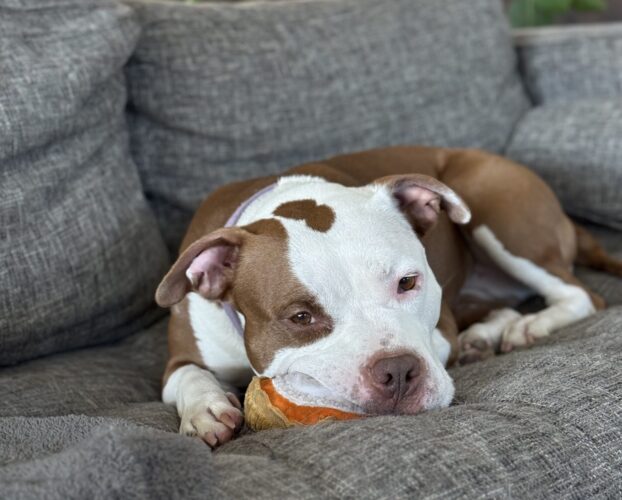
Photo Courtesy of Alexis Schulof)
After being confiscated from a previous owner who was charged with animal abuse, Biscuit spent three years in a Salt Lake County animal shelter on a court hold before she was eventually allowed to be adopted.For two years now, animal advocates have urged Utah lawmakers to do something to help cats and dogs saved from abusive situations only to spend months or years stuck in animal shelters as their owners’ criminal cases wind slowly through the courts, with taxpayers footing the bill.
They may go another year without a solution.
On a 12-16 vote, HB87 — also known as “Biscuit’s Bill” — failed to advance through the Utah Senate on Thursday. There’s an effort underway to revive it during the Utah Legislature’s 2026 session, but it remains to be seen whether its sponsor, Rep. Verona Mauga, D-Taylorsville, will be successful.
For animals that are “lawfully impounded” in connection with criminal animal cruelty or abuse cases, Mauga said her bill would create a court process to allow a judge to review an animal’s custody while the criminal case plays out, “so the court can address placement rather than requiring the animal to wait for the entire case to be resolved.”
Currently, an impounded animal under a court hold cannot be adopted or go to a foster home. Some don’t survive the wait.
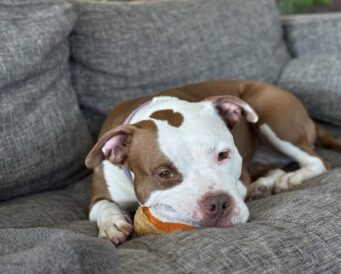
The bill was nicknamed after Biscuit, a dog who spent more than three years stuck at Salt Lake County’s animal shelter after she was confiscated from her previous owner, who was accused of animal abuse.
In legal limbo while her owner’s criminal case slowly progressed, Biscuit spent more than 1,000 days in the shelter with no ability to leave because she was considered property under a court hold. Her more than three years of care cost over $20,000 in taxpayer dollars, according to Salt Lake County Animal Services.
Alexis Schulof, a volunteer at Salt Lake County’s shelter, was eventually able to adopt Biscuit after her court hold was lifted. She took her home on Christmas Eve last year. But the years of waiting in a kennel left Biscuit with emotional scars that Schulof said she’s still working to help heal.
On Thursday, when the Utah Senate voted down the bill named after her dog, Schulof told Utah News Dispatch that Biscuit was of course oblivious — happily focused on playing in the freshly fallen snow.
Schulof, while disappointed, said she isn’t going to give up fighting for dogs like Biscuit.
“This is important for animals across Utah, but it’s also important for our community and the morale of those that work at the shelters,” she said. “I think the community also just doesn’t realize what we’re doing with animals (saved from) abuse.”
Schulof said she wished more lawmakers would “come see what being in captivity for three years actually looks like for the animal, what it actually looks like for employees.” She said it’s unbearable to watch dogs who are “spinning off the walls and eating everything” with no definite timeline for even the possibility of an alternative living situation.
“It can’t be the case that we allow victims of animal abuse to continue to sit in a system where they are so stressed,” Schulof said.
For humans, solitary confinement is reserved for “the worst of the worst,” she said.
“It is so cruel that we do it to animals who have done nothing, and then end up losing their minds as a result of it,” she said, adding that “we end up killing them” in many cases after those animals develop behavioral problems because of their confinement.
“It just doesn’t make sense,” Schulof said, calling HB87 a “no brainer.”
Floor debate
It was likely that “Biscuit’s Bill” would run into trouble in the Senate after it barely passed out of a Senate committee by just one vote earlier this week. In that hearing, Sen. Brady Brammer, R-Pleasant Grove, expressed concerns about its language being a “little loose” and creating ambiguity when it came to “animals associated with a crime.” He questioned whether it would apply to dogs, for example, that were trained to attack.
The bill’s Senate sponsor, Sen. Jen Plumb, D-Salt Lake City, changed the bill on the Senate floor in an attempt to address Brammer’s concerns. But the changes didn’t persuade him.
“This may be making it better, but it creates a procedure that I just view as very opaque, and a difficult procedure to follow,” he said. “I’m pretty familiar with court procedure, and as I was reading through this, I wasn’t exactly clear on what happens when an animal is impounded and how that all works.”
Brammer said he worried that by creating an entirely new court process, anyone dealing with an animal abuse case would then also have to deal with a separate court proceeding at the same time.
“I think there’s a responsibility to pay for the care of the animal, and it should be paid immediately. Otherwise, they forfeit the animal,” he said. “I know people love their animals, but I’m not there on this. … The solution is not more procedure. The solution needs to be clarity, and I don’t think the procedure built in very much clarity.”
Plumb said she and Mauga were open to improving the bill’s language.
When it came to the vote, margins were close, with several Republicans joining Democrats in supporting the bill. But when it appeared that the bill would fail, Senate Minority Leader Luz Escamilla, D-Salt Lake City, quickly changed her “yes” vote to a “no” in order to position herself to be able to help revive the bill — if the bill’s proponents are able to drum up enough support.
Lawmakers who vote on the “prevailing” side of a bill’s vote (in this case, the no votes), can make a motion to reconsider it. That’s why Escamilla said she changed her vote at the last minute.
“I’m hoping to bring it back,” Escamilla told reporters on Thursday.
If lawmakers do revive the bill, it would need to happen by the end of the day Friday.
Mauga told Utah News Dispatch she wants to address Brammer’s concerns “and see what we can do to push this bill through.”
“I don’t know if we can do it, but we are going to try as hard as we can,” she said. “This is such an important bill, and I think it’s an important issue to address.”
Mauga sponsored a similar bill during last year’s legislative session, but it died in the Senate when time ran out. She said she hopes the issue doesn’t need another year to fix.
“My hope is that we won’t have to bring it back (next year) because it passes tomorrow,” she said.
The bill has also been supported by animal shelters across Utah, including in Davis County and Salt Lake County.
Ashley Bales, spokesperson for Salt Lake County Animal Services, told Utah News Dispatch on Thursday that shelter staff were disappointed to see HB87 fail, but they intend to keep fighting to pass the bill – whether it’s this year or next.
“We’re still fighting for the animals like Biscuit and hoping that we can bring it back,” she said. “We’re going to do our best to revamp it.”
But Bales said the longer Utah law remains the same when it comes to seized abused animals, the longer those animals have to wait indefinitely for better living situations.
“We have animals in our custody right now,” she said, “that are continuing to wait.”