Utah lawmakers again weigh whether to require in-person ID for by-mail ballots
The House moves to ask voters whether to make the state’s top election official an elected Secretary of State. It remains to be seen what bills will survive the Senate
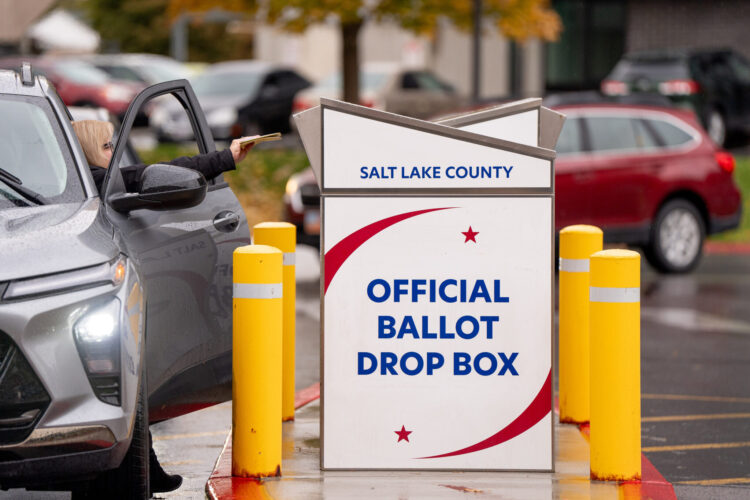
Photo by Spenser Heaps for Utah News Dispatch
A voter drops off a ballot in a drop box at the Salt Lake County Government Center in Salt Lake City on Election Day, Tuesday, Nov. 5, 2024.With one week to go until the end of the session, Utah lawmakers are still sorting through a flurry of complex bills that would make a wide variety of changes to Utah’s elections and voter privacy laws.
It remains to be seen which proposals will ultimately survive both the House and Senate — but here’s a breakdown on what legislators have been working on so far:
In-person ID requirements
It’s the second year in a row that one of Utah’s most powerful Republican state leaders, House Speaker Mike Schultz, has backed a bill that would require Utahns to personally return their mail-in ballots at a staffed drop box or voting center while showing a form of identification — unless they get permission to return their ballots in the mail.
Schultz, R-Hooper, supported a version of that bill last year, but after the Senate weighed in, the 2025 Utah Legislature ultimately passed a watered down version that required Utah voters to write four digits of their state identification number on their by-mail ballots’ return envelopes, while slowly phasing out the state’s automatic vote-by-mail system.
This year, with HB479, sponsor Rep. Jefferson Burton, R-Provo, is trying again to require in-person voter ID requirements for by-mail ballots that are turned in at drop boxes. Those in-person checks would take effect beginning in 2027, and starting in 2029, Utahns would not receive a by-mail ballot unless they request one every eight years. They would not be allowed to return a ballot by mail unless they make a “timely” request to do so.
Wednesday, Burton’s bill won an endorsement from a House committee on an 8-3 vote, with Democrats voting against. The bill now goes to the full House for consideration.
The bill’s critics argued it would create unnecessary obstacles making it harder for Utah voters to cast their ballots when the state’s election system is already widely secure.
Critics also worried about the cost of requiring counties to staff drop boxes to check voter IDs. Fiscal analysts estimated that Burton’s bill could cost as much as $10 million. But Burton in Wednesday’s committee hearing disputed those estimates.
“We absolutely do not accept or believe that that’s going to be $10 million,” Burton said, adding that the estimate was “based on every single voter using this methodology to vote.” He noted that under his bill, voters could still get permission to vote by mail or they could vote in person at a voting center.
Under Utah’s current vote-by-mail system, most voters receive by-mail ballots. Many return them in the mail or use ballot drop boxes, which aren’t currently required to be staffed. Ballots are currently verified by clerks matching signatures. Starting this year, voters will also already be required to include the last four digits of their state ID or Social Security on their by-mail ballot envelope.
Burton, a retired Utah Army National Guard officer, argued that his bill wouldn’t make voting too difficult while requiring more security. He said he’s lived in countries where “people die for the right to vote.”
“They don’t mind getting out of their easy chair. In fact it’s the greatest day of their life. I’ve seen people sobbing because they got to go vote,” Burton said. “We have to protect this. If you look at what goes on in this world, the first thing subversive organizations do is challenge your belief in the voting system, and that is why we have multiple ways to vote. And we encourage people to use their ID when they vote.”
Though multiple audits have shown that Utah’s vote-by-mail system does not have widespread fraud, Schultz and Burton have argued those audits have found instances of errors in the voter rolls, like two ballots cast in 2023 by “dead” voters. That was out of more than 2 million registered voters.
Secretary of State
The House on Thursday voted 57-12 to advance HB529, which would transfer the election duties currently assigned to the lieutenant governor to a new elected position titled Secretary of State.
But in order for that to happen in 2028, as HB529 calls for, Utah voters would need to sign off on the change through a proposed constitutional amendment. Alongside the bill, the House also passed HJR25, which would put the question to Utah voters during the 2026 election.
The bill and resolution, sponsored by Rep. Lisa Shepherd, R-Provo, have both cleared the House, but they may hit pushback in the Senate.
In recent media availabilities with reporters, Senate Republican leaders have questioned whether transferring the lieutenant governor’s duties to a different elected position would actually resolve worries about the top election official having a conflict of interest in overseeing the voting, since the secretary of state would also be an elected position.
Additionally, Senate Majority Assistant Whip Mike McKell, R-Spanish Fork, noted a separate omnibus election bill he’s running, SB194, includes a provision that requires the lieutenant governor to create a “conflict of interest avoidance plan.” That bill has already won support from the full Senate.
Senate President Stuart Adams, R-Layton, noted that “one of the challenges” with Shepherd’s proposal is that it would require a constitutional amendment.
“So that will probably weigh into the discussion,” Adams said. “So we’ll look at those merits, pro and con, and you’ll know by the end of the session what we think of the bill.”
Senate Minority Leader Luz Escamilla, D-Salt Lake City, questioned whether creating a new secretary of state position to administer Utah’s elections is “necessary.”
Shepherd, on the House floor, argued the state’s current lieutenant governor position is “insulated from accountability and direct election from the people” because it’s elected on a “joint ticket” with the governor.
“It’s like putting the referee in the middle of the game and having them be the starting quarter back, and with the team manager being on the joint ticket,” she said. “No other elected official in our government doesn’t have a direct accountability for the duties that they do.”
Shepherd said her proposal “is not about any current or elected individuals” serving Utah, but she argued it’s “time” to make Utah’s top elected official a distinct elected position — the way most other states handle elections and the way the Utah Constitution had it before a constitutional amendment in 1974 to assign the election duties to the lieutenant governor.
Omnibus election bill
SB194 is an omnibus election bill sponsored by Sen. Mike McKell, R-Spanish Fork, that would implement a variety of technical changes including:
- Banning county clerks from taking action in their capacity as a clerk “that shows partiality or discrimination for or against” a candidate, a ballot measure or political contribution.
- A requirement that the lieutenant governor create a “conflict of interest avoidance plan.”
- Measures to criminalize, as part of the state’s election code, using voter registration records to dox people “with the intent to retaliate against, threaten, interfere with, or fraudulently influence a person in relation to an election process.”
- A clarification that clerks must verify both signatures and the last four digits of voter identification numbers on returned by-mail ballots.
- A requirement that incumbent county clerks who are running for reelection to contract with another county clerk to help verify candidate signatures for that race.
- A measure that specifies midterm vacancies must be filled by a member of the same political party as the prior office holder when they were last elected or appointed.
- Allows candidates or office holders to use campaign funds to “reasonably purchase goods, other than weapons, or services, for the purposes of protecting” themselves or their family’s security, such as a security system.
McKell’s bill has cleared the Senate and won approval from a House committee on Friday morning. It now goes to the full House for consideration.
Bill to require proof of citizenship
HB209, sponsored by Rep. Cory Maloy, R-Lehi, would create a “bifurcated ballot system” for elections starting in November 2026, where a voter chooses whether to provide documentary proof of United States citizenship when registering to vote or before voting.
Those voters who do not provide “documentary proof” of U.S. citizenship would then only be able to vote in races for federal office, not any state or local offices. Federal law does not require proof of citizenship to vote for members of Congress or the president.
His bill would also provide a process for election officials to “independently determine” whether a registered voter is not a U.S. citizen, and would ban them from voting in state and local elections if they don’t “successfully dispute the determination.”
That bill has already cleared the House and is waiting for a second vote in the Senate.
But McKenzie thanked Johnson for working with him to address clerks’ concerns.
The bill has won support from the Senate and a House committee. It now goes to the full House for consideration.