Veterans Treatment Court extended to Second District Court
Rob Nielsen, Standard-Examiner
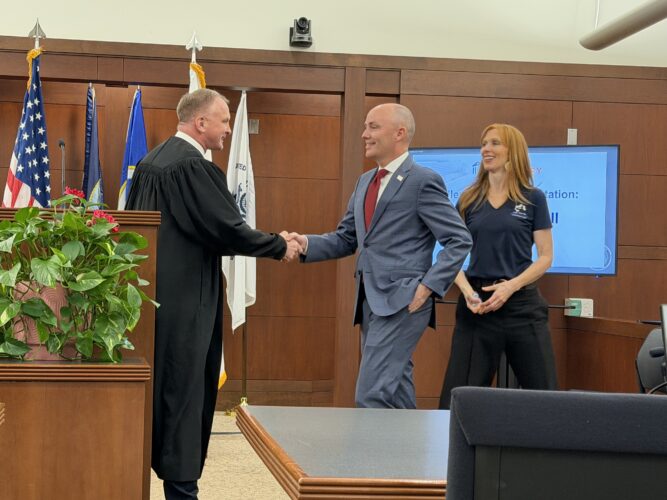
Second District Court Judge Craig Hall, Utah Gov. Spencer Cox and Jennie Taylor celebrate the arrival of a Veterans Treatment Court program in the Second Judicial District on Monday, Jan. 5, 2026.OGDEN — A specialized program designed to support military veterans who become involved in the criminal justice system is now being implemented in the Second Judicial District.
During a press conference Monday morning in Ogden, it was announced that a Veterans Treatment Court program will be implemented in the Second District, which includes Davis, Morgan and Weber counties.
“This program represents one of the best examples of how our justice system can adapt to meet the needs of our veterans,” Second District Court Judge Craig Hall said. “Many people assume that it is just a regular court, but for veterans — and it is not that.”
He said there are some major differences between how court usually functions and a Veterans Treatment Court.
“In a regular criminal court, we have a prosecutor who wants a conviction and a sentence,” he said. “On the other hand, we have a defense attorney who wants precisely the opposite of that. It is a very adversarial process and a confrontational process. In the end, there is either an acquittal or conviction, and if there is a conviction, there is a sentence — often incarceration for months or even years.
“For veterans court, after a rigorous screening process, if a veteran qualifies for and agrees to the program, the veteran typically enters a plea, usually a plea in advance,” he said. “At that point, they begin the Veterans Treatment Court, which could last between 18-24 months. The legal incentive for the veterans to join the Veterans Court program is if they graduate from Veterans Court, the veteran can either have their charges reduced or possibly even dismissed.”
According to a press release on the event, “participants who qualify for Veterans Treatment Court will engage in a structured program that may include mental health treatment, substance abuse counseling, regular court appearances, and mentorship from fellow veterans.”
“This program works,” Hall said. “It is a smart, compassionate and effective model of justice. It saves lives, it heals families and it makes our community safer by dramatically reducing recidivism.”
Currently, the Veterans Treatment Court program has been implemented in the Third and Fourth Judicial Districts.
Jennie Taylor, founder of the Major Brent Taylor Foundation, said that this program will help lead veterans forward in a very personal way.
“We have a system that’s built to help them start again,” she said. “Not just say, ‘Good luck as you try to start again.’ We’re going to hold your hand while you start again. We’re going to carry you through the hard time while you start again. We’re going to raise you up the same way you raised your arm to say that you would pay the price, with your life if necessary, so that we can try to help you when you came home. It shouldn’t be harder to come home from war than it is to go into the battle zone, but all too often it is.”
Utah Gov. Spencer Cox said the hope is to ultimately apply the lessons of treatment well beyond Veterans Treatment Courts.
“If we did what we’re doing in this court for everyone when they got home, we wouldn’t need this court,” he said. “What I’m hoping for is we can continue to get upstream of where these problems happen so that we will be able to disband this court some day because we don’t have veterans that are going through the cycle of trauma, addiction or other issues that lead them here.”