Utah Legislature kicks off 1st day of 2026 session with calls to focus on people, cost of living
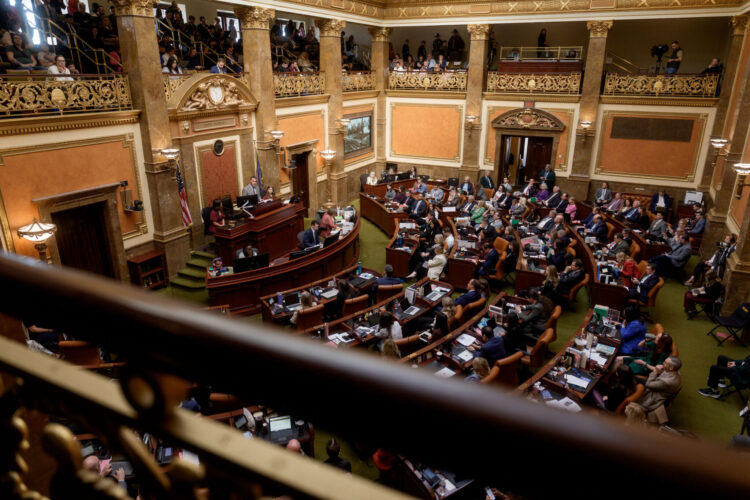
Photo by Spenser Heaps for Utah News Dispatch
Lawmakers convene in the House Chamber at the Capitol in Salt Lake City on the first day of the legislative session, Tuesday, Jan. 20, 2026.The Republican-controlled Utah Legislature launched its 2026 general session Tuesday with top House and Senate GOP leaders celebrating the state’s strengths while calling for lawmakers to focus on ways to help people in their day-to-day lives — specifically by reducing cost of living and taxes.
“We, as your representatives, see you, we hear you, and we endeavor to show up for you,” House Speaker Mike Schultz, R-Hooper, said during his opening day speech, listing issues including rising prices, housing, child care, education and Utahns’ hope to live in safer communities and to spend less time in traffic.
While highlighting the state’s current successes, Senate President Stuart Adams, R-Layton, said Utah is also “on track to become a national leader and the No. 1 state” for a list of industries, including: missile defense, energy production, cancer research, artificial intelligence, critical minerals and more.
“After 250 years, America is still the hope of the world. And I believe Utah is the hope of America,” Adams said.
Schultz and Adams’ messages were focused on optimism and calling on lawmakers to prioritize policies that have real-world impacts for Utahns and the state’s economic future. However, their opening-day speeches did not directly address some of the most controversial topics already sucking up much of the oxygen on Utah’s Capitol Hill, including several bills targeting transgender people and others aimed at restricting resources for immigrants without legal immigration status.
Democrats, including Senate Minority Leader Luz Escamilla, D-Salt Lake City, told reporters she worries the coming session is already being underscored by “mean” legislative proposals.
“They’re coming with everything,” Escamilla told reporters during a media availability, saying the immigrant and the LGBTQ+ communities are being directly attacked like she has never seen in her 18 years in the Legislature.
“I think some of these bills are pretty mean,” she said. “I mean, it’s at the core of keeping kiddos without access to health care or food at school. That’s a new low level.”
Senate Minority Assistant Whip Jen Plumb, D-Salt Lake City, said there are “some really difficult, some might even say horrifying, bills that are coming out,” but she added “those feel like distractions from the real issues at hand for our communities. We want to focus on those real issues, not on the cruel distractions.”
Governor calls for ‘dignity’ and ‘respect’
In an interview with Utah News Dispatch Tuesday morning, Utah Gov. Spencer Cox didn’t take a position on some of the more controversial bills filed so far targeting transgender people and undocumented immigrants, many of which are being sponsored by Rep. Trevor Lee, R-Layton. Cox said he will consider those bills on their merits if or when they land on his desk.
“But I will just say that the Legislature is not that one person,” Cox said. “We’re going to be working very closely with the Legislature to get this right, to still show the respect that every citizen of our state deserves, our transgender citizens who live here, our immigrants who are here.”
The governor also seemed to throw cold water on another bill being sponsored by Lee to rename Harvey Milk Boulevard in Salt Lake City after slain conservative influencer Charlie Kirk — a proposal city leaders and LGBTQ+ advocates have criticized as encroachment on local control as well as an attack on the gay icon.
Lee also sponsored a controversial bill last year that Cox wasn’t fond of — a bill to ban many flags (including pride or LGBTQ+ flags) from schools and all government buildings. Cox let that bill become law without his signature, and later called it a “dumb bill” while also criticizing Salt Lake City leaders for adopting pride or other flags symbolizing diversity and inclusion as official city banners in order to get around the law.
The governor said he expects lawmakers will show respect to “people in local municipalities who are making their own decisions, even if they’re decisions I disagree with, which was part of the flag bill last year and part of a street-naming bill this year.”
“If people want to get involved in municipal politics, they should run for municipal office. That’s the right way to do it,” Cox said.
He added that he will look at all of those bills “on the merits, but we’re going to show some dignity and some respect to the people who live here.”
When pressed in separate media availabilities with reporters, Adams and Schultz left an open question on whether those bills will find any traction.
“You know, there will always be things that consume the news cycle,” Schultz told reporters. “A lot of them make a difference for Utahns, (but) a lot of them don’t make a difference for Utahns, honestly. But we’re really focused on the things that do make a difference for Utahns.”
When pressed, Schultz didn’t name any specific bills he doesn’t want lawmakers to waste time on — but he said people will know when those bills “get held up” in the powerful House Rules Committee, which assigns bills to committee assignments.
“Certainly there’s always those bills that come out, they’re attention grabbers, but at the end of the day, do they really make a difference in people’s lives? Probably not,” he said. “We want to focus on the things that make a difference in people’s lives. Cost of living, again, those are going to be the ones we’re really focused on.”
Schultz has told Utah News Dispatch he’s supportive of policies to lower property taxes for Utahns, and both he and Adams want to cut the state’s income tax rate for a 6th year in a row — on top of the more than $300 million in revenue not coming into the state’s budget this year due to federal tax cuts.
Chief Justice Durrant on lawmakers’ plans to make changes to the judiciary
Another big issue looms over the 2026 Utah Legislature: How lawmakers will alter the state’s judiciary amid ongoing tensions between the two branches of government after a series of rulings that have upset Republican lawmakers, including in the state’s redistricting court battle.
That tension carries over from last year, when lawmakers considered a slate of bills many legal professionals characterized as an “attack” on the judiciary’s independence — but most of those proposals fizzled.
This year, though, legislators are expected to weigh more bills aimed at not only expanding the Utah Supreme Court and other courts, but also legislation to create more “transparency” requirements for judges and perhaps a proposed constitutional amendment that would, if approved by voters, let the Legislature call “special” retention elections for judges lawmakers deem “unfit or incompetent.”
Like he did last year, Utah Supreme Court Chief Justice Matthew Durrant addressed the strained relationship between the Legislature and the judiciary in his State of the Judiciary speech while also urging lawmakers who disagree with court rulings to do so on the “merits” of the decision, “not through impugning our integrity.”
“Disagreement is inherent in our system of government,” Durrant told lawmakers. “Public disparagement of another branch is not. While polarized us-versus-them rhetoric has become common in national circles, it is not — and should not be — the norm here.”
Durrant said that “much of the frustration expressed” with the judiciary in recent years “stems from a small number of decisions.”
“Those decisions can be counted on one hand, yet we handle nearly 500,000 cases annually in our trial courts,” he said. “I ask that your disappointment with a few results not lead to penalties for an entire branch of government, and by extension, penalties for your constituents.”
Durrant highlighted two key budget requests for the judiciary, including $6 million in ongoing funds to train and retain courthouse staff and more money to fund eight district court judges, one juvenile court judge, four commissioners, and at least one if not two Court of Appeals judges.
“These requests were made last year, but no new judges were allocated,” Durrant said, “which is why we return today with greater urgency.”
Durrant agreed that court decisions should come quicker — but that requires funding to help distribute the workload in the court system.
“Today, our district courts operate in triage mode. We need your help to fix that,” he said. “Each of our (budget) requests is grounded in measured, fact-based workload data. Historically, we have received funding for less than one judicial position per year. Although we appreciate any funding previously provided, at that historical rate it would take 20 years to fill the current need for judicial officers in Utah.”
The governor, Senate president and House speaker are all supportive of a bill that would expand the Utah Supreme Court from five justices to seven. Durrant said “that, of course, is your prerogative.”
“I ask only that you weigh the facts and understand the data you’ve been provided, just as we have in developing our requests,” he said. “If you elect to fund two new justices, please do not do it at the expense of the judicial positions we have prioritized.”
Durrant stressed that the need for more judges in the lower courts is “much greater” than it is in the Utah Supreme Court.
Additionally, Durrant acknowledged that the judiciary’s institutions aren’t “perfect, and so yes, they can be improved.”
“But they are not the cesspools of corruption and self interest that some would have you believe,” he said. “They are largely composed of good and decent people who are genuine in their desire to serve well. That is true of Utah’s legislature. It is true of Utah’s judiciary.”
However, in recent years, “we have witnessed a startling decrease in confidence in our public institutions,” he said, worrying it “threatens the core values” that have made the U.S. a “beacon of hope in the world.”
“We should each strive to promote confidence in our governmental institutions,” he said, urging lawmakers to show respect for the judiciary even when they disagree with the courts. “There can and should be substantive disagreements, both within our respective institutions and between them. These disagreements are to be celebrated, and valid criticism should always be welcome.
But the “problem comes,” he said, “when we cross over from substantive disagreement to personal attack.”
In recent months, many Republican lawmakers have accused the Utah Supreme Court and 3rd District Judge Dianna Gibson — who has ruled against the Legislature several times in the state’s redistricting lawsuit — of “judicial activism.” Durrant urged lawmakers against those types of comments.
“This erodes public confidence in our institutions. On those rare occasions when we strike down one of your statutes as unconstitutional, we carefully and dispassionately explain why,” he said. “You will never read an opinion where we challenge your integrity or good faith. I ask that you pay us the same courtesy in challenging our decisions.”
He urged them to disagree “on the merits, not through impugning our integrity.”
“I’m afraid ‘judicial activism’ has come to mean ‘a decision I disagree with,'” Durrant said.
After Durrant’s speech, most lawmakers gave him a standing ovation. At least four, however, remained in their seats: House Majority Leader Casey Snider, R-Paradise; Sen. Scott Sandall, R-Tremonton; and Reps. Trevor Lee, R-Layton, and Matt MacPherson, R-West Valley City.
Schultz told reporters he has “a lot of respect” for Durrant, and he acknowledged “we’ve got a lot of great judges.”
“But there are some legitimate concerns out there,” Schultz said, adding that he’s supportive of an effort to increase “transparency” on judges by requiring the creation of a website that’s similar the the Legislature’s, “where every vote we make is public, every comment on the record we make is public.”
“We want to find ways for the judicial branch to do the same thing,” he said.
Senate Democrats say they plan to guard judiciary’s independence
In a media availability, Senate Democrats told reporters they are prioritizing guarding the judiciary’s independence this session.
Sen. Stephanie Pitcher, D-Salt Lake City — who is also an attorney and a member of the Senate Judiciary, Law Enforcement, and Criminal Justice Committee — said she isn’t necessarily opposed to the concept of adding two more justices to the Utah Supreme Court, but she said she opposes the timing of the effort.
“I think, with the position that we’re at right now with redistricting and all of the litigation that’s gone through, I think it is a pretty clear attempt to sway the ideology of the Supreme Court at a really critical time in that litigation process,” Pitcher said.
Pitcher also called the argument of expanding the high court to address workload issues “largely pretextual.”
“If you talk to the courts, that’s not what they’re saying they need. As an attorney myself, I have clients that are waiting over a year to get a jury trial because our district courts are just so backlogged,” she said. “And so I think right now, if the intent truly is to help the judiciary, then it’s not expanding the Supreme Court, it’s providing resources to lower courts.”
Schultz and Adams have said they’re both supportive of expanding the Utah Supreme Court to bring it in line with other similarly-sized states — but they’re also supportive of expanding the other courts, too. It remains to be seen how much lawmakers will budget for the efforts.
Schultz said he agrees that the judicial branch should be independent, while also calling for more accountability and transparency around judges that are bad actors.
“We will follow the Constitution in trying to work to make the judicial branch more transparent,” he said. “We want to do so collaboratively with the judicial branch. We’re hoping they’re willing to work together with us on these things. But we’ll see.”