Utah lawmaker proposes allowing Legislature to call ‘special retention elections’ for ‘unfit’ judges
Rep. Walt Brooks’ proposed constitutional amendment is among several pieces of legislation aimed at the courts as tensions between lawmakers and the judiciary persist
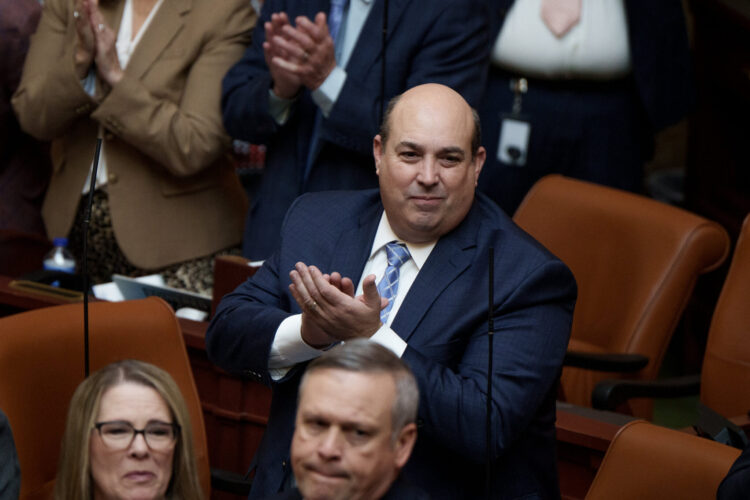
Photo by Spenser Heaps for Utah News Dispatch
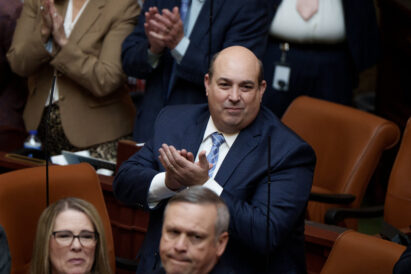
Rep. Walt Brooks, R-St. George, and other lawmakers rise in the House Chamber at the Capitol in Salt Lake City on the first day of the legislative session, Tuesday, Jan. 20, 2026.Amid ongoing tensions between the Utah Legislature and the state’s judiciary, a lawmaker wants to ask voters to give the Legislature the power to call a “special retention election” if legislators decide that a judge is “unfit or incompetent.”
Rep. Walt Brooks, R-St. George, is sponsoring HJR13. If the Legislature passes that resolution for the 2026 November ballot and a majority of voters approve it, the Utah Constitution would be changed to grant lawmakers the authority to put judges up for retention elections sooner than their regular six-year terms if the full Legislature decides that a judge is:
- Unfit or incompetent
- Persistently fails to make timely decisions in a case
- Has engaged in conduct that violates the judge’s oath of office
- Acts improper or creates an appearance of impropriety
If the Legislature determines a judge has done any of those things, the proposed constitutional amendment would allow the Legislature to “initiate a process for the judge to be subject to a special retention election as soon as practicable,” according to the resolution.
The Legislature would be able to call that special retention election “even if the judge could be liable to impeachment” or subject to investigation under current Utah law. The Legislature would also be required to set a state law to dictate the “manner and timing” of that special election.
A judge subjected to a special election called by the Legislature would still also need to go through their regular, six-year retention election — except if the special election occurs in the same year as the regular one.
If voters approve the proposed constitutional amendment, it would take effect in January 2027.
The proposed amendment comes during a session where lawmakers are expected to debate several pieces of legislation aimed at making changes to the judiciary as Republican lawmakers continue to be frustrated by the judicial branch. They’ve criticized the courts of being too slow to make decisions, while also vehemently disagreeing with several recent rulings.
In the state’s redistricting lawsuit in particular, 3rd District Judge Dianna Gibson has faced accusations from lawmakers claiming she’s an “activist” judge, and at least one lawmaker has previously said he wanted to seek articles of impeachment against her — though he’s since paused that effort while the Legislature appeals her court-ordered congressional map to the Utah Supreme Court.
Top Republican legislative leaders have also criticized the timing of Gibson’s redistricting rulings, saying they’ve left little to no time for lawmakers to appeal before the 2026 elections.
But Brooks, in an interview with Utah News Dispatch on Tuesday, said his bill isn’t meant to target any one specific judge, including Gibson — though he did say he does have his “gripes” with her.
“That’s not what this is about,” he said. “Honestly, the judicial branch should be taking care of this. … But there are some judges that are just not doing their job. They have a backlog a mile long.”
Brooks said the current judicial retention election required by the Utah Constitution leaves too much time before voters can hold a problematic judge accountable, and he said he wants to empower voters to have more of a “voice” when it comes to the judiciary.
“Six years is too long,” he said. “If someone’s derelict in their duties, and it’s, in this case, extremely negligent … then I think the people have the right to say, ‘Hey, we don’t want to retain this judge because they’re not servicing us, the people.'”
‘Fundamentally unfair’
In response to a request for comment Wednesday, the state’s judiciary (which rarely weighs in on legislation) said it didn’t have a comment to share on Brooks’ proposed constitutional amendment.
The Utah State Bar also hasn’t taken a position on the proposal, but the Bar’s president, Kim Cordova, told Utah News Dispatch on Wednesday morning that she has concerns with Brooks’ proposed constitutional amendment because it includes “broad” and “subjective” language lawmakers could use to target judges.
“It’s also a separation of powers issue,” Cordova said. “We have three separate branches of government, and the Legislature should not be the enforcers of a different branch of government.”
What behavior could fall under the definition of “unfit or incompetent,” Cordova questioned, along with conduct that is “improper or creates an appearance of impropriety?”
Cordova said judges are already accountable in a variety of ways — to voters every six years, and to the review body called the Judicial Performance Evaluation Commission, which provides nonpartisan information to voters regarding how judges score on factors including legal ability, integrity and judicial temperament, and administrative skills.
Any proposed amendment to the Utah Constitution should “really have the highest level of scrutiny,” Cordova added.
“Any changes should be serious in terms of subject matter, and everything that’s in (Brooks’ proposal) can be addressed appropriately in another manner,” she said.
She also noted it would put judges targeted by the Legislature in a compromising position because they can’t campaign or defend themselves in the public arena.
“Judges don’t run. They stay completely silent,” Cordova said. “So it’s so fundamentally unfair (to call a special retention election on) a judge when they can’t really respond. … They can’t do anything except put their heads down and do their job. And that’s what they do.”
Lawmakers, governor weigh in
Democrats including Rep. Doug Owens, D-Millcreek, and Sen. Stephanie Pitcher, D-Salt Lake City, expressed concerns with Brooks’ proposal, saying it could be used to target Gibson or other judges the Legislature doesn’t like or agree with.
“What we’re proposing through Brooks’ bill goes way beyond … it gives the Legislature broad authority to apparently hold an election and pick on any judge for whatever reason that they have an issue,” Pitcher said. “I find it incredibly problematic from a constitutional perspective, from a separation of powers (perspective).”
Pitcher also added it’s another legislative proposal among many this year that seem “retaliatory” against the judicial branch because Republican lawmakers are angry about past rulings checking their power.
“They continue to put forward bills that undermine or unconstitutionally take away power from that branch of government,” she said.
Owens said Brooks’ proposal also does nothing to address the real problem facing the judicial branch, which is an overwhelmed and underfunded district court.
“Our judges are overworked. They don’t have enough clerks to help. You know, we could fund the judiciary better,” Owens said, while also arguing that Utah’s court system is “extremely highly regarded.”
Tuesday, on the first day of lawmakers’ 45-day session, Utah Supreme Court Chief Justice Matthew Durrant told lawmakers in his State of the Judiciary address that the biggest need for more funding and judges is in the district courts — which he said have been operating in “triage mode” to handle their heavy workload.
It remains to be seen whether Brooks’ proposed constitutional amendment will gain traction.
Powerful legislative leaders including House Speaker Mike Schultz, R-Hooper, and Senate President Stuart Adams, R-Layton, and Gov. Spencer Cox have all expressed support for another bill to expand the Utah Supreme Court from five seats to seven, while also expanding lower courts.
Schultz has highlighted “huge concerns” he’s had with at least two judges, including 7th District Judge Don Torgerson — who twice referred to a defendant’s “privilege” while deciding to not require him to serve any additional jail time or pay a fine for possessing and distributing multiple images of children being raped and sexually abused, KSL TV reported — and 3rd District Judge William Kendall, who resigned after accusations of sexual abuse and sharing a “weed pen,” according to KSL.com.
Schultz, in a media availability with reporters Tuesday, said lawmakers will do “something” related to Torgerson during their 2026 session, but what they’ll do is “to be determined.”
Asked about Brooks’ proposal and if it’s aimed at Gibson, Schultz told reporters, “I don’t know that (it’s) necessarily aimed at one particular issue or not.”
“I think it’s fair to say there’s a lot of concerns out there with the judiciary right now,” Schultz said, emphasizing he wants to require the judicial branch to increase “transparency” around their decision-making while also balancing the independence of each branch of government.
“We want to do so collaboratively with the judicial branch, we’re hoping that they’re willing to work together with us on these things,” Schultz said. “But we’ll see.”
In an interview with Utah News Dispatch on Tuesday, Cox said he hadn’t yet read Brooks’ proposal, but he questioned whether it’s necessary.
“The Legislature does have the ability to remove a judge now,” Cox said, through impeachment. “I’m not sure why we would need something different than that. We do have retention elections, and I believe in the judiciary, even when I disagree with the judge. And I disagree passionately with (Gibson) in this case, but I think there should be a different standard for impeachment versus a standard where we disagree with someone.”
Cox also added — while talking more broadly about lawmakers’ focus on judicial legislation this year — that lawmakers have been “working on judiciary reform for several years now.”
“We’ve passed several bills, and they’re working, but the Legislature sometimes doesn’t have the patience to allow the things that they’ve actually done to play out, and so we’re maybe trying to fix a problem that we’ve already fixed,” Cox said. “So I like to give legislation a chance to work and then see where we are.”
Proposed constitutional amendments in Utah need to pass the Legislature with a two-thirds majority in both the House and Senate. It wouldn’t need the governor’s signature to go on the ballot.