Utah leaders make commitment to higher education, with more potential cuts coming
House Speaker Mike Schultz said other areas of government may benefit from reallocations similar to those implemented in universities last year
Alixel Cabrera, Utah News Dispatch
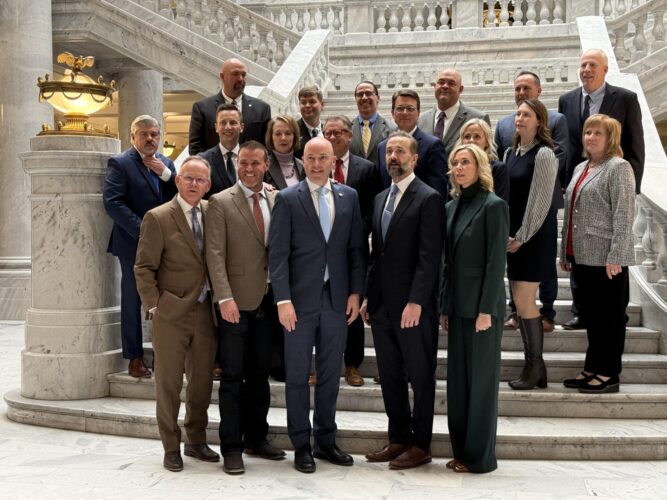
Utah Gov. Spencer Cox, legislative and higher education leaders after signing a higher education resolution at the Utah State Capitol on Friday, Jan. 23, 2026.After several years of reforms to the Utah System of Higher Education, state leaders and presidents of public colleges and universities signed a resolution committing to keeping higher education affordable, accessible and “focused on impactful outcomes.”
With the resolution, higher education and state leaders vowed to align higher education with the best interest of students and the state.
“We remain dedicated to research and teaching that fosters academic excellence, explores new ideas, respects differing viewpoints, drives economic growth, and discovers solutions to our most complex problems,” the resolution reads.
Gov. Spencer Cox was still fresh from his State of the State address, in which he called on Utahns to build “moral infrastructure.” His Friday remarks had a similar tone, highlighting not only the economic perks of higher education, but also the development of other skills.
“Just teaching people how to think for themselves, that matters. That matters as much as any economic gain,” Cox said. “Our ability to debate one another, our ability to understand who we are as Americans, our ability to reason and to learn from our past mistakes is just as important as any of the economic boosts that we see here.”
Cox also praised the Utah Board of Higher Education, but also said that “reform is never finished,” and listed his wish list for the system, including increasing timely degree completion rates, to “always credit for prior learning,” and to continue to maximize higher education’s financial value.
“I want to just say unequivocally that higher ed matters, that we support you,” Cox said. “And I hope you feel that coming out of this legislative session.”
Cuts may be discussed in the next weeks
Last year, flagship higher education legislation directed universities to cut and reallocate 10% of their budgets for courses, or $60 million in total, aiming to switch that funding from “underperforming programs” to initiatives that are in higher demand. With a tight deadline, some universities were left scrambling to make the cuts and had to plan for layoffs and the elimination of programs.
Utah House Speaker Mike Schultz, R-Hooper, said Friday there have been lots of benefits from that exercise and that he believed every area of government should be looking at similar initiatives.
The Executive Appropriations Committee directed all legislative appropriations subcommittees to identify a 5% ongoing spending reduction target this year. For higher education, that would mean a $93.7 million cut, according to a Legislative Fiscal Analyst presentation.
The Legislative Fiscal Analyst office recommended making cuts to different Utah System of Higher Education programs, like reducing the estimated budget to make an equal opportunity initiatives report, taking back engineering and computer science initiative funding approved last year, and reducing 60% of out-of-state tuition waivers, among others.
Schultz said more details about that may emerge in the next few weeks.
“We just went through that process with higher education. We’re not going to cut 5% of the budget, but we’re going to look at it and say, ‘OK, do we need to reallocate some more money? (Are) there things that we need to continue to look at?'” Schultz said. “So we’ll see. I’d say, let’s give it another week or two and see what comes out of that.”
The resolution was ceremonial, Schultz said, but represented a commitment to the system’s future, to reevaluate programs that don’t work, and to keep tuition costs down.
During the signing ceremony, Geoffrey Landward, Utah commissioner of higher education, commended the effort to collaborate among institutions and government.
“My only worry is that the significance of this will be lost in an era of higher education that is marked by diminishing trust, questioned value, or turmoil,” Landward said. “Assembled here today are the elected leaders of our state and leaders of our system of higher education, gathered in unity, saying with one voice, higher education will remain a pillar of our state and thrive in uncertain times because we refuse to let it flounder.”
A bill sponsored by Clinton Republican Rep. Karen Peterson went public on Friday, which, if approved would direct “the alignment of the system of higher education into regions for vertical and horizontal integration.”
That would help ease credits transfers, integrated admission, enrollment and student services.
“I think that’s a great right. You may want to start out at UVU, but finish at Weber State. You may want to start out in Utah Tech University in the southern part of the state, but end up finishing at University of Utah,” Schultz said on Friday. “Having that collaboration together so that kids aren’t duplicating resources and costing more money, that’s a benefit for the students.”