‘Silly season’: Weber County clerk/auditor Ricky Hatch discusses lawsuit to remove County Commission candidate from ballot

Jared Lloyd, Standard-Examiner
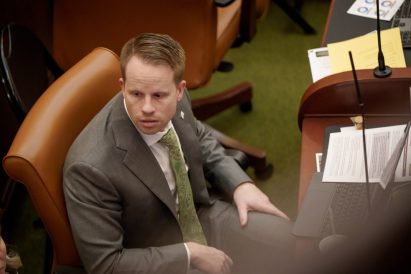
Weber County Clerk/Auditor Ricky Hatch speaks with the Standard-Examiner editorial board at the Standard-Examiner in Ogden on Wednesday, June 3, 2026.Editor’s note: This is the first in a series of stories following a Standard-Examiner editorial board interview with Weber County Clerk/Auditor Ricky Hatch. This interview touched on topics such as a a lawsuit to remove a Weber County Commission candidate from the ballot, the 2026 primary election and taxation.
WEBER COUNTY — As ballots for the 2026 primary election are appearing in mailboxes across Weber County, a lawsuit concerning one of those races is about to come to a head.
Last week, three Weber County Commission candidates — Richard Hyer, Katrina Gibson and Jon Beesley — petitioned the Second Judicial District Court in and for Weber County to order Weber County and Weber County Clerk/Auditor Ricky Hatch to disqualify County Commission Seat A candidate James Ebert, claiming violation of Utah state law.
During an interview with the Standard-Examiner editorial board Wednesday, Hatch said he wasn’t surprised to see a lawsuit come along at such a critical juncture.
“Election officials refer to this season as ‘silly season’ — stuff happens — so I wasn’t surprised that there was a lawsuit,” he said. “What surprised me was the vehemence with which the petitioners have pursued this lawsuit politically compared to the lack of strength of their position.”
He said that there are two claims being made by the petitioners.
“They are making two claims of violation of state code,” he said. “One is that (Ebert) did not provide a conflict of interest at the time of filing. And then the second one was that as a clerk, we did not keep his conflict of interest posted publicly for the entire time of the campaign season.”
Hatch said the controversy stems from Ebert’s filing of his conflict of interest forms.
“(Ebert) actually did come in with a completed file, or completed conflict of interest with all the forms,” Hatch said. “All the paperwork was filled out on the 2nd (of January), when he came in and filed. We went through all the checklists, he paid his fee and we sent him on his way. After he left, our staff realized that he hadn’t signed the conflict of interest.”
From there, Hatch said that election officials sought out Ebert’s wife, Steffani Ebert, who is the Weber County Comptroller, to deliver the document to James.
“They texted his wife, ‘Hey, would you take the conflict of interest that he brought in and take it home and have him sign it? Or you can do it online,'” Hatch said. “So she came down and picked it up, they went home and they decided to complete it online. The content is exactly the same — the paper version and the online version — and we gave that option, that online option, to all of the candidates, and only a couple actually took advantage of the online option.”
Hatch said that Ebert’s electronically filed conflict of interest form was submitted before the Jan. 8 deadline had passed but that Ebert appeared prior to the deadline to amend parts of his filing.
“His official name is Charles Jamison Ebert, but he’s known as James Ebert, so there’s a process that state law allows for that you fill out — you get five signatures, you fill it out and then say, ‘This is how I’m known,'” Hatch said. “He turned that in on Friday the 8th. And then the second thing is, he had originally signed that he was going convention only path, and he changed that to signature path and convention on the 8th. Those were both turned in on Friday, well before the deadline and we have notations of who processed that and the date that that was signed that he submitted those changes.”
Hatch noted that updates were then uploaded on to the county’s election website — but a mistake had been made.
“We forgot to attach the electronic conflict of interest form,” he said. “And so the the new packet on the 8th was uploaded without the conflict of interest form. We didn’t know that it hadn’t been uploaded. We have a process that we go through and we simply missed it. We didn’t know about it until we got an email from Katrina Gibson on April 14th, I believe it was, saying, ‘Hey, why doesn’t James have a conflict of interest?’ I asked our elections team, they said, ‘Wow, we totally missed it.'”
Hatch said that Ebert’s conflict of interest form was uploaded as soon as the error had been pointed out.
He added that mistakes happen in the course of administering elections, even with the rigorous safeguards.
“Election officials — we are the first to admit there is never a perfect election,” he said. “These happen. They’re not unusual. We have checklists and we go through multiple levels of review with our staff, our team reviews all of the packets. Sometimes things get through, and that’s what happened this time.”
Hatch said that state law actually helps to cover situations like this where technicalities arise.
“It says the two key things that I think are important,” he said. “First off, it delineates when there should be strict compliance and when there should be what it calls substantial compliance. Strict compliance is things like financial filings. We have to kick a candidate off a ballot if they don’t file certain financial disclosures on time. That’s just state law. Black and white. Then it says other provisions of this code shall be subject — I don’t know the exact terms — subject to substantial compliance with the eye to ensure … that the candidate remains on the ballot and that voters get to decide. It also has a statement that says this section should be construed liberally, and so I think they identify the importance of (compliance), but they recognize that there will be problems, such as this one, and they’re saying, ‘Have you substantially complied, or is it required that it’s strict compliance?'”
Hatch also made it clear that James Ebert’s wife is not in any way connected to the execution of this election.
“We’ve had to be extra careful, which is the right thing to do,” he said. “She doesn’t have access to the elections office. Her card, if used there, would not read in. We went and looked at the access log of the Elections Center to verify that she didn’t even attempt to come down there. She has no access to the systems that are used, the voter registration system. She won’t pick up ballots. She normally helps pick up ballots from dropboxes. She won’t help with that. And she found out about the complaints and the lawsuit not from me. She got it from elsewhere because I wouldn’t tell her.”
Hatch said that a decision is expected on the matter sometime Thursday afternoon.
Local News

UTA opens comment period on partial 2027 budget that includes Ogden upgrades

Federal worker from Ogden accused of receiving fraudulent disability payments while taking European hiking trip