Aaron Perry attempting to return home in run to be Davis County sheriff
-
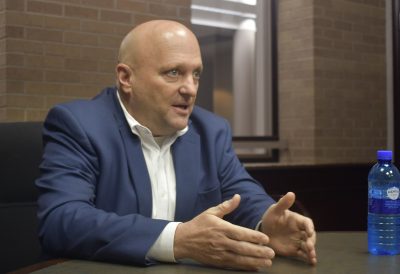
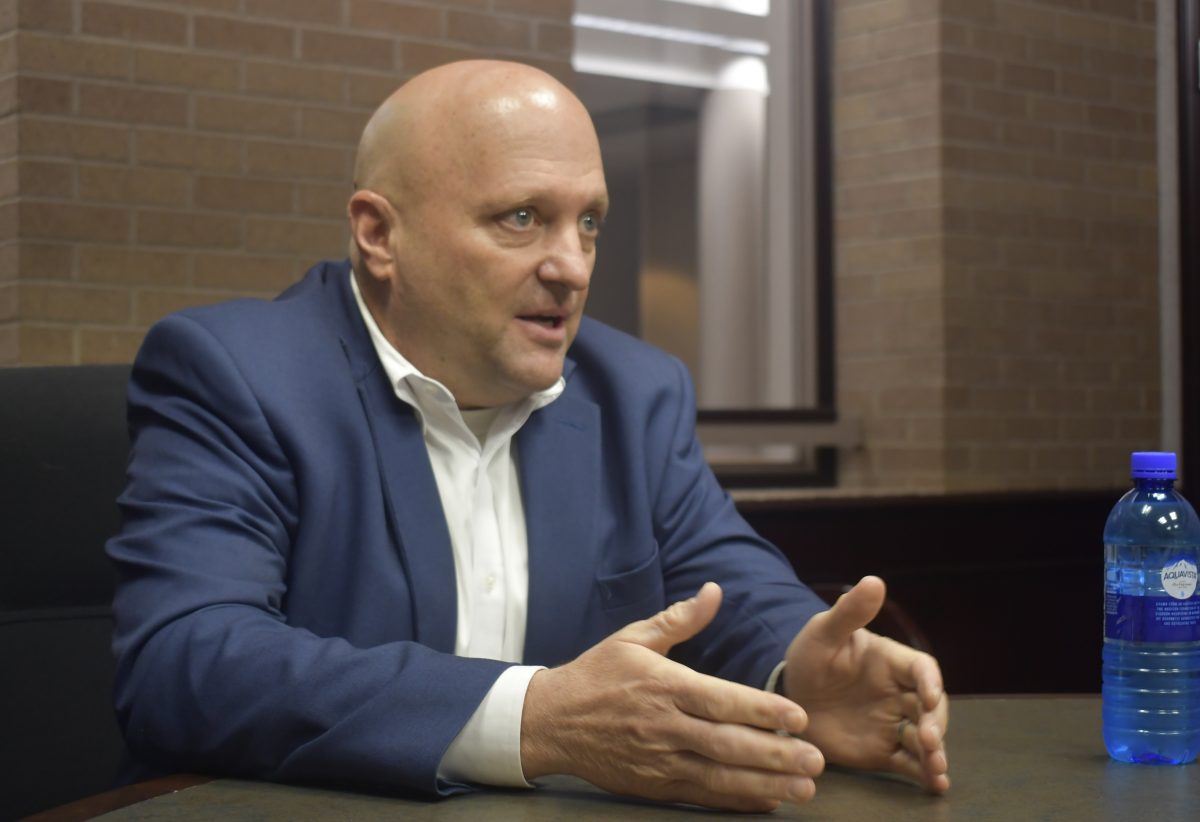
- Davis County sheriff candidate Aaron Perry talks to the editorial board at the Standard-Examiner in Ogden on Monday, April 27, 2026.
-
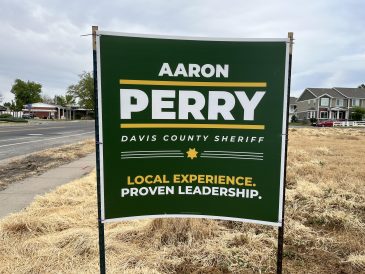
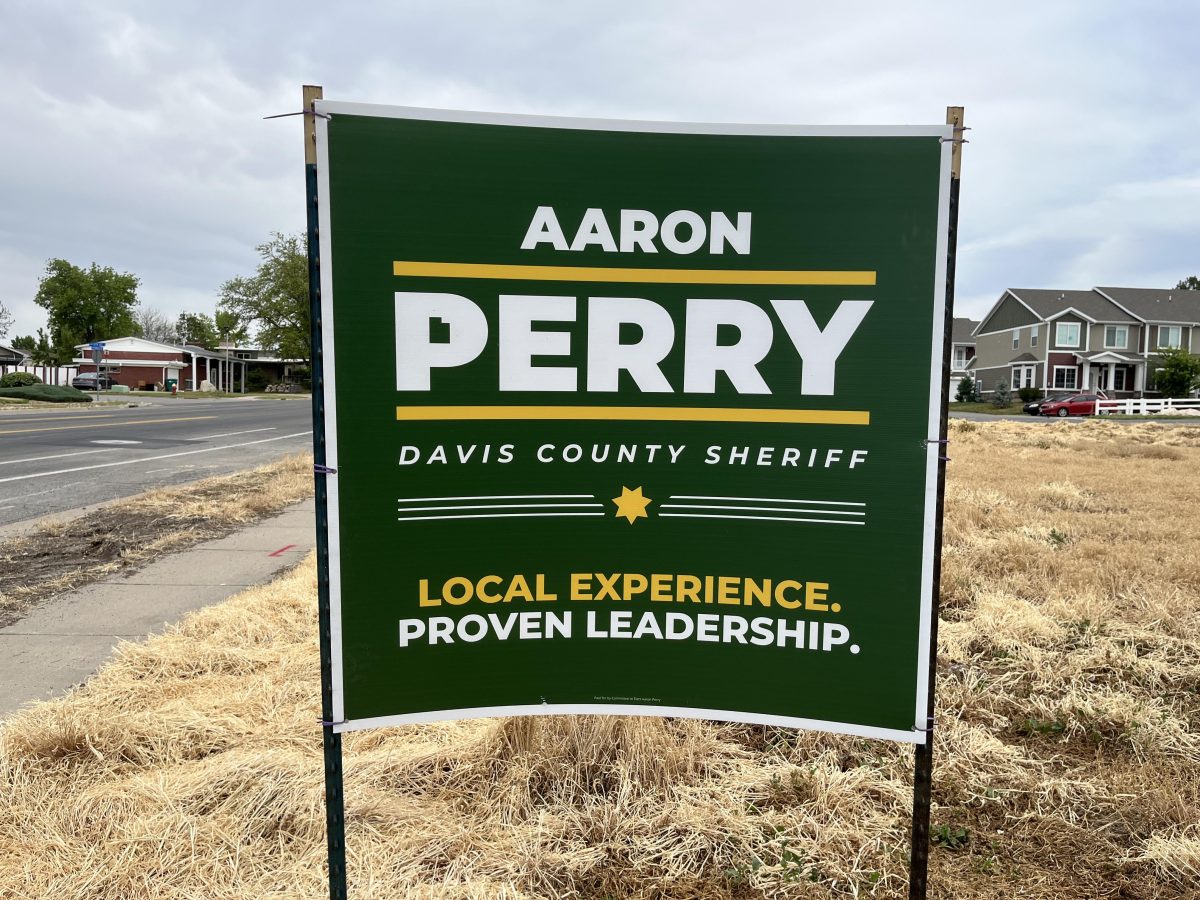
- A campaign sign for Aaron Perry, running as a Republican for Davis County sheriff, on Wednesday, May 13, 2026. (Ryan Comer, Standard-Examiner)
Jared Lloyd, Standard-Examiner
Davis County sheriff candidate Aaron Perry talks to the editorial board at the Standard-Examiner in Ogden on Monday, April 27, 2026.
Aaron Perry is trying to return home in his bid to become the next Davis County sheriff.
“I personally feel like the agency you start with, if you’ve been there for a while, is home,” he said. “It’s the agency that took a chance on me. It’s the agency that sent me through the police academy. It’s the agency where I met my wife. My wife and I actually met there my first day on the job. And so the Davis County Sheriff’s Office always felt like home to me.”
After 16 years working full-time at the Davis County Sheriff’s Office, Perry left to be an assistant police chief at the Roy Police Department in 2015, and when Ryan Arbon was elected Weber County sheriff, Perry moved over there, where he spent six years as a chief deputy.
He said he has “a personal connection” to the Davis County Sheriff’s Office.
“It’s hard for me to drive anywhere in Davis County without remembering a call that I carry with me, whether it was an officer shot in the line of duty that I responded to or some horrific accident or something, and I just care,” he said. “And I feel like it’s something I’m supposed to do, frankly. It’s not so much about what I want. … but it’s more about where I feel like I’m supposed to be.”
Ryan Comer, Standard-Examiner
A campaign sign for Aaron Perry, running as a Republican for Davis County sheriff, on Wednesday, May 13, 2026. (Ryan Comer, Standard-Examiner)
Public safety
One of the biggest public safety issues facing Davis County, according to Perry, is coordination and communication. He said the sheriff’s office contracts with three cities in the county and also runs the Davis County Jail.
“In a system like that where you have so many different agencies working to try to provide public safety, cooperation and communication become key to making sure that you’re, one, providing the resources where they need to be, and that you’re not providing unnecessary duplication of effort,” Perry said.
“So … to me, that’s one of the biggest challenges around public safety is making sure that we’re not working in silos and that we’re working together … and coordinating to make sure that we’re actually focusing on the right thing to address the right problems and, again, not creating unnecessary redundancies in services that we’re providing.”
Experience
Perry uses the words “extensive” and “experienced” when speaking of his education and background.
“When people are evaluating candidates, I would encourage them to look at the requirements for a local police chief,” Perry said. “What are the minimum requirements that people, that cities have decided over time that they believe, ‘Here’s the minimum requirements that we want for a police chief.’ And I would start with that as a baseline for your evaluation criteria.
“I have a master’s degree in public administration. I’m a graduate of the FBI National Academy, which is a command school for law enforcement executives ran by the FBI. … Nine years of executive leadership, law enforcement leadership experience, specifically, leadership experience in all three executive areas of the sheriff’s office: corrections, enforcement and administration.”
Perry highlighted his experience in corrections, which he said was missing from his resume while he was at Roy. He said Arbon wanted him to be a corrections chief instead of an enforcement chief.
“Corrections is a huge part of the sheriff’s office that I think oftentimes … is overlooked,” Perry said. “It’s the majority of the budget of the sheriff’s office. The sheriff’s office, usually in most counties, is 50% or more of the county budget, and then the corrections side of the budget is anywhere between, I would say, 60% and 70% of the sheriff’s budget.
“And so I really felt through that I gained those missing pieces that I was looking for.”
A campaign promise
Perry said he’s committed to walking the neighborhoods in Davis County’s three contract cities in uniform once a week because he wants to meet individuals where they are.
“And I think at first I’m going to get the question of, ‘What’s wrong? What happened?'” he said. “Because people are going to assume that if law enforcement is in the neighborhood, something happened. And I look forward to having that conversation of, ‘Nothing’s wrong. I’m your sheriff, and I’m just out here walking your neighborhood to get to know you. You can get to know me. What questions do you have? What concerns do you have? How can we serve you better?’ And get to know them so that my goal is that after a year of being sheriff, when people say, ‘Who’s your sheriff?’ that people, at least in those contract cities, will say, ‘I know who he is, (because) he’s been out in my neighborhood.'”
County jail improvements
One area Perry said he wanted to work toward finding a solution to was county jail booking times.
“Specifically, what will happen is you have officers from another city that will bring somebody in to book them,” he said. “And our medical unit … they’ll do an examination, and if they feel that they are too ill to be received, then they’ll require the officer to go to the local hospital and have a clearance from the ER doc at the local hospital before they come back.
“So imagine being in a graveyard shift. A lot of our cities in Davis County only have one, maybe two officers on. So now you’ve taken this officer, and let’s say it’s Sunset, you have one officer working. He’s taken the individual down to the jail. Now jail medical has said, ‘Hey, now we can’t accept them. You need to take them to the local hospital to be clear.’ Well, that can be another hour or two hours or more while you’re waiting out. So that’s maybe three, four hours that you’ve got this city now not covered.
“And that’s one of the first things I want to work on at the sheriff’s office is coming up with a plan to reduce those times and to be able to get those local officers back into their cities quicker and back in service.”
Cooperation with ICE
One topic Perry said has come up quite a bit on the campaign trail is involvement with Immigration and Customs Enforcement, or ICE.
There are currently three agreements that local law enforcement agencies can sign with ICE: the Jail Enforcement Model, the Warrant Service Officer program and the Task Force Model.
Perry said he called the local director of the Department of Homeland Security and was told that the cooperation needed most right now is with the Task Force Model.
The Task Force Model, according ice.gov, “serves as a force multiplier for law enforcement agencies to enforce limited immigration authority with ICE oversight during their routine police duties.”
In talking to the director, Perry said he was able to clarify the details of that agreement.
“I think the misperception of the Task Force Officer Model was that when you cross-deputized somebody in that Task Force Officer Model that you’re putting them on a task force that they’re going to go out and do targeted immigration-only enforcement,” Perry said. “Well, that’s what I was able to clarify talking to the director of ICE was they actually don’t want local officers and deputies being involved in the targeted immigration enforcement.
“But they see a huge advantage, and I actually agree with this, of having the task force officers so as you’re going throughout your duties … you can kind of bridge that gap and be able to coordinate with them.”
Giving an example, he said:
“You make a traffic stop at 2 o’clock in the morning,” he said. “An individual gives you a driver’s license from out of the country. That’s all the identification they have. That’s it. … And if you have that agreement, what that allows you to do is it allows those officers that are cross-deputized as task force officers with ICE to coordinate. They have a 24/7 call center. You can coordinate with them and they’ll run that based on that out of country driver’s license. They can check the immigration status and they can look at what the current immigration status is.
“And then, ultimately, the decision whether or not to detain them is up to that officer on scene, but what they’re really trying to do is they’re trying to identify those individuals that have a criminal history or the serious offenders and then be able to coordinate at that level to be able to detain them.”
Regarding the other two agreements, Perry said he’s a proponent of them, but in talking with the director, it felt like there was already cooperation happening.
The Davis County Sheriff’s Office, Perry noted, doesn’t have any signed agreements with ICE at this moment.
Closing statement
As part of his closing pitch to voters, Perry highlighted the importance of choices and cited two experiences.
In one case, there was a residential burglary involving $150,000 of property taken. Perry said he chose not to simply send the report to detectives but to actually work the call.
He was looking for an individual who had a cut on his right hand, and after knocking the first door, someone appeared who had a cut on his right hand.
“I didn’t know what to do because I’m brand new, like a two-year deputy, so I call my partner who had like 15 years on,” he said. “I was like, ‘Hey, I think I got the suspect.’ He helped me interview him and by the end of the weekend we had three suspects in custody and $150,000 in property recovered.”
Another choice involved keeping his radio on while he was going to work so that he could have an idea of what was going on before his shift started.
One day, Layton put out an attempt to locate for an armed robbery suspect, and they were parked right in front of Perry.
“I’m in uniform,” he said. “I look at them. I look in the mirrors and I look at them. They’re already looking at me. I’m able to call it out – because I have my radio on, even though I’m technically off duty. Highway Patrol gets there, short chase ensues, foot chase after that, they get him into custody and they solved like 30 robberies from Salt Lake to Ogden.
“All because of choices. All because of choices, the choice to work the burglary case, the choice to stay alert off duty. And what I would say, and the reason I would ask for the vote of the Davis County residents is because as your sheriff, I’m going to choose to serve in that way and to teach my deputies, every employee, to make those choices, to help those individuals write the best stories.”
For more on Perry and his campaign, visit https://www.perryforsheriff.com/
Contact Standard-Examiner editor Ryan Comer at rcomer@standard.net.