Centerville City Council’s Cheylynn Hayman displays pride flag on dais, explains reasoning
Ryan Comer, Standard-Examiner
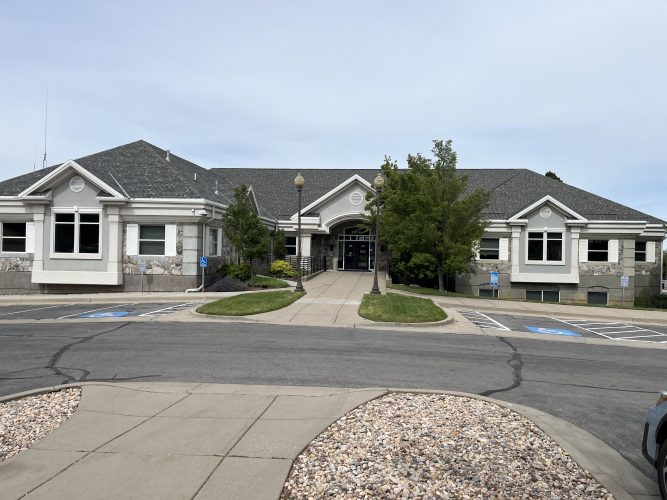
The Centerville City building in Centerville, Utah, on Monday, June 8, 2026. (Ryan Comer, Standard-Examiner)Editor’s Note: This is part one in a series on Centerville City Council member Cheylynn Hayman displaying a pride flag on the dais in the building where the Centerville City Council meets. Part two will include Rep. Trevor Lee’s response, and part three will explore certain city council election realities and representation. The Standard-Examiner has also reached out to Centerville Mayor Clark Wilkinson for comment.
Last year, House Bill 77 became law in Utah. Rep. Trevor Lee, the bill’s sponsor, described the bill as being intended “to ban any flag that had any political leaning or ability to say you’re aligning with something that’s not either the American flag or the state flag” from government property.
Cheylynn Hayman is challenging that law.
The Centerville City Council woman has a pride flag displayed on the dais.
Hayman doesn’t think the law applies to her situation.
“The law only applies to government entities and school employees,” she told the Standard-Examiner. “I am neither. This is something that I have done in my individual capacity. The city of Centerville as a government entity has not engaged in any conduct. There has been no conduct by Centerville City that would violate this statute.”
Specifically, Hayman points to subsection 2 of Utah Code 63G-1-704, which addresses flags “in or on the grounds of government property” displayed by “a government entity, or an employee of a school district or school within the public education system acting within the employee’s official duties.”
Said Hayman:
“Number one, I don’t believe that this statute applies to government employees outside of those narrow ones working for a school district. But even if that were true … as a city council member, I am not an employee of my entity. And there is a Utah Supreme Court case that expressly holds that.”
In a letter to Utah State Auditor Tina Cannon, which Hayman sent to the Standard-Examiner, Hayman cited Richards v. Cox as evidence that she is not a government employee.
“Elected representatives may ‘receive compensation and benefits for their services, [but] they have no masters within [the municipal city system],’ and ‘[a]lthough constituents elect [city council] members, they can’t then hire, fire, or supervise [council] members after election. In the end, [council] members are representatives of, rather than employees of, their constituents,'” she said in the letter.
Hayman warned in the letter that should the state auditor’s office “notify Centerville City that my individual display of a pride flag somehow constitutes a violation of the Statute by the Centerville City Council, please be advised that I intend to promptly initiate appropriate legal action to enjoin the enforcement of any such Statute in such manner, as doing so would violate my constitutionally protected rights to engage in free speech as an elected representative of Centerville City.”
Hayman acknowledged to the Standard-Examiner that the city council meets in a government building. She acknowledged that the dais is government property.
Still, she thinks the law doesn’t apply.
“Because the law doesn’t prevent flags from being displayed in government property,” she said. “It only prevents government entities from displaying nonsanctioned flags on government property.”
Hayman insisted that just because a pride flag is displayed in a city building doesn’t mean that it’s a government action.
“I am still just one individual acting in my own individual capacity,” she said.
She said that she has been “very clear publicly” that she is doing this in her “individual capacity and not on behalf of Centerville City.”
When asked why people should not view what is placed on government property as a reflection of what that government supports, she said she does “not think individual expression becomes official city speech merely because it occurs on government property, even if that speech comes from a councilmember.”
She continued:
“Councilmembers speak from the dais all the time. They ask questions, state views, disagree with one another, and explain votes. Those statements are not official positions of the city unless the council adopts them through its ordinary processes.
“The same is true here. A small flag in front of one councilmember does not become a statement by Centerville City any more than my saying ‘I support Pride flags’ from the dais would become an official city statement. Nor would my wearing a pride pin or clothing with a pride flag become official city speech simply because I wore it while sitting at the dais. The principle is the same.
“I have been very clear that I display the flag in my individual capacity, not on behalf of Centerville City.”
When asked if she would support, for example, a Confederate flag being displayed on the dais by an individual, Hayman said she is going to “protect the right of people to engage in free speech” and that she is limiting her speech to the display of a pride flag.
“I’m not going to speculate as to what people can or can’t do or under what circumstances, things are or not appropriate,” she said. “But I certainly think that every elected representative has the right in their individual capacities to display pride flags, wherever they choose.”
Contact Standard-Examiner editor Ryan Comer at rcomer@standard.net.