
UDOT spokesperson addresses Layton’s Oak Hills Drive safety concerns
Ryan Comer, Standard-Examiner
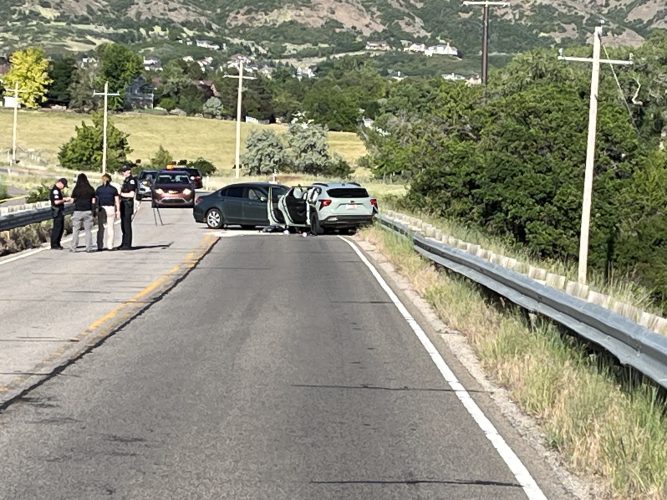
Two vehicles involved in a crash are shown on Oak Hills Drive in Layton on Friday, June 5, 2026. (Ryan Comer, Standard-Examiner)LAYTON — The investigation into the June 5 crash that occurred on Oak Hills Drive is ongoing, according to Lt. Clint Bobrowski of the Layton Police Department, but there are a number of challenges that motorists on the road face.
The two-lane road, officially State route 109 and owned by the Utah Department of Transportation, is 50 miles per hour from near where it connects with Highway 89 to close to Fairfield Road.
There’s a hill, which can lead to rapidly increased speeds.
Where the crash occurred, there are metal barriers on either side of the road, giving drivers nowhere to veer off the road if a car is coming toward them in their lane.
The yellow striping in the middle of the road is faded in some areas.
“We at UDOT are constantly monitoring roads, the conditions,” UDOT spokesperson Mitch Shaw told the Standard-Examiner. “We’re always looking at traffic volume, the number of vehicles that drive on the road, pedestrian activity and, of course, we look at crash history.”
He said this road doesn’t have a significant crash history but addressed the challenges.
Speed limit
Shaw said speed limits on Utah roads are designed for those roads. He said UDOT looks at “all kinds of data” to determine if speed limit adjustments are necessary.
“But we just don’t arbitrarily change speed limits,” he said. “Not saying that’s something we’d never do. Any time we have a fatal crash or a serious crash, we have a fatal crash review.”
He said UDOT would wait and see what the crash report revealed.
Shaw said artificially lowering the speed limit can be an ineffective solution.
“If you artificially lower a speed limit, there’s a whole bunch of study – years and years, decades of study – from transportation departments across the United States that basically says if you artificially lower a speed limit, people are still going to drive the speed,” he said. “Whatever the road – if we have a road that’s 40 miles per hour, we lower it to 25 miles per hour, but it’s totally safe to drive 40, what it teaches people to do is ignore the signs. We’re very careful with how we post speed limits.”
Barriers
Shaw said barriers are put on the road for driver safety.
“When we have barriers on the road, it’s in a place that we’ve determined driving off the road presents a greater hazard than staying in your lane,” he said. “There are places that there are barriers. There’s no reason for people to be speeding on this road. There’s no reason for people to be distracted. I don’t know the details of the tragedy, but we’ll look at it. If there’s something reasonable we can do to improve safety, we’ll do it, but we’re not there yet.
“We always want to look for a solution, but what it is depends on a case-by-case scenario.”
Striping
Shaw said that striping in Utah is a challenge because of the nature of the climate.
“The climate in Utah is pretty hard on the roads just because we have the two extremes,” he said.
Oak Hills Drive presents challenges because of its proximity to the mountains and the hill, which can lead to heavier snowfall and more treacherous conditions as one travels the road toward Highway 89.
Shaw said there’s a “regular rotating schedule” for road striping, “so when the striping starts to fade, (the road) gets put on a list and prioritized.”
Overall, the message from Shaw to motorists is to be alert.
“All drivers have to pay attention,” he said. “If you’re getting behind the wheel of a vehicle … know that you have a really great responsibility. Avoid distractions. Do not ever operate a vehicle when you’re under the influence. There’s a lot at stake when you get behind the wheel.”
Contact Standard-Examiner editor Ryan Comer at rcomer@standard.net.
Local News

Weber County 4-H members assemble care kits for county correctional officers in observance of 9/11 Day of Service

Volunteer opportunities available at local organizations
