Business Depot Ogden official recalls site’s military past, transition to civilian work
Special Collections Department, Stewart Library, Weber State University
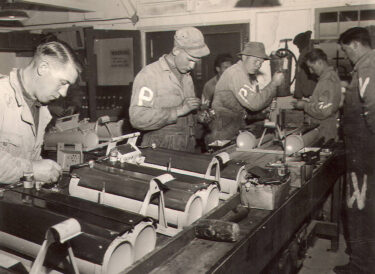
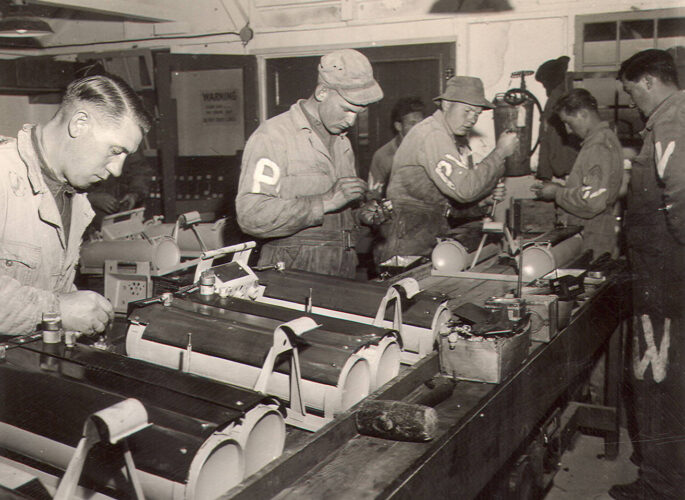
German prisoners of war work on machinery at the POW camp at Defense Depot Ogden during World War II.
Editor’s Note: This is the first in a series of three stories following a Standard-Examiner editorial board interview with Business Depot Ogden Partner Aaron Austad about the site’s history and ongoing importance to Ogden City.
OGDEN — Business Depot Ogden has been a landmark of sorts on Ogden’s north side for decades.
Today, the complex is dominated by warehouses serving the likes of the Weber School Foundation, Hershey’s, Wayfair, Allstate and others.
But, as Business Depot Ogden partner Aaron Austad reminds the public, its first service was to the United States Army as Defense Depot Ogden.
“In 1940 — mind you, this a year before (America’s involvement in) World War II is going to hit — the Department of War was going out looking for safe places to put its logistics center,” he said. “They wanted to move it inland and they put a request out to see who would be willing to do that and the people of Ogden, the Chamber included, went out and within 48 hours had purchased this piece of ground for $100,000.”
He said that construction began on the Defense Depot in December of 1940 and activated in 1941.
“All of these World War II buildings that are brick and steel-sided, they went up super fast,” he said. “The depot went up really, really quick. You would think the buildings would’ve been affected by quality, but they are solid, super-good buildings.”
Austad said that several of the original buildings still standing today have received high praise for their continued quality.
“We took a structural engineer into one of the brick buildings,” he said. “He said, ‘You should run into this building in an earthquake. This building is solid.'”
When the U.S. entered the war in late-1941, the DDO employed around 800. With the expanded needs of the war, this ballooned to a workforce of 6,000.
And Austad pointed out that this wasn’t necessarily a local workforce.
“Ogden didn’t have the workforce to be able to support the kind of distribution center that this was, so they had to bring in POWs” he said. “Those workers stayed out where the fairgrounds are located now, that was their barracks. They would come across into (DDO) and work during the day.”
He said, of that 6,000 figure, 4,657 were Italian POWs who actively worked at the depot. Some 2,000 German POWs were also held but as combat POWs, they weren’t part of the workforce.
“A lot of those POWs actually stuck around in Ogden,” he said. “A lot of Italian POWs liked it so much here that after the war, they married and stayed in Utah.”
For years, the DDO was known as the “Hub of the West” due to the ease of moving necessary Army materiel to where it was needed in the Western United States. Ultimately, the DDO would cease military operations in 1995.
Austad noted that in 1997 the Army started deeding the DDO over to Ogden City.
“There was a remediation effort that was taking place to get all of the environmental issues cleaned, and then they started deeding portions of that over to Ogden City,” he said. “Ogden City didn’t really know what to do with it at the time. They ended up selling off some of the properties with the idea that those companies would bring in employees and more economic development. Then they started to realize that wasn’t really happening.”
It was at this time that the Business Depot Ogden really started to come into its own.
“In 1999, they issued an RFP for developers to come in and actually develop the property and actually take charge of the BDO,” he said. “That’s when the Boyer Company came in and we entered a 70-year master lease with Ogden City that was effective the first part of 2000.”
From here on, the “Hub of the West” would be serving the needs of private businesses, both near and far.