
Behind the scenes of an effort to house homeless veterans across Utah
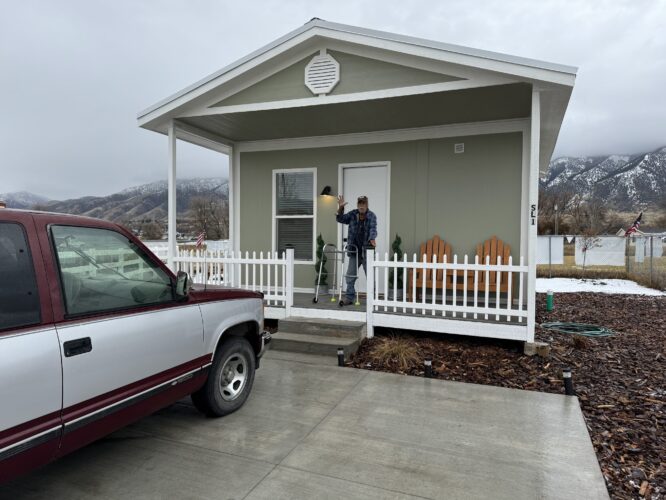
Photo Courtesy of USA Project Valor
Kelly K., a veteran, waves from the porch of USA Project Valor’s first veteran home built in Cache Valley, Utah.While Utah lawmakers were busy passing bills during the final week of their legislative session earlier this month, a small group gathered in a conference room at the Utah Capitol for a private meeting with Gov. Spencer Cox.
They were there to celebrate a housing project for homeless veterans that took multiple state, local and private partners to make a reality — but came together remarkably quickly.
In that meeting, which the governor’s office invited Utah News Dispatch to attend, Washington City Mayor Kress Staheli told a brief history of Washington City in Southern Utah. Today, the city is home to about 40,000 residents. But back in the 1940s, when World War II was breaking out, “we were no more than a dot on a map with maybe 400 or 500 residents,” he said.
At the time, “104 of our brave young men and young enlisted and served” in the war, Staheli said — making up roughly a quarter of the entire town’s population. Of those, he said 102 returned.
“From that point on, Washington City has been the place to celebrate and honor veterans in Washington County for decades,” Staheli said. According to the latest census numbers, Washington City is now home to more than 1,400 veterans.
Today, on the corner of Main Street and Telegraph Street in the city, is a community gathering place known as Veterans Park where those who served in the military continue to be remembered and honored.
Now, a few blocks north of the park, at least four homes are being built to house homeless veterans. There are also plans to build more on another parcel across the street, perhaps to bring the total up to eight or 10.
“Housing is human dignity. And who deserves more dignity than our veterans?” Staheli said.
To make the project possible, it took work and donations of various kinds from state officials, city leaders, a nonprofit and a prefabricated housing company. But surprisingly, it came together in a matter of days after talks started the week before, in late February.
Carlos Braceras, executive director of the Utah Department of Transportation, said he found out about the proposal for the quarter-acre parcel of UDOT-owned land in Washington City — a remnant from a past construction project — on a Friday afternoon.
Steve Waldrip, the governor’s senior housing adviser “did push me a little bit,” Braceras said, prompting laughs from around the table.
“And by Friday evening,” Waldrip said, “we had the land secured.”
The deal
For the first four units in Washington City, state officials agreed to lease the property — appraised at about $190,000 — for just $1 a year to USA Project Valor, a growing nonprofit based in Providence that so far has housed 25 veterans in Cache, Salt Lake and Iron counties. Soon, that list will also include Washington County.
The nonprofit’s board chairman and acting president, Michael Fortune, and his wife Kathleen — who he said was the “brains” of the operation — attended the meeting with the governor. There, Fortune spoke about their efforts to help “great men and women” who served their country but struggle after life “throws them a curveball.”
“One of the greatest statements we’ve had from a homeless veteran, is he said, ‘I finally have a home again,'” Fortune told the governor.
Fortune thanked Cox and his administration for making the project in Washington City possible, telling the governor, “you made this happen.”
But Cox shook his head, saying he doesn’t “get any credit for anything. My job is just to get out of the way and let really good people do their thing.”
“It takes an amazing couple to pull something like this off,” Cox said.
Fortune, in an interview with Utah News Dispatch, also credited the project to a prefabricated housing company, BOXABL. Martin Costas, the company’s CFO, also attended the meeting with the governor.
BOXABL’s founder, Galiano Tiramani, donated $1 million in the company’s stock to USA Project Valor, Fortune said, to help generate money for the nonprofit.
Fortune said Project Valor will be using donations to fund the veteran housing project in Washington City, which will be built using BOXABL homes and donated material from a variety of other construction partners to help prepare the property’s foundation.
The land lease deal with UDOT was “tremendous” to make the project a reality, Fortune said, noting that oftentimes land costs are a huge financial hurdle to overcome.
BOXABL homes have also been installed in The Other Side Village, a tiny home community for the homeless in Salt Lake City, and in the state’s microshelter community, which also sits on land owned by UDOT.
While exploring ways to expand USA Project Valor to other corners of the state, including Southern Utah, Fortune said former state homeless coordinator Wayne Niederhauser — who retired in December — recommended that he get in touch with Waldrip to see if there would be any opportunities on state-owned land.
After Waldrip suggested Fortune scope out some properties in Washington City, Fortune said he drove down the next day. When he reported back on his preferred parcel, he said Waldrip quickly got to work hashing out the deal.
Now, Fortune hopes the homes will be built in a matter of months, after permitting and foundation work is sorted out. But for the most part — after Washington City leaders also green lit the project — he said the endeavor is mostly in the clear.
Fortune said USA Project Valor, through its network of veteran assistance organizations, will vet who will live in those homes, but they aim to house veterans in need who are currently living in Southern Utah.
A veteran’s story
Alton Smith, 78, is one Army veteran whom USA Project Valor has helped into housing.
Originally from Michigan, Smith said he served as a field wireman in Vietnam in the ’60s. While he wasn’t engaged in direct combat, he said he still got a “taste of the war” at the camp.
“It was a very violent experience. Mortar attacks. Attempted invasions to the camp,” he said in an interview with Utah News Dispatch last week. “Every once in a while, we’d be in convoys going from one place to another and you’d see … a five-ton truck, only three or four trucks ahead of me, go like 20 feet in the air.”
Smith said he got used to the “continual noise” of the war. But when he came back home, he said the silence was deafening.
“That was one of the hardest adjustments, to adjust to the quiet,” he said.
In the years after, Smith said he struggled to find his way. “Life wasn’t working out,” he said, and he eventually came to Utah “to start over.” Eventually he connected with USA Project Valor, which he said helped him navigate a complicated spiderweb of bureaucracy to get housing assistance.
Now, he said he pays about $250 a month — based on his income from Social Security and veteran pension — to live in a home supported by USA Project Valor in Nibley.
“Without Project Valor, I’d still be in my truck,” he said. “I’ve never had this kind of good help, ever. … This is the greatest thing I’ve ever experienced.”
‘You’ve unlocked something’
Cox applauded everyone involved for making the Washington City project a reality, saying he was “as excited as I’ve been about just about anything we’re doing right now.”
“We care deeply about our veterans and want to make sure that they have our support, they know how much we love and appreciate them and the lives of service they’ve given us,” the governor said.
He added that his administration also cares “deeply” about housing challenges, and “we’ve found to move the needle on any of this, you really need innovative partnerships” on state and local levels, but also with the private sector.
“Usually, when you put all of those things together, it’s great, but it also means it takes a couple of years,” Cox said. “So to move very quickly (on this) is incredible.”
But what the governor said he’s most excited about is “not just the four units, which is incredible. … But you’ve unlocked something, where we took a piece of land that has no other value, really, there’s just not much we can do with it.”
“We have those pieces of land all over the state,” he said. “And so now this becomes a template to help so many more people and to do it really quickly.”
Cox said he hopes other cities across the state see what Washington City did and get motivated to do something similar.
Utah News Dispatch is part of States Newsroom, the nation’s largest state-focused nonprofit news organization.