Utah lawmakers approve legal framework for driverless cars, hoping to attract companies
The Legislature established different causes of action and compensation caps for injuries involving autonomous vehicles
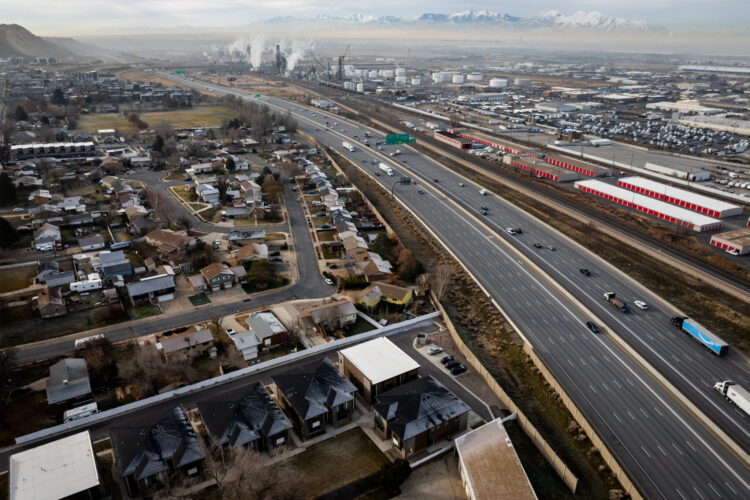
Photo by Spenser Heaps for Utah News Dispatch
Traffic moves along I-15 near neighborhoods in North Salt Lake on Wednesday, January 3, 2024.Are driverless cars poised to come to Utah?
State lawmakers haven’t heard of any definitive commitments from autonomous vehicle companies, but they have already approved legislation to establish a liability framework in case of road accidents that may happen when one of the drivers is an automated system.
Senate Majority Leader Kirk Cullimore, R-Sandy, who sponsored the bill that’s now waiting to be signed by the governor, said the framework would create a path for recovery for people injured in an autonomous vehicle accident, but also gives “some business certainty to any of these businesses that are looking to deploy these.”
“We can expect autonomous vehicles. The technology is already here. We can expect them to start coming into our state more and more,” Cullimore told a House committee earlier this month. “And what we’re trying to do is establish what that liability framework looks like.”
The bill creates different causes of action, including one for people who suffer injury or property damage directly caused by an autonomous vehicle. In that case, plaintiffs have to prove that the automated driving system was “a proximate cause of the injury or property damage,” according to the bill. Damages for those claims would be capped at $100,000.
People injured by driverless systems would also be able to sue for negligence with a damage cap of $1 million. That cap is for non-economic damages like “pain and suffering,” which doesn’t include damages for exorbitant medical damages, job loss or wrongful death.
Another legal route could be manufacturer and developer liability claims for defects on the driverless vehicles. In that case, plaintiffs must prove that a reasonable alternative design existed and that the vehicle caused more injuries than humans performing the same tasks at scale.
Whether driverless cars are safer than human-driven ones is still uncertain since there isn’t a lot of real-world autonomous vehicles accident data, a University of Central Florida study said.
However, in an analysis, the researchers suggest that accidents of vehicles equipped with advanced driving systems have a lower chance of happening than human-driven cars. But, driverless vehicles are more prone to accidents around dawn or dusk and while turning.
The Legislature will review the framework again in 2030, a move that Jake Lee, chair of the legislative committee at the Utah Association for Justice praised in a public comment, arguing that the bill “eliminates punitive damages and grants many protections to largely untested technology, and we just don’t have sufficient safety data to know whether this framework strikes the right balance.”
Cullimore said that in running the bill, he spoke to some automotive companies including Tesla, Waymo and Zoox. When asked whether the companies were worried about potential frivolous lawsuits in Utah, Cullimore said their concerns may extend to any jurisdiction where they may deploy.
“Anytime you deploy a new technology, you can’t really gage what your liability risks are, because it’s untested,” he said. “And so, to the extent that we can provide some certainty, I think it makes that market more appealing for them.”
While Cullimore doesn’t want to speak for everybody, he said he has spoken to the Utah Department of Transportation and other agencies about welcoming autonomous vehicles to the state and has received the support from groups of people with disabilities who have expressed enthusiasm for what the vehicles could mean for their mobility.
And overall, Cullimore says autonomous vehicles are safe.
“I think there are overall benefits to the state in doing this. When people drive more correctly the demand on infrastructure actually decreases,” he said. “Our current roadways can handle a lot more capacity if the critical mass of the vehicles were autonomous, so you might need less roads and you could accommodate more growth.”
Local News
Ogden gas prices climb 31.3 cents in last week; Layton Walmart jumps 37 cents in two days
Utah lawmakers approve legal framework for driverless cars, hoping to attract companies