Ogden Valley City weighs 519% property tax rate increase; average homeowner impact estimated at $555 per year
Ryan Comer, Standard-Examiner
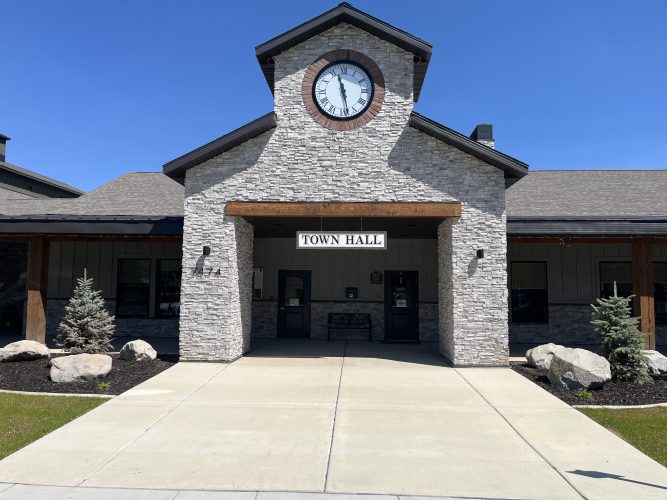
The Huntsville Town Hall and Community Center, pictured Friday, May 8, 2026.HUNTSVILLE – Ogden Valley City is looking to increase its property tax rate by 519%, but the impact of the astounding figure to the property taxes paid on an average residence per year is just 8.58%
The percentages are part of a proposed property tax impact schedule document that was reviewed Friday by the City Council at the Huntsville Town Hall and Community Center.
“Ogden Valley City will consider an increase to its property tax rate from .000159 to .000985 (estimated) to generate an additional $2,542,506 in ad valorem tax revenue,” the document states.
For a primary residence with an average taxable value of $672,302, the impact is estimated to be $555.32 per year.
For a commercial property with an average taxable value of $1,147,912, the estimated increase is $948.18 per year.
The operational impact without the tax increase would be $1,261,500, including a budget change of $361,500 in the municipal energy sales tax and a change of $900,000 in the transportation utility fee.
There currently is not a municipal energy sales tax or transportation utility fee collected, and the table provided by the document shows it would remain that way under the proposed budget with a tax increase.
“If the property tax is approved, Ogden Valley City would like to *eliminate or decrease the municipal energy tax that is scheduled to start in FY27,” the document reads.
At the bottom of the document, the asterisk next to “eliminate” is explained:
“Note: All figures are preliminary and based on current assumptions. The City is currently evaluating eligibility for Tax Anticipation Note (TAN) funding. Final budget amounts and funding requirements may change based on the outcome of this evaluation.”
The document adds: “If the tax increase is not approved, Ogden Valley City will need to implement a transportation utility fee to maintain safe road conditions.”
Departments affected by whether the tax increase is approved include as follows:
- Administration ($334,731 budget change)
- Class C – Roads ($440,425)
- Community Development/Planning ($245,650)
- Public Works/Municipal Services ($206,200)
- Grant Management ($40,000)
- Addition to Fund Balance ($14,000)
Regarding the Administration Department, the document reads:
“Without the increase, the Administration Department will be unable to hire a Treasurer, and Accounts Payable Clerk, and a Communications Specialist. The treasury role and AP clerk are key financial functions requiring technical expertise. The Communication Specialist is needed to provide more extensive communications to residents. The City will have to rely on volunteers to fill these roles.”
Regarding Class C – Roads:
“Delays in road maintenance will accelerate pavement deterioration, ultimately requiring more extensive and costly repairs in future years.”
Regarding Community Development – Planning and Engineering:
“Cuts to the Planning Department will significantly limit long-term planning efforts, reducing them to only essential functions. Staffing levels will be minimal, limiting the City’s ability to respond to citizen requests in a timely manner. This will impair the City’s ability to thoughtfully guide growth in the Valley and may lead to higher costs and missed opportunities in the future.”
Regarding Public Works/Municipal Services:
“While delaying master plans and scaling back engineering may provide short-term budget relief, it significantly increases long-term costs and risk. Without proper planning and design, the City is more likely to face unanticipated infrastructure issues, costly emergency repairs, and missed opportunities for efficient development.”
Regarding Grant Management:
“While reducing funding for grant matches may provide short-term budget relief, it will prevent the City from accessing grant opportunities that require local participation. This will result in missed funding opportunities and higher long-term costs for the City.”
Regarding Addition to Fund Balance:
“To meet statutorily required fund balance levels without a tax increase, the City’s General Fund revenues will have limited capacity to contribute. As a result, the City will rely on a combination of fee-supported revenues and operational efficiencies to support compliance.”
City Recorder Sharon Robins told the Standard-Examiner that there will be a tax update going forward at every meeting. The next work session will be Monday at 2 p.m. Meetings are also held the first and third Tuesdays, and there are also occasional special meetings.
Property taxes are a topic of conversation as of late in part because of the Roy City Council choosing Tuesday to move forward with a tentative budget that includes a 55.45% property tax increase.
Only Council member Bryon Saxton voted to not move forward with it.
The Roy City Council meeting Tuesday was standing-room only, with residents taking up nearly 90 minutes to issue public comments against the proposal.
Property taxes were also a point of discussion at the Layton City Council meeting Thursday, with the council voting to adopt a resolution approving a tentative budget that did not include a property tax increase.
“Another year with no property tax increase in the city,” Council member Zach Bloxham pointed out during the meeting.
He continued:
“We don’t want to raise taxes, and seven years in a row, we haven’t done that. … I think that’s the way we should be doing things.”
Contact Standard-Examiner editor Ryan Comer at rcomer@standard.net.