
Will $1 billion for the Great Salt Lake materialize? Sen. Curtis says he’s working on it
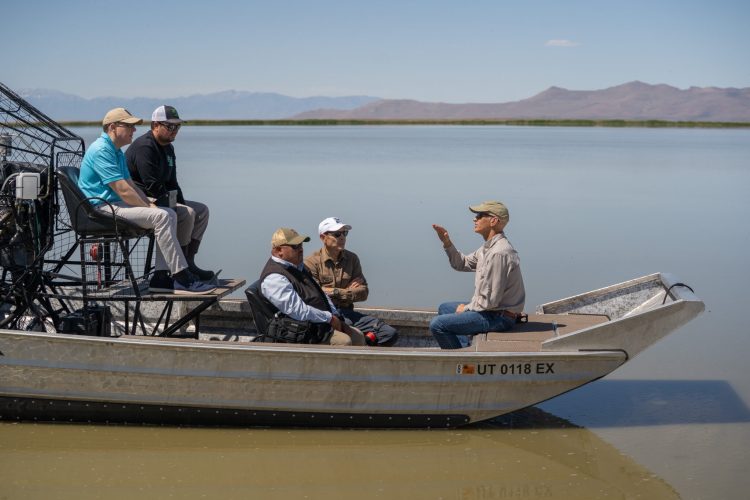
At right, Tim Davis, Utah Department of Environmental Quality commissioner, briefs U.S. Sen. John Curtis and Environmental Protection Agency Administrator Lee Zeldin during a tour of the Great Salt Lake at Farmington Bay on May 23, 2026. (Pool photo by Trent Nelson/The Salt Lake Tribune)
During a discussion focused on water and saving the shrinking Great Salt Lake, U.S. Sen. John Curtis said on Monday he’s trying to drum up the political will in Congress to help President Donald Trump’s $1 billion proposal for the lake materialize.
The president’s budget request is just that — a request, which needs approval from Congress.
“Now we, as legislators, have to figure out where that money’s going to come from,” the Utah Republican said at the University of Utah’s Hinkley Institute of Politics in Salt Lake City during a speaking event hosted by the Sutherland Institute, a conservative think tank.
Utah’s federal delegation is now working to convince their colleagues the effort “is worth $1 billion.”
“So that’s the mode that I’m in right now, is working with my colleagues to help them understand why a $1 billion investment in the lake is a good investment,” he said. “To do that, I’m physically inviting them here to Utah, talking to them, trying to educate them.”
He said it’s also Utah leaders’ jobs, in order to help convince Congress to bring that money to fruition, to answer the question: “What would you do with $1 billion?”
Curtis warned, however, that it may take multiple years to bring that $1 billion to the state.
“In a perfect world, we’d get a $1 billion in this year’s budget. In reality, we may work for a couple of years,” he said. “But I do actually think, ultimately, the federal government’s investment may exceed $1 billion, and it probably should.”
He argued the shrinking Great Salt Lake is a “regional issue,” with ecological and economic threats that could hurt not just Utah, but the West. He also said it could have global implications, if state and federal leaders figure out a way to save the saline lake — which hasn’t been done before, ever.
“There is no track record of success of ever saving a lake like the Great Salt Lake. We have never done it in the world’s history. Every place has failed in actually doing it,” he said. “So doing it here, figuring it out, it’s important for the world, not just Utah. It’s important for the region. And that’s why I think it’s important to make a case federally for some assistance.”
Curtis’ comments came during a livestreamed interview with Sen. Todd Weiler, a Republican legislator who also works as president and CEO of the Sutherland Institute.
Weiler said there have been “some pretty far-fetched ideas” to solve the problem, including building a canal or a river from the ocean to Utah or from Mississippi, or a pipeline from southern Idaho.
“Do you put much stock into those ideas?” Weiler asked.
In August, Curtis convened a panel of experts and policymakers, challenging them to come up with “bold and audacious” ideas for saving the Great Salt Lake, KSL reported. He has also called for “pioneer-scale ambition” to do so.
Curtis pointed to Utah pioneers building a 28-mile canal only equipped with picks, shovels and horse-drawn equipment as an example of what Utahns’ ancestors accomplished during their time — and he called for ideas that may seem wild for our time.
“I think we should take some of these constraints off and say for a minute, just dream. Like, what would happen if we piped water from Idaho?” Curtis said, adding he’s also heard ideas to bring water from Louisiana. “What would happen if we worked with California folks and said, ‘Look, let’s put in desalination in California. We’ll help you pay for it and then you pull less water out of the Colorado River.”
Curtis added that “I guarantee you, if we did any of those things and we sat in a room 50 years from now, we would go, ‘Wow, man, that was cheap.'”
Weiler said he thinks the desalination partnership with California “actually has merit” and will “probably happen.”
Curtis said what’s been “missing in the conversation” around saving the Great Salt Lake is, in addition to encouraging Utahns to conserve water, “we’ve got to be more bold and more audacious and think of the things right now that seem impossible.”
“We have to change the math. There is not enough water, even with conservation,” he said. “Well, how do you change the math? You do something dramatic like that.”
Weiler asked what Curtis’ message is to young Utahns “who worry they won’t have a reliable water source for a healthy Great Salt Lake to raise their own children here” 30 years from now.
“Well, the evil part of me wants to say, ‘Yes, you should move away, right? Because I’d like less people here,” Curtis said. “But in reality, this is an amazing place to live. And if you look at every place where you would consider living, they’re going to have issues. … So the reality of it is, you have to make your home better, no matter where you decide to live. … I’d also say roll up the sleeves and be part of the solution. Like, let’s figure this out.”
When Weiler asked if state or federal government “mandates” are the solution to saving the Great Salt Lake, Curtis said mandates have problems.
“I would question the efficacy of mandates and exactly what would we mandate?” he said. “How do you mandate a shower time? How do you mandate water — everybody’s lawns are different sizes. … I cannot personally think of a lot of situations where mandates have actually been that effective.”
Weiler said “the most effective mandate” would be to require water metering statewide. Curtis agreed, saying, “I like that one.”
Weiler said alfalfa farmers in recent years have become “the boogeyman” when it comes to the lake, but he noted the crop is often “grown in areas that are outside the watershed for the Great Salt Lake.”
“So if we banned alfalfa hay growing tomorrow, it wouldn’t necessarily help the Great Salt Lake nearly as much as people think it would,” Weiler said. “And other things would be grown in place of those crops.”
While encouraging big ideas to find solutions, Curtis also warned against placing the blame for Utah’s water problems on one actor.
“If you’re coming up with boogeymen, you’re going to come up with enemies,” Curtis said.
He urged that the conversation not be focused on “good versus bad” but rather on how everyone involved can do their part.
“We’re all part of this, right? If you single out any group, you’re just going to make them an enemy … We need everybody on the team,” Curtis said. “So I would advocate for, ‘Look, nobody’s at fault here. It is what it is. It’s developed over time. Now let’s come together, put our best minds together, and make good decisions.”