Weber State president sees value in partnerships between WSU, other institutions, state and local employers
Rob Nielsen, Standard-Examiner
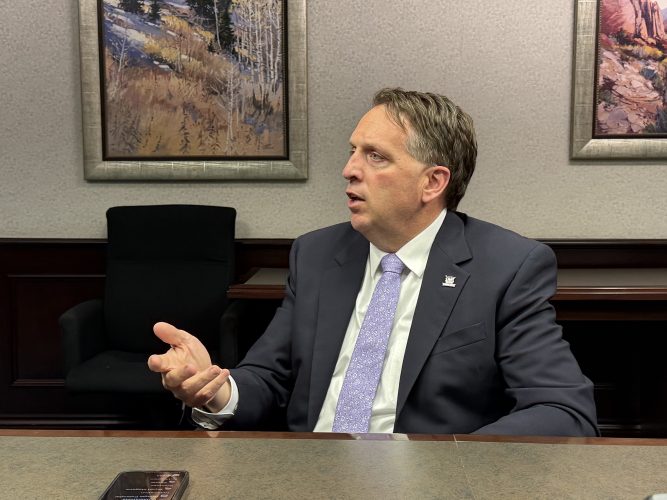
Weber State University President Chris Mallett speaks with the Standard-Examiner editorial board on Wednesday, Sept. 2, 2026. (Rob Nielsen, Standard-Examiner)Editor’s note: This is the third of three stories following a Standard-Examiner editorial board interview with Weber State University President Chris Mallett. Discussion topics included Mallett’s vision for WSU, partnerships with other higher education institutions and the local business community, evolutions in higher education and what artificial intelligence’s place is on campus.
OGDEN — Is the next big innovation in higher education how it tackles AI? What about new degree programs?
New Weber State University President Chris Mallett thinks it’s something more fundamental — forging partnerships with outside entities.
“Partnerships are the differentiator,” he said.
Specifically, Mallett wants to boost WSU’s relationship with regional employers.
“Universities for centuries have operated a little bit with this sort of ivory tower view of, ‘We’ll educate them and then we’ll send them to the workforce, and then you can either do what you want with them.’ ‘Trust us,’ kind of mentality,” he said. “I think the future of our industry is more integrated partnerships with employers so that we’re co-designing and co-developing things from day one that ensure that our programs are relevant and that our graduates are job ready on day one because employers have been with us at the table from day one.”
Mallett noted that Weber State already has very fruitful partnerships with local employers Hill Air Force Base and Intermountain Health, but that he intends to see the list grow.
“We’ll be doing more and more of that as we grow,” he said. It also helps enable experiential learning so that it’s no longer just the courses; it’s the courses and the experiences that we can create in partnership with industry. I think that’s the unlock and the innovation.”
He said that this is what potential students and their families want to see before committing to a university these days.
“They’re going to demand that relevance, that integration, that connection with industry because that will increase the likelihood that they gain the experiences that they need to start their careers or continue their careers and create prosperity for themselves and their families,” he said.
Mallett added that it’s not just local industry that WSU must forge partnerships with in the coming years.
“This is clear from the state’s vision for the system, the Board of Higher Education and the 16 colleges and universities that we’re meant to partner with one another to reduce costs and to improve the quality of service for students,” he said.
He added that the relationship between public universities and trade schools doesn’t need to be an adversarial one, citing how WSU has already worked with institutions like Davis Technical College and Ogden-Weber Technical College.
“What I’ve come to understand being six weeks into the job is that President Mortensen, President Taggart and Darin Brush have been building this model long before the state compelled it,” Mallett said. “The state organized, most recently, this concept of regions, and there’s legislation that required it and USHE was meant to operationalize that vision, in part, because those three presidents have been building this partnership for five to seven years.”
Mallett said these partnerships will be just as important for area employers as working directly with them.
“I can tell being a new entrant to those partnerships that they’re authentic, that genuinely Darin and Jim and Brad and now me really care the most about what’s best for the learner and then we’ll sort what’s best for the institutions as part of that,” he said. “It bodes well for the employers of Weber and Davis County because, from the employer’s perspective, they’re looking for the institutions to help create the future workforce and to provide programs that have relevance to the workforce. When those three institutions are working together, we increase the likelihood that we can do that.”
In addition to strong partnerships with employers and other educational institutions, Mallett said the university has a strong relationship with the state he would like to maintain and build upon.
“There are a lot of legislators and legislatures in America right now that are not supporting higher education,” he said. “The legislatures in Utah are making significant investments in our industry. Just created a research bond to do state-funded research. That’s almost unheard of. Most of the time, they just leave that to the federal government, but in Utah, the legislature understood that we needed to continue to innovate and Weber State’s going to be competing for some of that funding. In fact, we’re just looking at the proposals that our faculty have developed right now.”
He said this support from the legislature and other institutions leaves WSU in a positive place to take on the future as he begins his presidency.
“We have strong support and legislative partners,” he said. We have financial resources. We’re well-resourced from a facilities perspective. We have multiple campuses. We have a digital platform. We have a low price point. We serve everyone. We meet (students) where they are and we’re aligned with industry and we’re gonna get them experience. That is the university of the future, I’m sure of it.”