Layin’ it on the Line: The Utah Tax Trap: How ignoring state rules could spike your RMD taxes by 20% or more

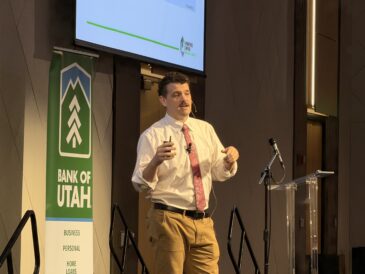
Photo supplied
Lyle BossMost Utah retirees assume they’re playing it safe by leaving traditional IRAs untouched until Required Minimum Distributions kick in. But that seemingly conservative strategy could be quietly draining thousands of dollars from retirement accounts every year, thanks to a little-understood collision between federal RMD rules and Utah’s unique tax structure.
The problem isn’t just the taxes themselves. It’s the timing–and how deferral strategies that work beautifully in some states can backfire spectacularly here in Utah.
The Hidden Cost of “Maximizing” Your IRA
For decades, conventional wisdom has preached a simple gospel: stuff as much as possible into tax-deferred accounts, let compound growth work its magic, and worry about taxes later. For many Utah retirees with substantial IRAs built over 30-year careers, that advice made perfect sense–until RMDs arrive at age 73.
Here’s where Utah’s 4.65% flat income tax becomes problematic. Unlike states with graduated brackets or no income tax at all, Utah taxes virtually all retirement income at the same rate regardless of amount. Add federal taxes on top, and a retiree in the 22% federal bracket suddenly faces a combined 26.65% tax hit on every RMD dollar.
But the real damage comes from bunching. When large RMD withdrawals coincide with Social Security benefits, pension income, or investment gains, total taxable income can spike dramatically in a single year. Utah partially taxes Social Security for higher earners, meaning that forced IRA distributions can push retirees over thresholds where previously untaxed benefits suddenly become taxable–creating a cascading effect where one tax triggers another.
Why Deferral Backfires in Utah
Consider a Salt Lake County couple, both 74, with $800,000 in traditional IRAs. Their combined RMD this year: roughly $31,000. If they’re already receiving $50,000 in Social Security and have modest investment income, that RMD could push their provisional income high enough to trigger taxation on up to 85% of their Social Security benefits under federal rules–and Utah follows federal taxable income calculations for Social Security.
The math gets brutal quickly. What seemed like a manageable RMD suddenly inflates their taxable income by far more than $31,000 when previously exempt Social Security gets pulled into the tax net. They’re forced to withdraw even more to cover the unexpected tax bill, which triggers yet another tax hit the following year. It’s a compounding spiral that erodes the nest egg faster than anticipated.
This scenario repeats across Utah as Baby Boomers age into RMD territory with larger-than-ever IRA balances, built during high-contribution years when six-figure salaries were common in Utah’s booming tech and financial sectors.
The Roth Conversion Window That’s Closing
There’s a narrow window between retirement and RMDs where strategic Roth conversions can defuse this tax bomb–but most Utah retirees miss it entirely.
Between ages 60 and 72, many retirees have lower taxable income after leaving work but before Social Security and RMDs begin. Converting traditional IRA dollars to Roth accounts during these years spreads the tax pain across multiple lower-income years rather than bunching it into high-income RMD years. Yes, you pay Utah’s 4.65% tax on the conversion–but you’re paying it in the 12% or 22% federal bracket instead of the 24% or higher bracket you might face later.
Once converted, Roth accounts grow tax-free and have no RMDs during the owner’s lifetime. For a Utah couple in their mid-60s with $600,000 in IRAs and modest current income, converting $50,000 annually for five years could save upwards of $75,000 in combined federal and state taxes over a 20-year retirement compared to taking full RMDs starting at 73.
The opportunity closes permanently once RMDs begin, because you can’t convert RMD dollars to Roth accounts–you must take the RMD as taxable income first, then you can convert additional amounts if desired.
Qualified Charitable Distributions: The Overlooked Strategy
For charitably inclined retirees age 70½ or older, Qualified Charitable Distributions offer another way to sidestep the Utah tax trap. QCDs allow direct transfers from IRAs to qualified charities, counting toward your RMD without increasing taxable income.
This matters enormously in Utah. A $10,000 QCD satisfies that portion of your RMD while avoiding the 4.65% state tax and whatever federal bracket applies–potentially saving $2,600 or more. For retirees who donate to church congregations, community foundations, or local nonprofits anyway, routing those gifts through QCDs essentially makes every donation 26% more valuable by eliminating the tax you’d otherwise pay.
Utah retirees often donate generously–The Church of Jesus Christ of Latter Day Saints contributions alone represent significant charitable giving in the state–but many still write checks from after-tax accounts while letting IRAs compound, missing the chance to make tax law work in their favor.
Why Utah’s Tax Structure Amplifies the Problem
Utah stands apart from neighboring states in ways that magnify RMD challenges. Nevada and Wyoming have no state income tax. Colorado offers retirement income exclusions. Idaho provides generous credits. Utah offers limited retirement tax benefits and applies its flat rate to nearly all income sources.
That flat structure means there’s no benefit to spreading income across multiple years to stay in lower brackets–but there’s enormous penalty for bunching income into years where Social Security taxation thresholds get triggered or where Medicare IRMAA surcharges apply. Utah retirees face the same federal IRMAA brackets as everyone else, but they’re more likely to cross those thresholds inadvertently because they can’t use state tax planning to smooth income.
Adding to the pressure: Utah’s cost of living has climbed steadily as the state’s population has grown. Housing, healthcare, and property taxes have all increased, meaning retirees need more after-tax income to maintain their standard of living–making tax efficiency more critical than ever.
The Deadline You Can’t Ignore
If you’re between 55 and 72 with substantial traditional IRA or 401(k) balances, the time to act is now, not later. Once you reach 73 and RMDs begin, your options narrow dramatically. You’ll be locked into a tax structure that could consume 20% or more of every distribution through the combination of federal and Utah state taxes, Social Security taxation, and potential IRMAA surcharges.
Running projections now–before the trap closes–lets you identify whether Roth conversions, QCDs, or other strategies make sense for your specific situation. Every year of delay means one fewer year to spread tax liability across lower-income periods, and one more year that compounding works against you by growing the IRA balance that will eventually face forced distributions.
The complexity lies not in any single tax rule but in how federal and Utah provisions interact. Tax software misses these nuances. Generic online calculators can’t account for Utah-specific considerations. This requires personalized analysis that factors in your complete financial picture: Social Security timing, pension income, investment gains, healthcare costs, legacy goals, and charitable intentions.
For Utah retirees who’ve spent careers diligently saving in tax-deferred accounts, the bitter irony is that success in accumulation can trigger painful consequences in distribution if not managed proactively. The state’s tax structure doesn’t reward procrastination–it punishes it, consistently and predictably, year after year.
The question isn’t whether Utah’s tax rules will affect your RMDs. It’s whether you’ll restructure your retirement accounts now while you still have flexibility, or wait until forced distributions dictate your tax bill for you. One approach preserves tens of thousands of dollars over retirement. The other ensures the state and federal government claim their maximum share, whether you needed to withdraw that much or not.
Lyle Boss, The REAL BOSS Financial, endorsed by Glenn Beck as the premier retirement advisor for Utah and the Mountain West States. Boss Financial, 955 Chambers St. Suite 250, Ogden, UT 84403. Telephone: 801-475-9400. https://www.safemoneylyleboss.com/
Business

Layin’ it on the Line: The Utah Tax Trap: How ignoring state rules could spike your RMD taxes by 20% or more
Economists see decent year ahead for Northern Utah’s economy despite some labor market cooling