WSU Faraday lectures share the fun of science
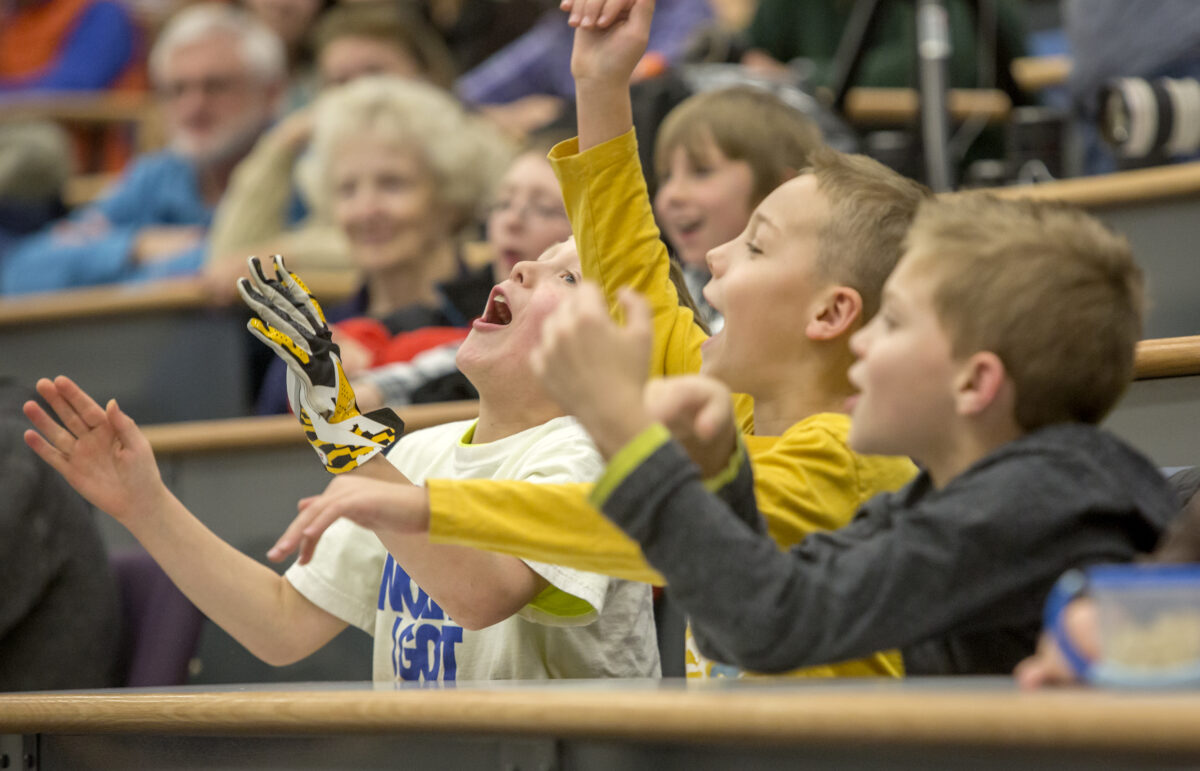
Olin Smith, Hayden Stoke and Aden Ohlin (from left) react in excitement as Weber State University chemistry professor Michelle Paustenbaugh mixes cabbage juice with various acids and bases and causes the liquid to change color at the Faraday Lecture at Weber State University on Monday, Dec. 15, 2014.
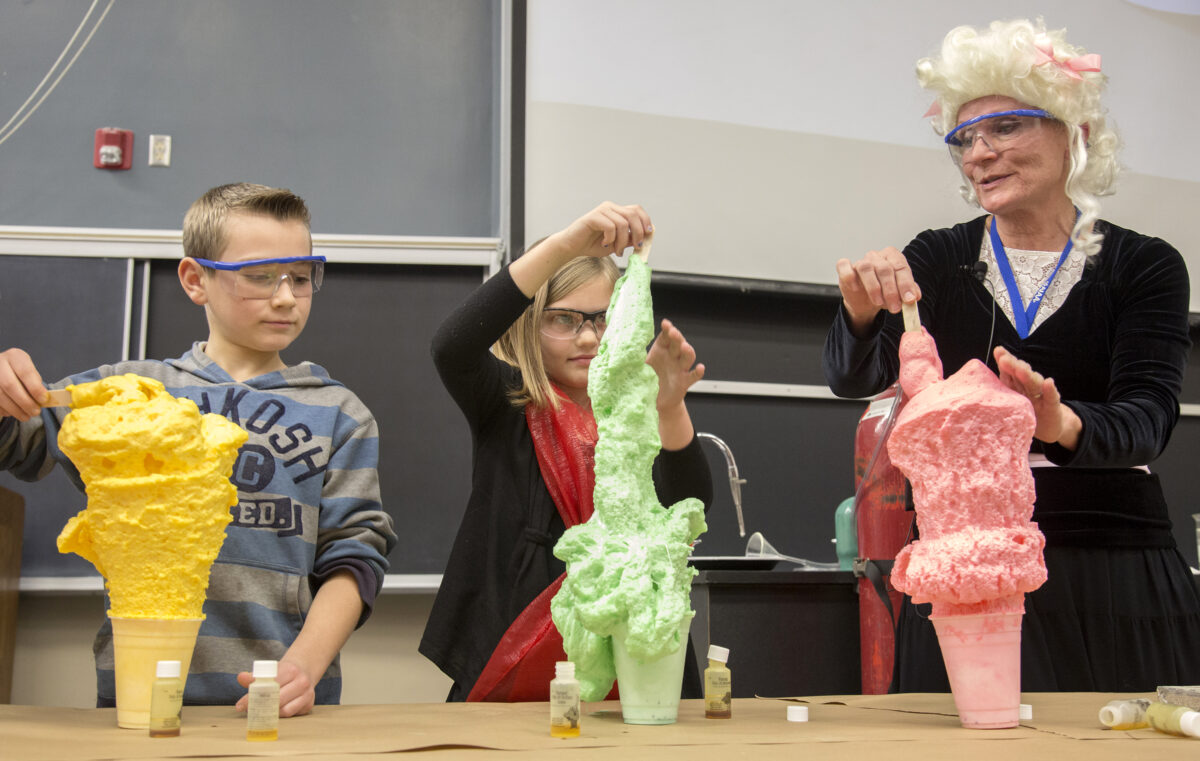
Gerrit Brandon, left, Brinley Lawson, center, and Carol Campbell mix polymer foams at the Faraday Lecture at Weber State University on Monday, Dec. 15, 2014. Campbell, a chemistry professor at WSU, and other staff gave interactive chemistry lessons while acting as famous scientists during the second annual public lecture.
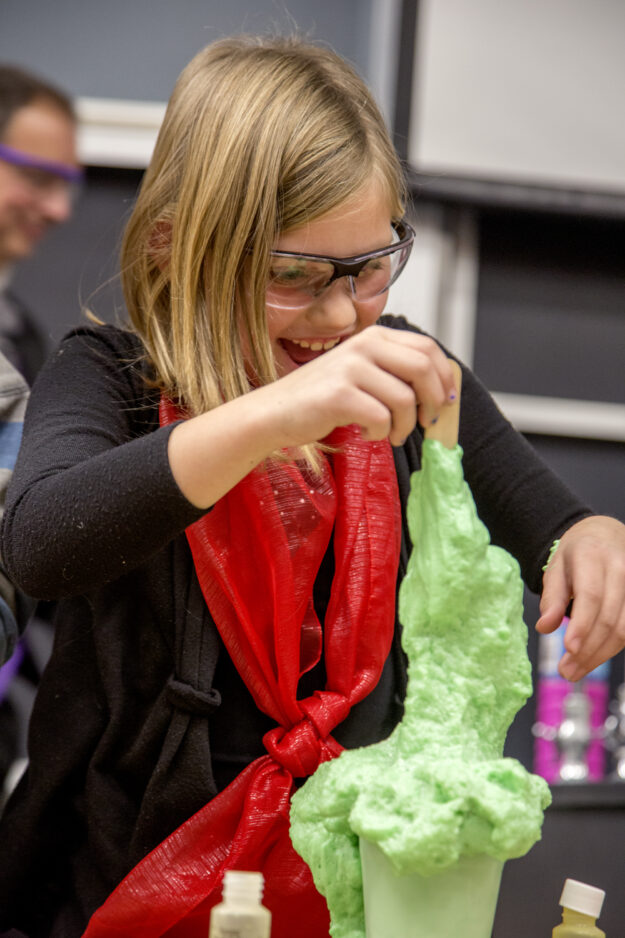
Brinley Lawson watches as her polymer foam grows and hardens at the Faraday Lecture at Weber State University on Monday, Dec. 15, 2014.
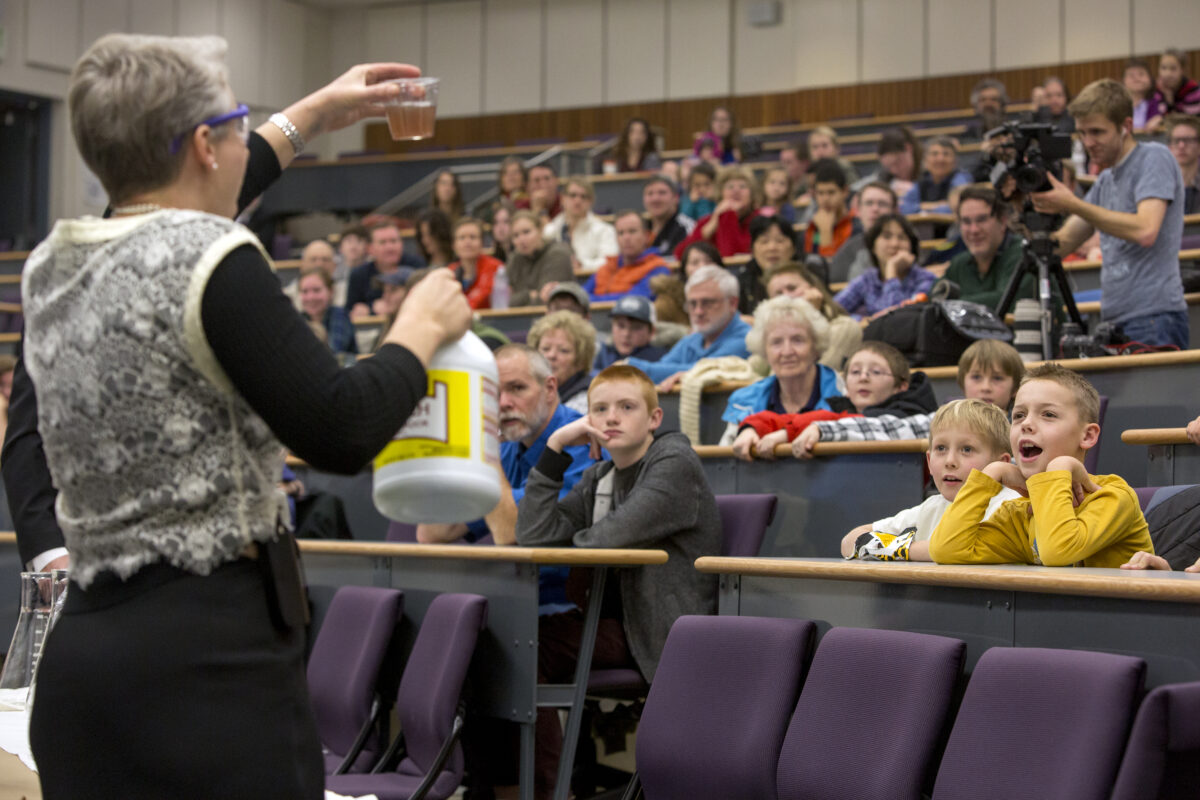
Hayden Stoke, in yellow, watches as Weber State University chemistry professor Michelle Paustenbaugh turns cabbage juice yellow by mixing it with bleach at the Faraday Lecture at Weber State University on Monday, Dec. 15, 2014.
OGDEN — Children love watching soap bubbles float through the air, and then delicately pop when they fall to the ground. They love soap bubbles even more when the bubbles are filled with hydrogen and oxygen, and gently float upward until they explode with a loud bang when touched by the flame of a torch.
Children and adults laughed and screamed as Weber State University faculty members demonstrated chemical reactions during the school’s annual Faraday Lectures this week in the Lind Lecture Hall.
WSU President Charles Wight played the role of Michael Faraday, an English scientist who began offering Christmas Lectures in 1825, at The Royal Institution in London.
“When Michael Faraday did this in the 1800s, it was for the general public and there were a lot of adults in the audience, but really he wanted to inspire the children and impart some of the excitement of science.”
Children were inspired as Wight, dressed in an old-fashioned looking suit with tails, recreated Faraday’s lecture on the chemical history of candles.
“A candle is quite a remarkable thing — it looks pretty simple, but there’s actually a lot of chemistry that’s going on in just a simple candle,” said Wight, a physical chemist.
After explaining how candles work, he asked the audience what they see in the air when a candle is blown out.
“Smoke,” several children replied.
“It looks like smoke, but it’s actually not smoke — it’s actually condensed wax,” Wight said, describing it as the equivalent of steam, but resulting from heating wax instead of water. “I can prove to you that it’s wax, and not smoke, by a fairly simple experiment.”
He then blew out a candle’s flame, and restarted it without actually touching a match to the wick.
“You can light the wax trail, and the flame will jump back to the wick,” he said.
When the audience clapped in delight, Wight pointed to chemistry professor Michelle Paustenbaugh, who shared the stage dressed as Nobel Prize winning scientist Marie Curie.
“Madam Curie complains that I do dangerous things, that are way too dangerous for people to do at home,” he said. “But try this at home.”
After proving that candle flames are hollow, and more, he did do more dangerous things that should not be done at home.
“It’s time to blow something up,” said Wight, whose specialty is the chemistry of explosives and propellants.
He blew the lid off of a paint can filled methane gas, causing the entire can to jump off of the table. He also filled soda pop bottles with oxygen and hydrogen, in a variety of mixtures, and lit the gasses to cause small — but loud — explosions.
Paustenbaugh amazed audience members by changing clear liquid in a series of beakers to a rainbow of colors, by adding other clear liquids. The color change happened because the beakers were filled with acid-base indicators, she said.
She showed how to make an acid-base indicator at home, by putting red cabbage in a blender and then using a strainer to remove the pulp.
“It’s such a good indicator that it works best if you dilute it with a little water,” she said.
Audience members suggested a variety of household substances to add to the cabbage juice, to test whether they are an acid or base. Lemon juice changed the cabbage juice from purple to red, showing that lemon juice is an acid. Baking soda turned it a nice blue color, indicating a strong base. Bleach turned the purple juice green, showing that it’s a base, and then the juice became clear.
“Bleach is bleach,” said Wight, explaining the extra color change.
Paustenbaugh did several other demonstrations, including one that showed how chemists use elements, such as lithium, copper and sodium chloride, to make the different colors of fireworks.
Carol Campbell, a chemistry instructor, played the part of scientist Marie Lavoisier. She invited three children to mix polymers with a liquid curative to create solid towers of polyurethane foam, that looked a little like brightly colored ice cream cones or cotton candy.
Damien Sotelo, and 11-year-old from Ogden, was one of the children invited to help. After the lecture he said that he’d never thought about being a chemist before, but he’s interested now.
Campbell also dipped little WSU basketballs into liquid nitrogen.
“It’s about -340 degrees Fahrenheit, which if you were in Evanston tonight would be about the outside temperature,” she joked.
The balls were instantly frozen by the liquid nitrogen, and shattered when she used tongs to throw them against the blackboard.
Campbell followed that by crushing and restoring cans using atmospheric pressure, and creating a mini grain elevator explosion in a can.
Wight grabbed a fire extinguisher, and Paustenbaugh a heavy blanket, for Campbell’s final experiment, in which she created a fountain of sparks by lighting thermite powder with a strip of magnesium metal.
“What we did is make molten iron,” she said. “That’s hot stuff — that’s about 3,400 degrees.”
Maxwell Frampton, a 14-year-old from Clinton, attended the lecture as homework.
“I thought it was really neat. I was entertained,” he said. “I came here as an assignment from school, and it was more fun than even my teacher made it out to be.”
He especially liked the experiments involving fire.
“It’s probably the most entertaining thing you could ever do,” he said.
Bailey Caturia, a student at NUAMES charter school, was also at the lecture to get extra credit in chemistry.
“It was cool. I was impressed by some of the things I learned,” said the 15-year-old from Layton.
She was impressed by the acid and base experiments, especially an experiment that had a liquid changing back and froth from orange to black.
“I’ve never seen it change so fast,” she said. “Usually you can see it slowly changing, in the ones I’ve seen before, but I’ve never seen it flash different colors.”
Her mother, Laura Caturia, said next year she plans on bringing another daughter to the lecture. In the meantime, she’s going to show her Faraday’s experiment with the vapor trail of a candle.
“She’s going to be really stymied on how that happened,” she said. “Hopefully we can recreate it.”
Ammon Patterson, a 13-year-old from Mountain Green, attended the lecture with his father. He enjoyed Wight’s exploding bottles.
“These are great events to show kids the fun of science,” said Matthew Patterson, who is Weber School District’s science curriculum specialist. “It’s great that Weber State did this for the community, and that I can bring my own kids and I can show them the ‘wow’ and the ‘gee wiz’ of science.”
Contact reporter Becky Wright at 801-625-4274 or bwright@standard.net. Follow her on Twitter at @ReporterBWright.