
Utah SAGE test results illuminate math struggles
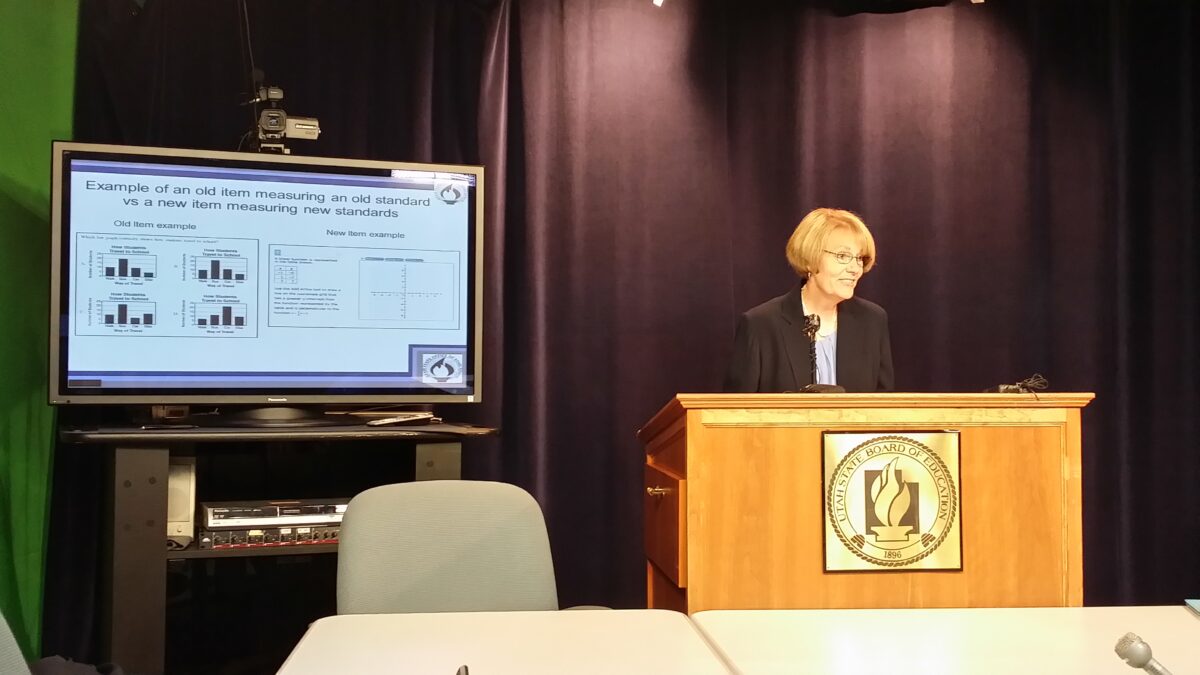
Judy Park, associate superintendent of the Utah State Office of Education, explains why SAGE tests are more rigorous than the state's former assessment. Park was the main presenter at a press conference on Oct. 24, 2014, announcing results of SAGE tests.
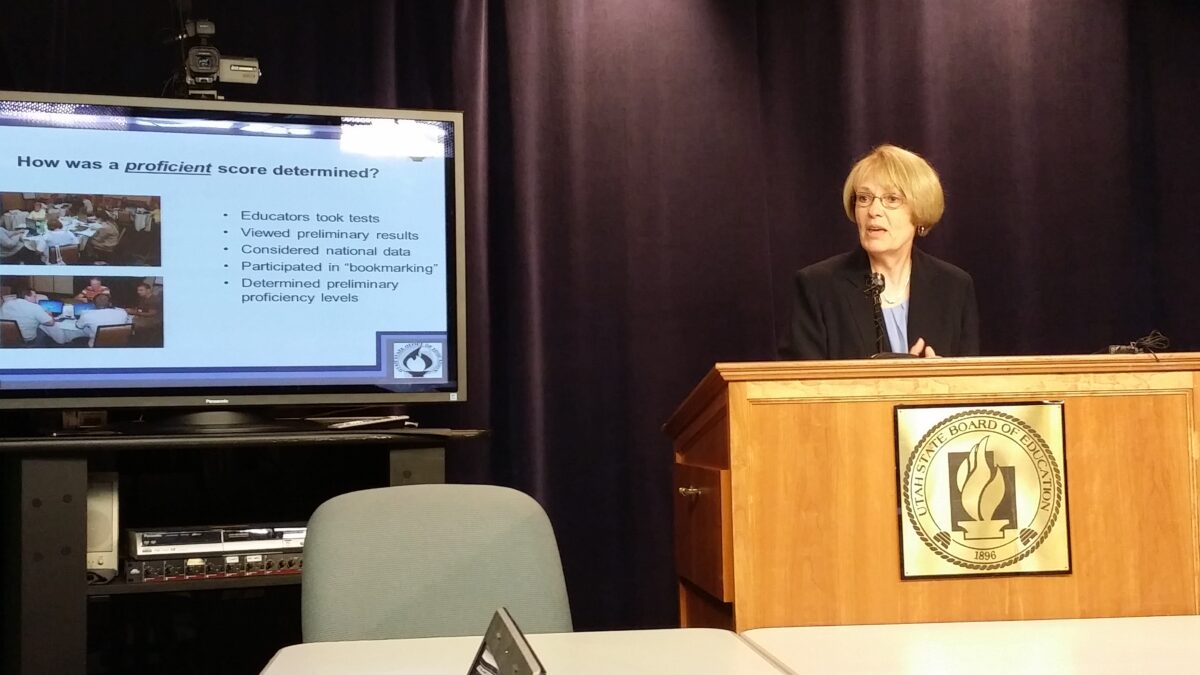
Judy Park, associate superintendent of the Utah State Office of Education, explains how proficiency levels were set for SAGE assessments. Park was the main presenter at a press conference on Oct. 24, 2014, announcing results of SAGE tests.
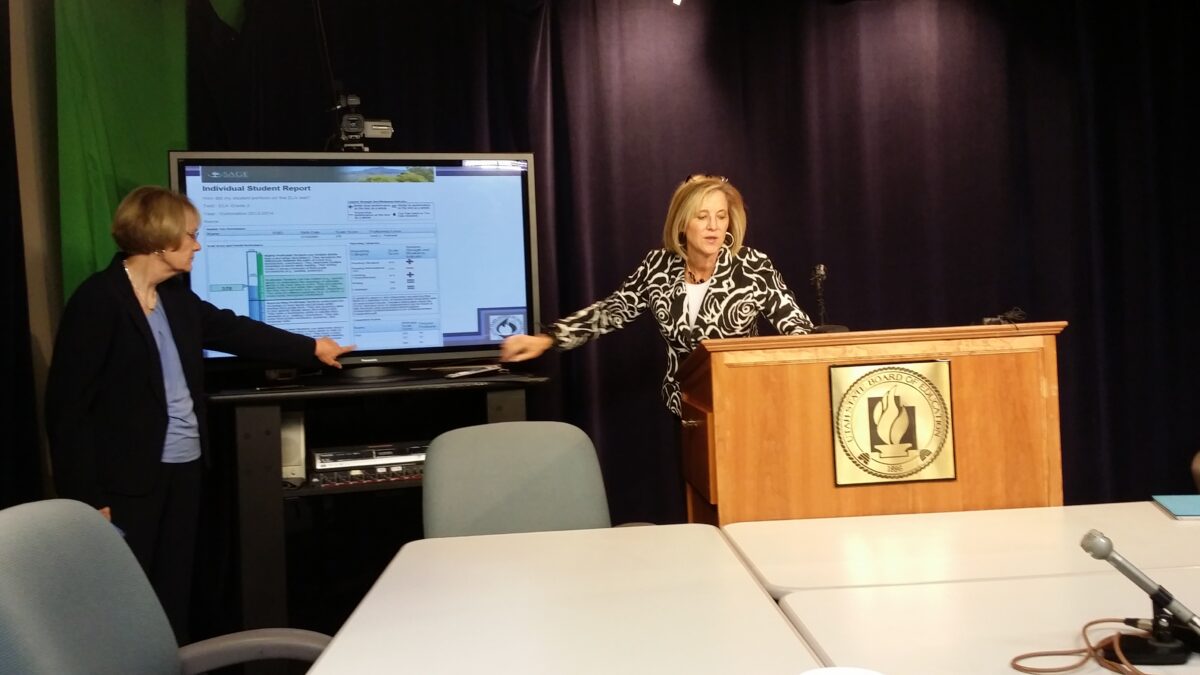
JoEllen Schaeffer, assessment director for the Utah State Office of Education, explains the report that will tell parents how their children performed on the SAGE test. Schaeffer and Judy Park (left), associate superintendent of the Utah State Office of Education, were presenters at a press conference on Oct. 24, 2014, announcing results of SAGE tests.
SALT LAKE CITY — The state Office of Education released scores today for statewide assessments taken by students last spring. Results of the Student Assessment of Growth and Excellence tests show that 41.7 percent of Utah students are proficient in language arts, 43.7 percent are proficient in science, and 38.7 percent are proficient in mathematics.
Those SAGE scores may seem low, but top-level educators say they’re a reflection of positive change.
“This isn’t bad news,” said Judy Park, associate superintendent of the Office of Education, at a pre-release press conference Friday. “This is an opportunity for us to re-look at what’s happening in our educational system, what our expectations for our students are, and ensuring that those expectations are aligned to the world.”
Utah doesn’t exist in isolation anymore, and students are applying for colleges and jobs all over the world, Park said.
“Our students need to be globally competitive,” she said. “It’s a different world now, and we’ve got to respond to that.”
Utah’s response was to raise the bar by adopting more rigorous standards, according to Park, including Common Core.
“Proficiency now means are you on track to be college- and career-ready,” she said. “That’s a very different type of proficiency than we’ve had in the past, that was based on proficiency about what you learned in the school year.”
At the same time, the state developed its computer adaptive SAGE tests, which have fewer multiple choice questions and more that require students to come up with answers on their own.
“When you have raised expectations from standards, when you have an increased rigor with your assessments, it’s a simple equation and you just know that the percentages of students that are proficient are going to be different than what we’ve had in the past,” Park said.
Aggregated SAGE results can be seen online at www.schools.utah.gov/main/, by clicking the Public School Data Gateway link. In addition to state scores, results are reported by district and by school, for each test.
Proficiency levels for local districts are:
• Box Elder School District: Language arts, 40.0 percent; mathematics 44.3 percent; science 48.3 percent.
• Davis School District: Language arts 46.4 percent; mathematics 43.6 percent; science 49.1 percent.
• Morgan School District: Language arts 48.9 percent; mathematics 48.4 percent; science 61.1 percent.
• Ogden School District: Language arts 28.1 percent; mathematics 20.3 percent; science 26.8 percent.
• Weber School District: Language arts 37.6 percent; mathematics 33.8 percent; science 39.2 percent.
The Northern Utah Academy for Math, Engineering and Science, an early college charter high school based in Layton, posted some of the highest scores in the state, with a 75.6 percent proficiency rate in language arts, 65.9 percent in mathematics, and 79.9 percent in science. SAGE results do not, however, provide an across-the-board endorsement of charter schools — like traditional schools, some posted high scores and others had proficiency levels in the single digits on certain tests.
Utah’s weakest link seems to be secondary math. The state proficiency average for Secondary Math I is 31.4 percent, for Secondary Math II it’s 27.3 percent, and for Math III it’s 30.1 percent. Locally, Ogden High’s proficiency rate was 4.4 percent for Secondary Math II, and 3.6 for Secondary Math III.
“We knew before hand that we need to do more to prepare kids for college and careers,” said Rich Nye, Ogden School District’s assessment and curriculum director. “We’ve been addressing math before SAGE came out.”
The data shows that Ogden’s students aren’t the only ones struggling with math as they move on to higher grades. There were other schools with scores in single digits and low teens.
Nye said educators in his district weren’t surprised by their students’ scores, because they’re already using interim assessments that align well to the new standards.
“We know what our gap has been, as a district … as it compares with the state average,” he said. “Year after year we’re decreasing that.”
Ogden School District created a video to post on its website, https://ogdensd.org/, about SAGE results. In it, Superintendent Brad Smith said, “We make no excuses. We understand there are explanations that might provide detail about why any particular child performs in any particular way, however, SAGE assesses our performance as a system. We own it. We own our children. We will address those things that are within our control, and we will take action.”
One of Ogden’s bright spots was Horace Mann Elementary, where students earned higher proficiency rates than many of their district peers.
“They’ve really worked together as a team — teachers, staff and principal,” said district spokesman Zac Williams. “We’re excited that SAGE validated the work they’ve done.”
Sheri Heiter, Weber School District’s testing and assessment specialist, said she’s proud of the students’ performance on SAGE. However, the district’s proficiency scores were slightly below state averages across the board. Heiter attributes the scores to a combination of factors, from the increased rigor and new standards, to the unfamiliar test format and the district’s changing demographics. Teachers are still getting a handle on the best ways to teach the new standards, she said, and learning the best ways to teach children whose first language is not English or who live in poverty.
“It’s a work in progress,” she said. “These are things we’ll pay attention to, and we’ll make the changes we need to, to make sure our kids have the best possible chance.”
Assessment tests should be used as a tool to pinpoint student learning gaps, and guide teachers in providing meaningful instruction. Smith, who leaves Ogden School District in November to take over as state schools superintendent, has expressed his frustration at getting the SAGE data in late October instead of shortly after the tests were administered.
Park said it took a long time to process because this is the first time the SAGE test has been given, and experts had to analyze the results to determine baseline proficiency levels. In the future results will be immediate.
Parents will soon have access to the individual scores of their children. In addition to the score, there will be a number from 1 to 4 for each test; the numbers 3 and 4 indicate that a student is considered proficient and has passed the test.
“This is an opportunity for the student, for parents and for educators, to make those adjustments and be really focused around success as the student leaves high school. You might say, ‘Well this kid’s only in third grade. Oh my word — 8 years old — college and career readiness is so far away. But the time to be on track, the time to be in that correct preparation alignment to be successful after high school, starts pre-K,’ ” she said.
Schools are graded, in part, using student test scores to show growth. Park said that won’t be possible this year, because comparing scores from the Criterion-Referenced Tests the state used in the past with SAGE scores is like comparing apples and oranges.
“It’s hard for me to look at my apple, and figure out how much my orange has grown based on my apple,” said Park.
While the SAGE scores appear to be low, Park says the new data more closely matches state scores on ACT and National Assessment of Educational Progress tests. She also said that states across the nation are working on raising standards and implementing more difficult tests. Utah is ahead of many in making changes.
“This is a great opportunity,” she said. “My son says, ‘We are where we are.’ This is our new reality. This is our new ‘where we are.’ If everyone will now focus on moving forward and improving student achievement, we’re absolutely confident that you’re going to see these results improve over time.”
Contact reporter Becky Wright at 801-625-4274 or bwright@standard.net. Follow her on Twitter at @ReporterBWright.
Education

MEDIC SOLO first aid courses coming to Ogden next month

Giving back: Ogden Pioneer Days Foundation, school district foundations form partnership to aid Dolly Parton’s Imagination Library